Lesson 01 — One Timeline, Many Places
Learners build a timeline with real dates and place events from several world regions in order, meeting the BCE/CE way of counting years as one system among many. This is the Grade 4 upgrade of the ordering skill: dates, not just clues, carry the order.
Objectives
Objectives
- D08.S1.04.01 Use a timeline with dates to sequence events from two different places and compare what was happening at the same time.
Essential question
How do I use a timeline with dates to place events from different places in order?
Key vocabulary
Materials
Standard materials
- A long timeline strip · 1 per learner or pair A left-to-right line with a "long ago" end and a "today" end, marked with date labels (BCE on the left, CE on the right)
- A set of "world events" cards for the worked example · 1 set Six cards, each with a drawing, a place name, and a date — pyramid (Egypt), grid city (Indus Valley), carved head (Mesoamerica), pillar (India), lake city (Mesoamerica), mountain roads (Andes)
- Pencils and crayons · per learner For drawing events onto the timeline
Low-tech / no-cost
- Found objects in a line A stone, a seed, a shell — one object stands for each event, laid left-to-right on the ground from "long ago" to "today"
- Body and voice Walk the timeline outside, stopping at each event spot and naming its place and date aloud
Enriched / lab & device
- A globe or world map · 1 Optional — point to each place (Egypt, the Indus Valley, Mesoamerica, India, the Andes) as its card is placed
- A tablet or camera · 1 per group Optional — photograph the finished timeline as a portfolio record
Works in different contexts
- large-group Build one big floor timeline together; the whole group calls out "long ago!" or "today!" while one learner places each card in order by date
- self-directed The learner lays out the cards in date order alone, writes or says each date, then checks the order against the answer key
- outdoor-only Lay the timeline on the ground with found objects, walking from the oldest date to today and naming each place and date as you step
- multi-age Older learners read the dates aloud and scribe, while younger learners place the cards and act out each event
- level-grouped Learners who grasp ordering quickly coach others by asking "which date is furthest back? which is closest to today?" rather than telling
Lesson 1 — One Timeline, Many Places
Summary
Learners build a timeline with dates and place events from several world regions in order. The new skill this year is the date: Grade 3 ordered local landmarks by clue; Grade 4 puts events from Egypt, the Indus Valley, Mesoamerica, India, and the Andes on one line and uses dates — counted in BCE (“Before Common Era”) and CE (“Common Era”) — to know which came first. They also learn that this is one way of counting years among many that peoples have used.
Objectives
- Use a timeline with dates to sequence events from different places in order. (D08.S1.04.01)
Connection
A timeline is a line that puts events in order, from furthest back to today. You can line up the order of your own day — wake, eat, learn, play, rest — but to line up big events across the whole world, people use dates, year numbers written on the line. Dates let us place a pyramid in Egypt and a city by the Indus River and a carved head in Mesoamerica on the same line and see which is older. Dates are one way — among many — that people count and record time.
Materials
- A long timeline strip (one per learner or pair)
- A set of “world events” cards for the worked example, each with a drawing, a place, and a date
- Pencils and crayons
Preparation
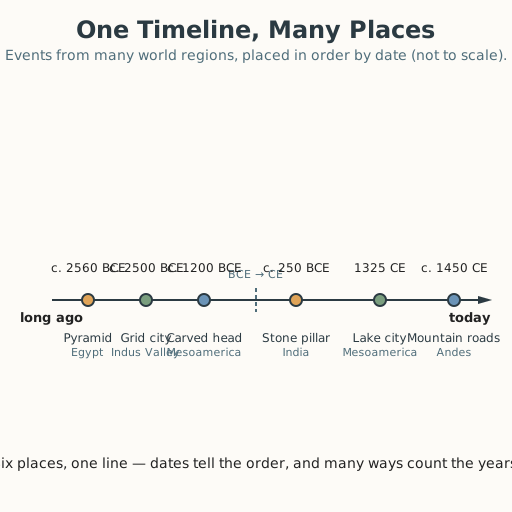
- Prepare the six event cards. Great Pyramid (Giza, Egypt), about 2560 BCE. Grid city (Mohenjo-Daro, Indus Valley), about 2500 BCE. Carved stone head (Olmec, Mesoamerica), about 1200 BCE. Stone pillar (Ashoka, India), about 250 BCE. Lake city (Tenochtitlan, Mesoamerica), founded 1325 CE. Mountain roads (Inca, Andes), about 1450 CE.
- Draw the timeline strip with a “long ago” left end and a “today” right end, and a mark where the year-count changes from BCE to CE.
- Decide the line reads left-to-right and keep it the same for everyone.
Facilitator note
This lesson is written to the learner (“you”). Sequencing by date is a foundational skill, so teach it with a worked example first (Kirschner, Sweller & Clark, 2006): model placing two cards, saying the date and checking “2560 BCE is further back than 2500 BCE, so the pyramid goes before the city.” Then guide the rest before learners work independently. Teach BCE/CE simply and honestly: “CE means Common Era — the years most of the world now counts forward from; BCE means Before Common Era, the years before that point.” This is one calendar among many — different peoples mark years in their own ways (Islamic, Hebrew, Chinese, and many others), and a timeline using BCE/CE is a shared tool, not the only truth about time. This is a global story, never one people’s triumph: the events are chosen from Africa, South Asia, and the Americas so no single region is the “main” story. Honor every body: describe each card in words for a learner who cannot see it; a learner who does not use a speaking voice points or places the card. Dates are approximate (“about”) — that honesty is part of doing history well.
Procedure
- Gather and remember (5 min). Think of one very old thing you have heard about from anywhere in the world, and one thing that happened recently. Which is older? How do you know?
- Meet the timeline and the dates (10 min). Look at the worked example: a line with a “long ago” end and a “today” end. The year-count changes from BCE (Before Common Era) to CE (Common Era) partway along. In BCE, a bigger number means earlier. In CE, a bigger number means later.
- Place the world events (15 min). One by one, place the six cards by their dates:
- Great Pyramid (Egypt), about 2560 BCE
- Grid city (Indus Valley), about 2500 BCE
- Carved stone head (Mesoamerica), about 1200 BCE
- Stone pillar (India), about 250 BCE
- Lake city (Mesoamerica), 1325 CE
- Mountain roads (Andes), about 1450 CE For each, say the date and check it against its neighbors: “2560 BCE is earlier than 2500 BCE, so the pyramid comes first.”
- Build your own order (10 min). Mix the cards. Put them back in date order on your own line, and say or write each date as you place it.
- Close (5 min). You just did what historians do: you used dates to order events from many places on one line. One timeline, many places — and many ways of counting the years.
Differentiation
- Support: Use only three cards with clear dates far apart, and place them together saying each date aloud.
- Support (blind/low-vision): Sequence real objects by touch and say or sign each date and place; a partner reads the labels.
- Support (non-speaking): Order the cards and point to the date on each, or use picture-only cards, instead of speaking.
- Support (Deaf/HH): The cards are visual — read the dates with your eyes and sign “before,” “after,” and “long ago” as you place each one.
- Support (motor-difference): Use a large, stable line and bigger cards; point or eye-gaze to each spot while a partner moves the card.
- Extension: Add two more events from your own region or family with approximate dates, and place them on the line.
Assessment
- Formative (observation): Can the learner place the six events in date order from furthest back to most recent?
- Formative (oral/performance): Does the learner read or say each date and explain how they know one event is earlier than another — by speaking, signing, pointing, or acting?
Resources
- Encyclopaedia Britannica, “Pyramids of Giza” — the Great Pyramid was built for the pharaoh Khufu around 2560 BCE. https://www.britannica.com/topic/Pyramids-of-Giza
- Encyclopaedia Britannica, “Mohenjo-daro” — a planned city of the Indus (Harappan) civilization, flourished about 2500 BCE. https://www.britannica.com/place/Mohenjo-daro
- Encyclopaedia Britannica, “Olmec” — the Olmec of Mesoamerica carved colossal stone heads beginning around 1200 BCE. https://www.britannica.com/topic/Olmec
- Encyclopaedia Britannica, “Ashoka” — emperor Ashoka (ruled about 268–232 BCE) raised stone pillars with messages of kindness and respect. https://www.britannica.com/biography/Ashoka
- Encyclopaedia Britannica, “Tenochtitlan” — founded by the Mexica (Aztec) people in 1325 CE. https://www.britannica.com/place/Tenochtitlan
- Encyclopaedia Britannica, “Inca” — the Inca (Tawantinsuyu) built a vast mountain-road network across the Andes, flourishing by the 1400s CE. https://www.britannica.com/topic/Inca
Home connection
At home, ask someone to help you write down three family or community events with their dates (a birth, a move, a festival) and place them in order on a line. Notice which came first and how the dates tell you.