Lesson 02 — At the Same Time
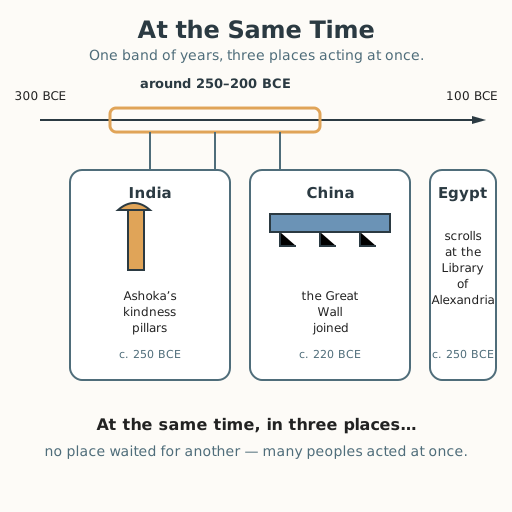
Learners compare what was happening in different places at the same time, using a dated timeline with a highlighted band at about 250–200 BCE to see that India, China, and Egypt were each doing something remarkable at once. The lesson builds the habit of asking "what else was happening?" instead of telling one place's story alone.
Objectives
Objectives
- D08.S1.04.01 Use a timeline with dates to sequence events from two different places and compare what was happening at the same time.
Essential question
What was happening in different places at the same time, and what can comparing them teach us?
Key vocabulary
Materials
Standard materials
- A "same time" comparison strip · 1 per learner or pair A dated timeline with a highlighted band at about 250–200 BCE, and three event cards for India, China, and Egypt
- Event cards for the worked example · 1 set Ashoka's pillars (India), the Great Wall joined (China), scrolls at the Library of Alexandria (Egypt) — each with a drawing, place, and "about" date
- Pencils and crayons · per learner For marking the "same time" band and writing comparisons
Low-tech / no-cost
- Three objects and a rope or line Lay three found objects side by side on a marked band of the line to show three things happening at once
- Body and voice Three learners stand in a row at the "same time" spot, each acting out one place's event and saying "at the same time, in…"
Enriched / lab & device
- A world map · 1 Optional — point to India, China, and Egypt and draw a line to the timeline band
- A tablet or projector · 1 per group Optional — show photos of the pillars, the Great Wall, and a reconstructed library reading room
Works in different contexts
- large-group Three learners act as India, China, and Egypt standing on one band of a floor timeline, while the group says "all at the same time!"
- self-directed The learner places three cards on one band of the timeline and writes one sentence comparing two of the places
- outdoor-only Mark one band of the ground timeline with sticks or stones and stand three found objects on it to show "at the same time"
- multi-age Older learners read the dates and scribe the comparison sentences, while younger learners place the cards and act each event
- level-grouped Learners who finish early coach peers by asking "what was happening in X while Y was happening in Z?" rather than telling
Lesson 2 — At the Same Time
Summary
Learners use a dated timeline to ask a historian’s second great question: what was happening in different places at the same time? They focus on one band of time — around 250–200 BCE — and discover three things happening at once: Emperor Ashoka raising kindness pillars in India, workers joining walls into the Great Wall in China, and scholars gathering scrolls at the Library of Alexandria in Egypt. Comparing across places at one moment shows that no single place is “the” story; many peoples were building, writing, and thinking at once.
Objectives
- Use a timeline with dates to compare what was happening in two or more places at the same time. (D08.S1.04.01)
Connection
Have you ever wondered what a child in another part of the world was doing while you were eating your breakfast? History asks the same question, but with bigger steps: while one people built a wall, another carved a message into stone, and a third copied books — all around the same years. When we line up dates, we see that the human story was never one people taking turns; it was many peoples acting at once, each with their own idea worth honoring.
Materials
- A “same time” comparison strip (one per learner or pair)
- Three event cards for the worked example (India, China, Egypt)
- Pencils and crayons
Preparation
- Draw the timeline strip with dates, and highlight the band around 250–200 BCE.
- Prepare three cards: Ashoka’s pillars (India), about 250 BCE; the Great Wall joined (China), about 220 BCE; scrolls at the Library of Alexandria (Egypt), about 250 BCE.
Facilitator note
This lesson is written to the learner (“you”). Comparison is a foundational skill, so model the first comparison fully (Kirschner, Sweller & Clark, 2006): “Around 250 BCE, in India, Ashoka raised pillars telling people to be kind; around the same years, in China, workers joined walls into the Great Wall — two places, one moment, two different works.” Then guide the third place. The point is many-at-once, never “who was first” or “who was best.” Each of the three events matters in its own right: India’s message of kindness, China’s great wall, Egypt’s meeting place of many peoples’ learning. Dates are approximate (“about”) — say so, and model the honesty. Honor every body: describe the cards aloud for a learner who cannot see them; a learner who does not use a speaking voice points or acts. Hold gently that “around the same time” means within the same span of years, not the same day.
Procedure
- Gather and wonder (5 min). Think of two things you did at the same time today (you ate while someone else was reading). History can compare places the same way.
- Meet the band of time (10 min). Look at the timeline. One band is highlighted: around 250–200 BCE, about 2,250 years ago. What was happening then?
- Place three places at once (15 min). Put the three cards on the band:
- India: Emperor Ashoka raised stone pillars telling people to treat one another with kindness and respect.
- China: workers joined many walls into the Great Wall to protect the land.
- Egypt: scholars gathered scrolls at the Library of Alexandria, a meeting place of learning from many peoples. For each, say: “At the same time, in…”
- Compare two places (10 min). Choose two of the three. Say or write one sentence: “While people in China were joining the Great Wall, people in India were…” — and one sentence about how the two works were different.
- Close (5 min). No place waited for another. At the same time, in three places, people were building, writing, and thinking. The human story is many stories moving at once.
Differentiation
- Support: Compare just two places with heavy picture support and one shared sentence said together.
- Support (blind/low-vision): Feel three distinct objects standing on one band of the line and say or sign “at the same time” as a partner names each.
- Support (non-speaking): Place the three cards on the band and point to each as its name is said, instead of speaking.
- Support (Deaf/HH): The cards are visual — place them on the band and sign “same time,” “India,” “China,” and “Egypt” as you go.
- Support (motor-difference): Use a large band and bigger cards; point or eye-gaze while a partner moves each card.
- Extension: Add a fourth place from your own timeline (from Lesson 1) that falls near the same years, and say what it was doing “at the same time.”
Assessment
- Formative (observation): Can the learner place the three events on the same band and name what each place was doing at the same time?
- Formative (oral/performance): Does the learner compare two places in one sentence (“while X was…, Y was…”) — by speaking, signing, writing, or acting?
Resources
- Encyclopaedia Britannica, “Ashoka” — emperor Ashoka raised stone pillars carrying messages of kindness and non-violence around 250 BCE. https://www.britannica.com/biography/Ashoka
- Encyclopaedia Britannica, “Great Wall of China” — long walls were joined into the Great Wall by the Qin dynasty around 220 BCE. https://www.britannica.com/topic/Great-Wall-of-China
- Encyclopaedia Britannica, “Library of Alexandria” — a famous library of the ancient world in Egypt, gathering scrolls of learning from many peoples. https://www.britannica.com/topic/Library-of-Alexandria
Home connection
Ask someone at home: “What was happening in our family the year I was born, in two different places at the same time?” Write the two events with their dates and notice they happened at once.