Lesson 05 — Keeping Knowledge Alive
Learners discover how a knowledge tradition survives: by being watched, practiced, remembered, and taught to the next generation. They hear the true story of Hōkūleʻa, a Polynesian canoe navigated from Hawaiʻi to Tahiti in 1976 without instruments by a master navigator and his apprentice — a living example of knowledge kept alive and passed on.
Objectives
Objectives
- D08.S2.04.01 Describe a knowledge tradition of a specific people, such as herbal medicine, star navigation, or oral history, and explain how it is kept and passed on.
Essential question
How is a knowledge tradition kept and passed from one generation to the next?
Key vocabulary
Materials
Standard materials
- A "how knowledge passes" flow card set · 1 set Cards showing the chain — elder teaches, child watches, child practices, child teaches the next child — plus the Hōkūleʻa story cards (navigator, canoe, stars, apprentice)
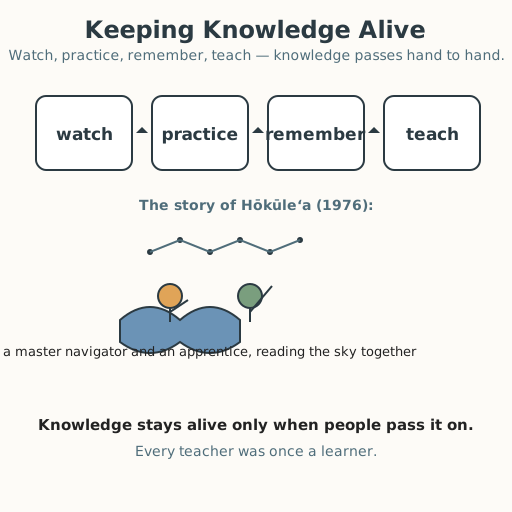
- A "passing it on" flow chart · 1 per learner or pair Four linked boxes — watch, practice, remember, teach — with a line under each
- Pencils and crayons · per learner For completing the flow chart
Low-tech / no-cost
- Found objects and a hand-to-hand pass Pass a leaf, stone, or shell hand to hand down a line to show knowledge moving from elder to child to child
- Body and voice Act the chain — an elder shows, a child copies, the child teaches the next child — saying each step aloud
Enriched / lab & device
- A short video or picture book on Hōkūleʻa · 1 Optional — to see the canoe and the master navigator teaching an apprentice
- A tablet or camera · 1 per group Optional — record learners telling a knowledge tradition they know, as their own "passing it on"
Works in different contexts
- large-group Make a human chain — an "elder" passes a story or skill to a "child," who passes it to the next, the whole group naming each step
- self-directed The learner fills the flow chart alone and then teaches someone else a small skill to feel the passing-on
- outdoor-only Pass a found object hand to hand and tell a short story at each pass, showing how knowledge travels
- multi-age Older learners read the flow cards and scribe, while younger learners act the watch-practice-remember-teach chain
- level-grouped Learners who finish early coach peers by asking "who taught whom? what did they do to learn it?" rather than telling
Lesson 5 — Keeping Knowledge Alive
Summary
Learners discover how a knowledge tradition survives across generations: by being watched, practiced, remembered, and taught to the next person. They hear the true story of Hōkūleʻa, a Hawaiian voyaging canoe that in 1976 sailed from Hawaiʻi to Tahiti guided only by the stars, waves, and the teaching of master navigator Mau Piailug — a living example of knowledge kept alive and passed from teacher to apprentice.
Objectives
- Explain how a knowledge tradition is kept and passed from one generation to the next. (D08.S2.04.01)
Connection
Think of something you learned by watching someone, then practicing, then doing it yourself — riding, cooking, counting, a game. That is how knowledge passes on: someone shows, you try, you remember, and one day you show someone else. Knowledge traditions around the world pass the same way, hand to hand across the years. When a tradition almost disappears, the same chain — teacher to learner — can bring it back.
Materials
- A “how knowledge passes” flow card set, including the Hōkūleʻa story cards
- A “passing it on” flow chart (watch, practice, remember, teach)
- Pencils and crayons
Preparation
- Prepare the flow cards: watch (a child watches an elder), practice (the child tries it), remember (the child holds it in mind), teach (the child shows the next child).
- Prepare the Hōkūleʻa story cards: a double-hulled canoe, a star chart, a master navigator, an apprentice pointing at the sky.
Facilitator note
This lesson is written to the learner (“you”). Teach the four-step chain as a worked example first (Kirschner, Sweller & Clark, 2006): model “watch → practice → remember → teach” with a simple skill, then connect it to the Hōkūleʻa story. Tell the Hōkūleʻa story accurately and with respect (see Resources): the Polynesian Voyaging Society built Hōkūleʻa and, in 1976, sailed her from Hawaiʻi to Tahiti using traditional wayfinding; the master navigator Mau Piailug of Satawal taught the art to others, reviving a tradition that had nearly been lost. This is a story of survival and revival, not a museum piece — hold the navigators as living experts, and never suggest their knowledge was “beaten by” modern tools. Honor every body: describe the cards in words for a learner who cannot see them; a learner who does not use a speaking voice points or acts. If a learner’s own family has a passed-down skill, celebrate it as a living knowledge tradition.
Procedure
- Gather (5 min). Think of something you learned by watching someone and practicing. Who taught you? How did you learn it?
- Meet the four steps (10 min). Knowledge passes in a chain: watch someone who knows, practice it yourself, remember it, then teach it to the next person. Walk the chain together with a small skill (a clap pattern, a knot, a song).
- Hear the story of Hōkūleʻa (15 min). Long ago, Polynesian navigators crossed the ocean reading the stars, waves, clouds, and birds. For a time, this knowledge almost disappeared. Then, in 1976, the canoe Hōkūleʻa sailed from Hawaiʻi to Tahiti — about 2,500 miles of open ocean — guided not by instruments but by master navigator Mau Piailug, who read the sky and sea. He taught apprentices to do the same, so the knowledge would not be lost again. Watch → practice → remember → teach, across the ocean and the years.
- Trace the chain (10 min). On your chart, under each step, write or draw how wayfinding (or another tradition) moved through it: Mau watched and learned, he practiced, he remembered, and he taught the next navigators.
- Pass something on (5 min). Teach one small thing you know to a partner — a word, a move, a fact. Notice the chain working in you.
- Close (5 min). Knowledge stays alive only when people pass it on. Every teacher was once a learner, and every learner can become a teacher.
Differentiation
- Support: Trace the chain with just two steps (watch, teach) and heavy picture support, saying them together.
- Support (blind/low-vision): Feel a small object passed hand to hand and describe the four steps aloud as it travels.
- Support (non-speaking): Order the four flow cards and point to each step, instead of speaking.
- Support (Deaf/HH): The cards are visual — order them and sign “watch,” “practice,” “remember,” and “teach” as you go.
- Support (motor-difference): Use larger cards and a stable chart; point or eye-gaze while a partner moves each card.
- Extension: Choose a knowledge tradition from your own or another culture and write its watch-practice-remember-teach chain with the names of the people who carry it.
Assessment
- Formative (observation): Can the learner order the four steps (watch, practice, remember, teach)?
- Formative (oral/performance): Does the learner explain how one tradition is kept and passed on — by speaking, signing, writing, or acting?
Resources
- Polynesian Voyaging Society (Hōkūleʻa) — the 1976 voyage from Hawaiʻi to Tahiti and the practice of traditional wayfinding. https://hokulea.com/
- UNESCO — Intangible Cultural Heritage: knowledge and skills transmitted from person to person across generations. https://ich.unesco.org/
Home connection
Ask someone at home to teach you a small skill they learned from an older person, then teach it to someone else. Notice the chain: who taught them, and whom will you teach?