Lesson 06 — Two Stories for the Sun
Learners hear two peoples' stories for the Sun's daily journey — the Japanese Amaterasu and the Egyptian Ra — and see that both peoples also observed the real Sun closely. They learn to hold story and observation side by side with respect, never ranking one people's story or one way of knowing above another.
Objectives
Objectives
- D08.S2.04.02 Compare how two cultures explain the same natural event, such as the seasons or the Sun, through story and observation.
Essential question
How do two cultures explain the same natural event — the Sun's daily journey — through story and observation?
Key vocabulary
Materials
Standard materials
- "Two stories of the Sun" cards · 1 set Amaterasu (Japan) — the sun goddess who hid in a cave; Ra (Egypt) — the sun god who sailed his boat across the sky — each with a drawing and a short telling
- A two-column chart · 1 per learner or pair Columns for "Japan — Amaterasu" and "Egypt — Ra," with rows for "story" and "what people observed"
- Pencils and crayons · per learner For completing the chart
Low-tech / no-cost
- Voice and a lamp or the Sun Tell both stories aloud by a window or outdoors, and watch the real Sun's light and shadow as the thing both peoples observed
- Body and shadow Act the Sun's journey — rise, cross the sky, set — and act each story's Sun (a goddess coming out of a cave, a god sailing a boat)
Enriched / lab & device
- A picture book of one or both stories · 1 Optional — an illustrated retelling of the Amaterasu or Ra story
- A tablet or projector · 1 per group Optional — images of Japanese sun imagery and Egyptian sun temples to see how each people honored the Sun
Works in different contexts
- large-group Tell both stories to the whole group, then half the group acts Amaterasu and half acts Ra, each showing the Sun's journey
- self-directed The learner reads both tellings, fills the chart, and then tells one story back to a grown-up or peer
- outdoor-only Sit under the real Sun and tell both stories, watching light and shadow change as the Sun moves
- multi-age Older learners read the tellings aloud and scribe, while younger learners act each story's Sun
- level-grouped Learners who finish early coach peers by asking "what did this people observe about the Sun, and how does their story show it?" rather than telling
Lesson 6 — Two Stories for the Sun
Summary
Learners hear two peoples’ stories for the same natural event — the Sun’s daily journey across the sky — the Japanese story of Amaterasu and the Egyptian story of Ra. They see that both peoples observed the real Sun closely and told stories to make meaning of what they saw. The lesson holds story and observation side by side, with equal respect, never ranking one people’s story or one way of knowing above another.
Objectives
- Compare how two cultures explain the same natural event through story and observation. (D08.S2.04.02)
Connection
Every day the Sun appears to rise in the morning and set at night. You have probably watched its light and shadow change across a day. People everywhere have watched this same event and asked what it means. Some tell stories; some measure and observe; many do both. Two peoples — in Japan and in Egypt — watched the very same Sun and told two different, beautiful stories about it. Both are ways of honoring the same mystery.
Materials
- “Two stories of the Sun” cards (Amaterasu and Ra)
- A two-column chart (Japan / Egypt; rows for “story” and “what people observed”)
- Pencils and crayons
Preparation
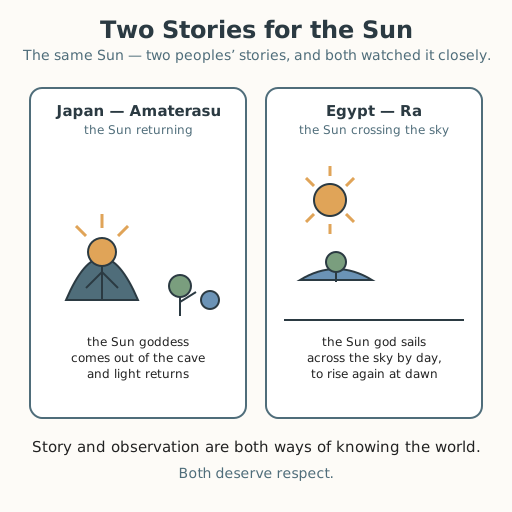
- Prepare two cards with short, respectful tellings. Japan — Amaterasu: the Sun goddess; when she hid in a cave, the world went dark, and the other spirits lured her out with a mirror and laughter, so light returned. Egypt — Ra: the Sun god who sailed his boat across the sky each day and through the dark beneath the world each night, to rise again at dawn.
- Prepare the chart.
Facilitator note
This lesson is written to the learner (“you”). This is the unit’s most sensitive lesson — treat both stories with full respect, and never rank “myth” against “science.” These are two peoples’ living cultural stories, told to make meaning of the Sun, not “wrong guesses” that science later “corrected.” The Japanese and Egyptian peoples also observed the sky with real care (temples aligned to sunrise; solstices marked for rice-growing and the seasons). Modern astronomy observes the same Sun and explains the apparent rising and setting by Earth’s rotation. Hold all three — story, careful observation, and modern astronomy — side by side, as different ways people make sense of the same event, none “better” than the others. This follows philosophy §11 (inquiry, not creed). Tell both stories warmly and without ranking; let learners weigh them with growing respect. Honor every body: tell the stories aloud in words for a learner who cannot see the cards; a learner who does not use a speaking voice acts or draws. If a learner’s own culture has a Sun story, welcome it with honor.
Procedure
- Gather (5 min). Watch the light today, or remember the sky: where does the Sun seem to rise, and where does it set? What do you notice?
- Hear two stories (15 min). Listen to both tellings:
- Japan — Amaterasu: the Sun goddess grew so sad and angry at her brother’s misdeeds that she hid in a cave, and the world went dark. The other spirits set a mirror outside and began to laugh and dance. Curious, she peered out, saw her own bright light in the mirror, and came out — so light returned to the world.
- Egypt — Ra: the Sun god sailed his boat across the sky by day, and through the dark lands beneath the world by night, to be reborn each dawn. The rising and setting of the Sun was his daily journey.
- Notice what both peoples observed (10 min). Both peoples watched the same real Sun: it appears in the east, crosses the sky, and disappears in the west, and its light and warmth make life possible. Each story is one way of making meaning of what they saw.
- Compare on your chart (10 min). For each column, write or draw the story and the observation behind it. Then say one way the two stories are different and one way they are alike (both honor the Sun’s light and its daily return).
- Close (5 min). The same Sun, two peoples’ stories — and both watched it closely. Story and observation are both ways of knowing the world, and both deserve respect.
Differentiation
- Support: Hear one story fully and retell just its ending with heavy picture support.
- Support (blind/low-vision): Hear both stories told aloud and feel a warm lamp (the Sun) and a mirror; describe each story’s Sun in your own words.
- Support (non-speaking): Point to each card and to the Sun’s path (rise, cross, set), instead of speaking.
- Support (Deaf/HH): The cards are visual — act each story’s Sun with your hands and body, and sign “Sun,” “rise,” and “set.”
- Support (motor-difference): Use a large chart; point or eye-gaze to each part while a partner writes.
- Extension: Add a third people’s Sun story you know or find, and tell what it observes and what it means.
Assessment
- Formative (observation): Can the learner retell each story’s main idea and name what both peoples observed (the Sun’s daily path and light)?
- Formative (oral/performance): Does the learner compare the two stories without ranking one above the other — by speaking, signing, drawing, or acting?
Resources
- Encyclopaedia Britannica, “Amaterasu” — the Japanese Sun goddess of the Shinto tradition and the story of the cave. https://www.britannica.com/topic/Amaterasu
- Encyclopaedia Britannica, “Re” — the ancient Egyptian Sun god (Ra), who sailed the sky by day and the underworld by night. https://www.britannica.com/topic/Re
Home connection
Ask someone at home: “Does our family or culture have a story about the Sun, the Moon, or the stars?” Listen to it, and tell it back. Notice what it observes and what it means.