Lesson 10 — Peaceful Resistance
Learners meet three peaceful resistances from three world regions — Parihaka in Aotearoa New Zealand, Gandhi's Salt March in India, and the Defiance Campaign in South Africa — and explain what people did and why they chose peaceful, nonviolent ways. They see that refusing unfairness without hurting others is a real, brave, and effective path people have chosen again and again.
Objectives
Objectives
- D08.S4.04.02 Describe a peaceful way people have resisted unfair treatment in history and why they chose it.
Essential question
What are peaceful ways people have resisted unfair treatment, and why did they choose them?
Key vocabulary
Materials
Standard materials
- "Peaceful resistance" story cards · 1 set Three cards — Parihaka (Aotearoa New Zealand), the Salt March (India), the Defiance Campaign (South Africa) — each with a drawing, place, and date
- A "why peaceful?" chart · 1 per learner or pair Two columns — "what they did" and "why they chose peaceful ways" — with a row for each of the three stories
- Pencils and crayons · per learner For completing the chart
Low-tech / no-cost
- Voice and body Act each peaceful act — welcoming with bread and song, marching to make salt, refusing a pass with dignity — and say why it was peaceful
- Found objects A small loaf or seed (bread, Parihaka), a pinch of salt (Salt March), a folded paper "pass" (Defiance Campaign) — hold each and tell its story
Enriched / lab & device
- A short video or picture book on one of the three movements · 1 Optional — to see Parihaka's nonviolence, the Salt March, or the Defiance Campaign
- A world map · 1 Optional — point to Aotearoa New Zealand, India, and South Africa as each story is told
Works in different contexts
- large-group Tell the three stories to the whole group; three groups each act one peaceful act, and the class names the reason each people chose peace
- self-directed The learner reads the three stories, fills the chart, and then tells one story back to a grown-up or peer
- outdoor-only Tell the stories while walking a short "march," pausing to act each peaceful act and say why it was chosen
- multi-age Older learners read the stories aloud and scribe, while younger learners act each peaceful act
- level-grouped Learners who finish early coach peers by asking "what did they do, and why did they choose peaceful ways?" rather than telling
Lesson 10 — Peaceful Resistance
Summary
Learners meet three peaceful resistances from three world regions — the Māori village of Parihaka in Aotearoa New Zealand (1881), Gandhi’s Salt March in India (1930), and the Defiance Campaign in South Africa (1952) — and explain what people did and why they chose peaceful, nonviolent ways. They see that refusing unfairness without hurting others is a real, brave, and effective path that people have chosen again and again.
Objectives
- Describe a peaceful way people have resisted unfair treatment in history and why they chose it. (D08.S4.04.02)
Connection
Have you ever seen something unfair and wanted to change it? There are many ways to resist unfairness. Some people fight; but many peoples have chosen a different way — peaceful resistance: refusing, marching, boycotting, and welcoming, without hurting anyone. From Aotearoa New Zealand to India to South Africa, ordinary people chose peace to win dignity. Their choice still teaches us today.
Materials
- “Peaceful resistance” story cards (Parihaka, Salt March, Defiance Campaign)
- A “why peaceful?” chart (what they did / why they chose peaceful ways)
- Pencils and crayons
Preparation
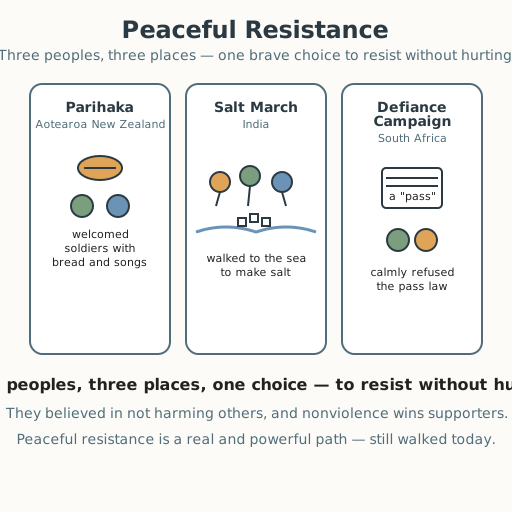
- Prepare three cards. Parihaka (Aotearoa New Zealand, 1881): Māori leaders Te Whiti-o-Rongomai and Tohu Kākahi led their people in peaceful resistance when their land was taken — they plowed the land and, when soldiers came, welcomed them with bread and children’s songs, refusing to fight. Salt March (India, 1930): Mohandas Gandhi led a long walk to the sea to make salt peacefully, breaking an unfair law that taxed and controlled salt. Defiance Campaign (South Africa, 1952): thousands of people calmly refused unjust “pass” laws that controlled where Black South Africans could go, accepting arrest with dignity rather than fighting.
- Prepare the chart.
Facilitator note
This lesson is written to the learner (“you”). This is the unit’s closing lesson — tell all three stories with respect and accuracy, never as one people’s triumph over another, but as three peoples’ choice for dignity. Teach the three with a worked example first (Kirschner, Sweller & Clark, 2006): tell Parihaka fully, then guide the Salt March and the Defiance Campaign. Why peaceful? Each people chose it for both moral and practical reasons — a belief in non-harming (Gandhi’s ahimsa; Parihaka’s commitment to peace), and because nonviolence wins supporters and avoids hurting others. Hold the tension honestly but age-appropriately: these were real struggles against real unfairness; do not soften the injustice, but do not dump adult despair — always connect to the people’s courage and agency, and to the hope of fairness. Distinguish fact from value: what happened is history; that peaceful resistance is good is a value many people share. Honor every body: tell the stories in words for a learner who cannot see the cards; a learner who does not use a speaking voice acts or draws. If a learner’s own people have a story of peaceful resistance, welcome it with honor.
Procedure
- Gather (5 min). Think of a time you saw something unfair. What are some ways a person could change it? Which ways hurt others, and which do not?
- Hear three peaceful stories (20 min). Listen to each:
- Parihaka (Aotearoa New Zealand, 1881): When their land was taken, the people of Parihaka resisted peacefully — they plowed the land in protest, and when soldiers arrived, they welcomed them with bread and children’s songs, refusing to fight.
- The Salt March (India, 1930): Gandhi and thousands walked about 240 miles to the sea to make their own salt, peacefully breaking an unfair law, as part of the long movement for India’s freedom.
- The Defiance Campaign (South Africa, 1952): thousands calmly refused unjust “pass” laws that controlled where Black South Africans could go, accepting arrest with dignity rather than violence.
- Ask why peaceful (10 min). For each, say why the people chose peaceful ways: they believed in not harming others, and they knew nonviolence wins supporters and keeps the focus on the unfairness itself.
- Fill your chart (10 min). For each of the three, write or draw what they did and why they chose peaceful ways.
- Close (5 min). Three peoples, three places, one brave choice: to resist unfair treatment without hurting anyone. Peaceful resistance is a real and powerful path — and it is still walked today.
Differentiation
- Support: Hear one story fully and retell just its peaceful act and one reason, with heavy picture support.
- Support (blind/low-vision): Hear the stories told aloud and hold a seed, a pinch of salt, and a folded paper “pass,” describing each peaceful act in your own words.
- Support (non-speaking): Act or point to each peaceful act, instead of speaking.
- Support (Deaf/HH): The cards are visual — act each peaceful act with your hands and body, and sign “peace,” “march,” and “refuse.”
- Support (motor-difference): Use a large chart; point or eye-gaze to each part while a partner writes.
- Extension: Choose one movement and find one more thing it achieved over time, and one peaceful method it used that you noticed.
Assessment
- Formative (observation): Can the learner match each movement to its peaceful act?
- Formative (oral/performance): Does the learner describe one peaceful resistance and why its people chose it — by speaking, signing, writing, or acting?
Resources
- NZHistory (New Zealand Ministry for Culture and Heritage), “Parihaka” — the peaceful resistance of the village of Parihaka under Te Whiti-o-Rongomai and Tohu Kākahi in 1881. https://nzhistory.govt.nz/politics/parihaka
- Encyclopaedia Britannica, “Salt March” — Gandhi’s 1930 nonviolent march to Dandi to make salt and break the salt law. https://www.britannica.com/event/Salt-March
- South African History Online, “Defiance Campaign 1952” — the 1952 nonviolent campaign in South Africa against unjust pass laws. https://www.sahistory.org.za/article/defiance-campaign-1952
Home connection
Ask someone at home: “Have you ever changed something unfair without fighting?” Listen to their story, and talk about one peaceful thing you could do when you see unfairness.