Lesson 09 — Rules, Leaders, and Fair Decisions
Learners explore how groups make decisions through rules and leaders — by proposing, discussing, and deciding — and what people can do when a decision is unfair: speak up, gather others, and propose a better rule. They meet the Haudenosaunee Great Law of Peace, a long-lived example of decision-making that aims to include many voices.
Objectives
Objectives
- D08.S4.04.01 Explain how rules and leaders make decisions in a group, and identify what people can do when a decision is unfair.
Essential question
How do rules and leaders make decisions in a group, and what can people do when a decision is unfair?
Key vocabulary
Materials
Standard materials
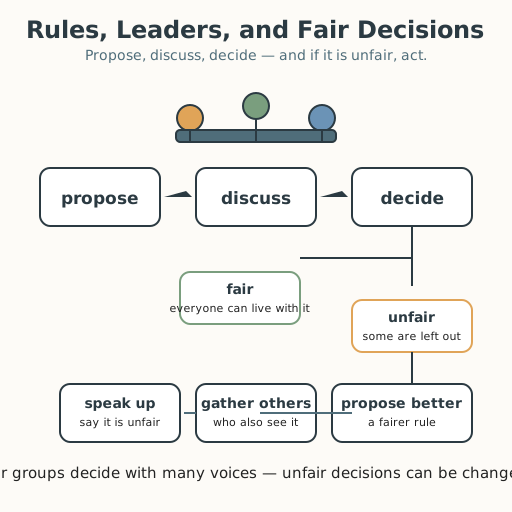
- A "how a group decides" flow chart · 1 per learner or pair Steps — propose, discuss, decide — with a branch for "if it is unfair" leading to "speak up, gather others, propose a better rule"
- A fairness scenario card · 1 per pair A small group story — e.g., a shared garden where one child is given no water turn — to decide together
- Pencils and crayons · per learner For completing the flow chart
Low-tech / no-cost
- A talking stick or stone Pass it so each voice gets a turn to propose and discuss, showing a fair way to decide
- Body and voice Act a council — propose, discuss, decide — then act speaking up, gathering others, and changing the rule when it is unfair
Enriched / lab & device
- A picture book or short video on the Haudenosaunee Great Law of Peace · 1 Optional — to see consensus decision-making in a real, long-lived example
- A tablet or camera · 1 per group Optional — record a small group making a fair decision together
Works in different contexts
- large-group Run a whole-group council with a talking stick — propose, discuss, decide one classroom question — then discuss what to do if it felt unfair
- self-directed The learner works through the fairness scenario alone, deciding what to do if the decision is unfair, then shares with a grown-up or peer
- outdoor-only Sit in a circle and pass a stone as the talking stick, deciding one shared question fairly, and practice speaking up for a fairer rule
- multi-age Older learners read the flow chart and scribe, while younger learners act the council and the "speak up" branch
- level-grouped Learners who finish early coach peers by asking "is this decision fair to everyone? what could you do?" rather than telling
Lesson 9 — Rules, Leaders, and Fair Decisions
Summary
Learners explore how groups make decisions through rules and leaders — by proposing, discussing, and deciding — and what people can do when a decision is unfair: speak up, gather others, and propose a better rule. They meet the Haudenosaunee (Iroquois) Great Law of Peace, a long-lived example of decision-making built to include many voices, and connect it to their own classroom and community.
Objectives
- Explain how rules and leaders make decisions in a group, and identify what people can do when a decision is unfair. (D08.S4.04.01)
Connection
Every group you are part of — a class, a team, a family — has rules and some way of deciding things: who goes first, who shares what, how to settle a question. Some ways of deciding are fair (everyone has a say) and some are not (a few decide for everyone). The question of how to decide fairly is one people everywhere have asked — and people can always speak up when a decision hurts some and helps others.
Materials
- A “how a group decides” flow chart (one per learner or pair)
- A fairness scenario card (one per pair)
- Pencils and crayons
Preparation
- Prepare the flow chart: propose → discuss → decide, with a branch from “decide” to “fair” (everyone can live with it) and “unfair” (speak up, gather others, propose a better rule).
- Prepare the scenario card: a shared garden where the group decides who waters on which day, but one child is given no turn because they are the youngest.
Facilitator note
This lesson is written to the learner (“you”). Model the decide-then-check flow with a worked example first (Kirschner, Sweller & Clark, 2006): walk one decision from propose to discuss to decide, then model the “unfair” branch (“if the rule leaves someone out, they can speak up, gather others, and propose a fairer rule”). Teach the Haudenosaunee Great Law of Peace accurately and with respect (see Resources): the Haudenosaunee confederacy of several nations made decisions by long discussion aimed at agreement (consensus), with clan mothers holding an important role and the voices of different nations all included — a living tradition, not a museum piece. Connect to the child’s own life: the classroom and family are real groups where fairness can be practiced. Honor every body and every family shape: describe the chart in words for a learner who cannot see it; a learner who does not use a speaking voice points, signs, or writes. Keep the “unfair decision” example gentle and close to home, and always connect it to agency — something the learner can do.
Procedure
- Gather (5 min). Think of a rule in your class or family. Who made it? How was it decided? Was everyone’s voice heard?
- Meet how groups decide (10 min). A group decides in steps: propose an idea, discuss it so many voices are heard, then decide. Leaders help guide this — but a fair decision includes the people it affects.
- Meet a fair-way example (10 min). The Haudenosaunee (Iroquois) peoples of North America built the Great Law of Peace, a way of deciding by long discussion aimed at agreement, with clan mothers and the voices of several nations all included. It aimed for decisions everyone could live with.
- What to do when it’s unfair (10 min). Read the garden scenario. Walk the “unfair” branch: the child left out can speak up, gather others who see the unfairness, and propose a better rule (a turn for everyone). Discuss: which step would you take first, and why?
- Practice in your own group (10 min). Choose one real question in your class or family. Propose, discuss, and decide it — then check: is it fair to everyone? If not, what will you do?
- Close (5 min). Fair groups decide with many voices, and unfair decisions can be changed. Speaking up, gathering others, and proposing a better rule is how fairness grows.
Differentiation
- Support: Walk only the “unfair” branch with the garden story and one shared sentence said together.
- Support (blind/low-vision): Hear the scenario told aloud and decide the steps orally, with a partner recording them.
- Support (non-speaking): Point to the flow-chart steps and to the three “unfair” actions, instead of speaking.
- Support (Deaf/HH): The chart is visual — point to the steps and sign “speak up,” “gather,” and “propose” as you go.
- Support (motor-difference): Use a large, stable chart; point or eye-gaze to each step while a partner writes.
- Extension: Write a short “fair decision” plan for a real group you belong to, naming who proposes, who discusses, and how everyone’s voice is heard.
Assessment
- Formative (observation): Can the learner order the steps (propose, discuss, decide)?
- Formative (oral/performance): Does the learner name at least one thing people can do when a decision is unfair — by speaking, signing, writing, or acting?
Resources
- United Nations Convention on the Rights of the Child, Article 12 — children have the right to say what they think and to have their views taken into account. https://www.ohchr.org/en/instruments-mechanisms/instruments/convention-rights-child
- Britannica Kids, “Haudenosaunee (Iroquois)” — the Haudenosaunee confederacy and its Great Law of Peace. https://kids.britannica.com/kids/article/Haudenosaunee/353303
Home connection
At home, think of one rule your family has. Ask who made it and whether everyone’s voice was heard. If it feels unfair to someone, talk together about one step you could take to make it fairer.