Lesson 03 — Dignity: Being a Person of Worth
Learners learn that **dignity** is being treated as a **person of worth**, and they give an example of dignity being **honored** (greeted by name, listened to, given a seat) or **denied** (ignored, talked over, left out). Dignity belongs to every person — it is not earned, and it cannot be taken away, only denied.
Objectives
Objectives
- D09.S2.04.01 Explain what dignity means (being treated as a person of worth) and give an example of it being honored or denied.
Essential question
What does dignity mean, and what does it look like when it is honored or denied?
Key vocabulary
Materials
Standard materials
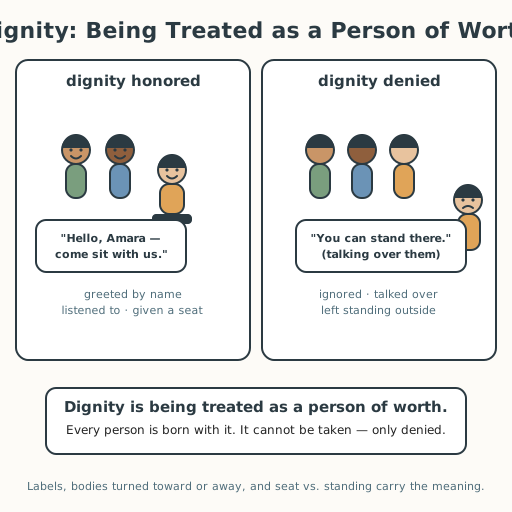
- A "dignity honored / dignity denied" picture strip · 1 Two panels from the same scene — in one, a person is greeted by name, listened to, and given a seat; in the other, the same person is ignored, talked over, and left standing
- Two puppets or soft toys · 2 For acting out a small scene where dignity is honored, then one where it is denied
- Paper and drawing tools · per learner
Low-tech / no-cost
- Voice and body Act out "honored" and "denied" with tone and posture — a warm greeting vs. being talked over; no strip or toys needed
- A drawn two-panel strip Draw one scene twice — once with dignity honored, once denied — on paper or the ground
Enriched / lab & device
- Laminated "dignity" cards · 1 set per pair Durable cards showing dignity honored and denied for repeated sorting and discussion
- A story or video of dignity honored (a person welcomed, named, and heard) · 1 Optional, showing dignity in real life without shaming anyone
Works in different contexts
- large-group Show the two panels large and name the difference together, then act out one honored and one denied moment with puppets while the group calls out which is which
- self-directed The learner compares the two panels and tells or writes what dignity means and one example of it being honored or denied
- outdoor-only Use a real small moment — inviting someone into the circle, saving a seat, or leaving someone standing outside — to feel honored vs. denied
- multi-age Older learners model a dignity-honoring greeting; younger learners try naming whether dignity was honored or denied
- level-grouped Learners who need more support sort picture cards into "honored" and "denied"; learners ready for more explain *why* being ignored denies worth, using "because every person matters"
Lesson 3 — Dignity: Being a Person of Worth
Summary
Learners learn that dignity is being treated as a person of worth, and they give an example of dignity being honored (greeted by name, listened to, given a seat) or denied (ignored, talked over, left out). Dignity belongs to every person — it is not earned, and it cannot be taken away, only denied. This deepens Grade 3’s “left out and made more fair” into the fuller idea of a person’s worth.
Objectives
- Explain what dignity means (being treated as a person of worth) and give an example of it being honored or denied. (D09.S2.04.01)
Connection
Everyone wants to be seen as a person who matters. When someone greets you by your name, listens to what you say, and makes room for you, you feel your own worth — that is your dignity being honored. When someone ignores you, talks over you, or leaves you standing outside while others sit, you can feel your worth being pushed down — that is your dignity being denied. Dignity is not something you have to earn by being clever or strong or rich; every person is born with worth. People honor it everywhere — a host offering a guest water and a seat, a class that saves a chair for the new child, a speaker who waits for the quiet person’s answer. Today you will learn what dignity means and name a moment it was honored or denied.
Materials
- A “dignity honored / dignity denied” picture strip
- Two puppets or soft toys
- Paper and drawing tools
Preparation
- Prepare the two-panel dignity strip (one scene, treated two ways).
- Set up a small space for acting out honored and denied moments.
Facilitator note
Written to the learner (“you”). This lesson teaches dignity — the worth every person has, simply by being a person. Hold it with care and never as shame: the “denied” examples are invented and gentle (ignored, talked over, left standing), and the point is the act, never the person. No learner is ever asked to confess a time they denied someone’s dignity, and no learner is ever labeled as having denied it. Frame both panels as things that happen in the world, and hold “what does each way of treating someone do to their worth?” as a question. Emphasize that dignity cannot be taken — it can only be denied — so the learning ends in agency and hope: we can choose to honor it. A learner who does not speak aloud points to the honored panel or signs; a learner who is deaf or hard of hearing follows the strip through sign and caption; a learner who is blind or low-vision hears both panels described and names which honors and which denies worth, and why; a learner with a motor difference can direct a partner to act the scene. A learner may always pass. The aim is that every learner can say, in their own way, “dignity means being treated as a person of worth — here is a moment it was honored, and here is one it was denied.”
Procedure
- Gather and remember (5 min). Last time you named a value — something you care about. What is a value? Today we look at something every person has: their worth.
- Meet “dignity” (10 min). Dignity means being treated as a person of worth. It is honored when you are greeted by name, listened to, and given a place. It is denied when you are ignored, talked over, or left out. Dignity is not earned — every person is born with it.
- Compare the two panels (15 min). Look at the strip: one scene, two ways. In the “honored” panel, name what shows worth (the greeting, the listening, the seat). In the “denied” panel, name what pushes worth down. Wonder together: what does each way do to the person? Could you choose to honor it?
- Act it (10 min). With the puppets, show a small moment of dignity honored (a warm “hello, come sit with us”), then one denied (being talked over). A learner who does not move the puppets can point to the honored or denied panel or direct a partner.
- Close (5 min). Dignity is being treated as a person of worth. It is yours, and it is everyone’s — and we can choose to honor it.
Differentiation
- Support: Sort two picture cards into “honored” and “denied” with a grown-up model; a non-speaking learner points to the honored panel; a learner with limited movement directs a partner.
- Extension: Invite learners to wonder what to do when they see someone’s dignity being denied — a small, safe action that honors it instead.
Assessment
- Formative (observation): Can the learner explain what dignity means and give an example of it being honored or denied?
- Artifact (portfolio): The learner’s drawing of one honored or denied moment, with a one-line explanation.
Home connection
At home, notice a small moment of dignity honored (a greeting, a seat offered, being listened to) and name it together: “that was someone’s worth being seen.”
Resources
- United Nations Convention on the Rights of the Child (child-friendly summary; every child’s worth and dignity): https://www.unicef.org/child-rights-convention
- The idea that every person is born with dignity and worth is a shared value across many traditions; it appears in the Universal Declaration of Human Rights and in the moral teachings of cultures worldwide.