Lesson 02 — What Is a Value? Naming One of Mine
Learners learn that a **value** is something a person cares about that guides how they choose and act, and each learner names **one of their own values** with a "because I care about..." A value is not a test answer — it is a real care, held as a question and a guide.
Objectives
Objectives
- D09.S1.04.02 Describe what a value is (something a person cares about) and name one of their own values.
Essential question
What is a value, and what is one value that I hold?
Key vocabulary
Materials
Standard materials
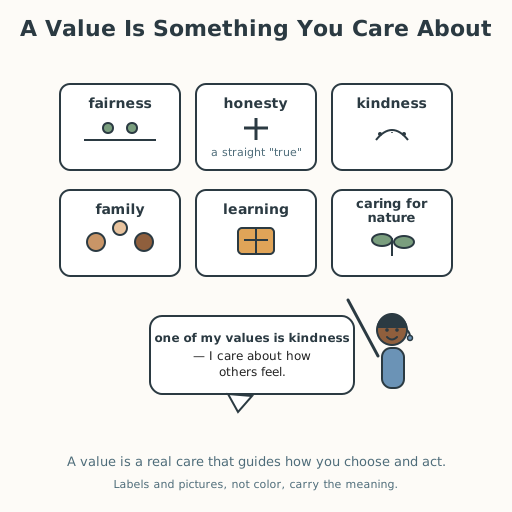
- Values cards · 1 set Cards naming things people care about — fairness, honesty, kindness, family, learning, nature, health, courage, safety, friendship — each with a simple picture
- A "my value" sheet · per learner A page with a heart or star outline for the learner to write or draw one value they hold, and a "because I care about..." line
- Crayons or pencils · per learner
Low-tech / no-cost
- Voice and body Act out each value (sharing, listening, helping) and name it; no cards or sheets needed
- Found objects A stone, a leaf, a seed each standing for a different value, placed in a circle
Enriched / lab & device
- Laminated values cards and a class "values wall" · 1 set Durable cards plus a display where each learner posts their named value
- A short video or story of a person acting on a value · 1 Optional, showing a value turned into a real choice
Works in different contexts
- large-group Show each values card large; the group guesses the value from its picture, then one learner names their own value and why they care about it
- self-directed The learner sorts the values cards into "things I care about most" and names one value and why
- outdoor-only Find something in nature you care about (a tree, clean water, an animal) and name the value it shows, such as "caring for the living world"
- multi-age Older learners model "a value is something you care about"; younger learners name one thing they care about
- level-grouped Learners who need more support match values cards to a "because I care about..." frame; learners ready for more name a value and give a time they acted on it
Lesson 2 — What Is a Value? Naming One of Mine
Summary
Learners learn that a value is something a person cares about that guides how they choose and act, and each learner names one of their own values with a “because I care about…” A value is not a test answer — it is a real care, held as a question and a guide. This builds on Grade 3’s reasons and needs toward the deeper idea of what a person holds dear.
Objectives
- Describe what a value is (something a person cares about) and name one of their own values. (D09.S1.04.02)
Connection
Everyone has things they care about — things that make them say “that matters to me.” You might care about fairness, honesty, your family, learning, nature, or being kind. When you care about something deeply enough to let it guide your choices, that is a value. People everywhere hold values — a fisher who returns a fish too small to keep is acting on care for the river’s future; a friend who tells the truth even when it is hard is acting on honesty; a family that shares its last bread is acting on care for each other. Today you will learn what a value is, and name one value that is really yours.
Materials
- Values cards (fairness, honesty, kindness, family, learning, nature, health, courage, safety, friendship)
- A “my value” sheet per learner
- Crayons or pencils
Preparation
- Prepare the values cards, or decide which values to act out aloud.
- Prepare the “my value” sheet with a heart or star outline and a “because I care about…” line.
Facilitator note
Written to the learner (“you”). This lesson introduces values gently — as things a person genuinely cares about, not as a list to be graded. Model naming a value yourself first (“I value honesty — because I care about people being able to trust my word”), then invite learners to name their own. A value is personal, and there is no correct answer: a learner may name anything from “my family” to “fairness” to “the river.” Hold values as questions and guides, never as a ranking — no learner’s value is “better” than another’s, and we never shame a value that differs from our own. Some values conflict (honesty vs. kindness), and that is worth wondering about later in the unit. A learner who does not speak aloud points to a values card or draws their value; a learner who is deaf or hard of hearing follows the cards through sign; a learner who is blind or low-vision hears each value described and names their own aloud; a learner with a motor difference can direct a partner to circle their value. A learner may always pass, or name a value privately to a grown-up. The goal is a learner who can say, in their own way, “this is something I care about — this is a value of mine.”
Procedure
- Gather and remember (5 min). Last time you compared two reasons and decided which was stronger. What helped you decide? Today we look at what lies under our reasons: the things we care about.
- Meet “value” (10 min). A value is something a person cares about that guides how they choose and act. It is not a fact you memorize; it is a care you hold. Look at the values cards and name each one: fairness, honesty, kindness, family, learning, nature, health, courage, safety, friendship.
- Sort and choose (10 min). Which cards show things you care about most? Put them in order for yourself. Wonder: how do you know you care about it? (It makes you feel something; you would act on it.)
- Name your value (15 min). On your sheet, draw or write one value that is yours, and finish the sentence: “I value ______ because I care about ______.” Share with a partner if you wish. If drawing or writing is not your way, act it out, point to a card, or have a partner scribe while you direct.
- Close (5 min). A value is something you care about that guides you. Today you named one of yours — and no one can take that from you.
Differentiation
- Support: Offer a smaller set of cards and a spoken sentence frame (“I care about ___ so I value ___”); a non-speaking learner points to a card; a learner with limited movement directs a partner.
- Extension: Invite learners to name a time they acted on their value, and wonder how it felt.
Assessment
- Formative (observation): Can the learner describe what a value is (something a person cares about) and name one of their own with a “because”?
- Artifact (portfolio): The learner’s “my value” sheet, kept in their portfolio.
Home connection
Ask a grown-up or older family member: “What is one thing you care about a lot, and how does it guide what you do?” Listen, then share your own value with them.
Resources
- CASEL SEL Framework (self-awareness — identifying one’s values): https://casel.org/fundamentals-of-sel/
- The idea of values as “things a person cares about” is a child-friendly entry point to moral philosophy; see the philosophy-for-children tradition (Matthew Lipman and colleagues).