Lesson 05 — Decisions and Leaders: Here and There
Learners describe how decisions are made and leaders chosen in **their own community**, then compare with **one other place in the world**. They meet several real ways groups decide — consensus, majority vote, elders' councils — and learn that no single way is the only right one; the fair test is whether every voice counts.
Objectives
Objectives
- D09.S3.04.01 Describe how people make decisions and choose leaders in their community and compare with one other place in the world.
Essential question
How do people make decisions and choose leaders here, and how is it done in another place in the world?
Key vocabulary
Materials
Standard materials
- A "ways to decide" chart · 1 A poster or sheet listing several real ways groups decide — talk until everyone agrees (consensus), majority vote, elders' council, drawing lots — each with a picture
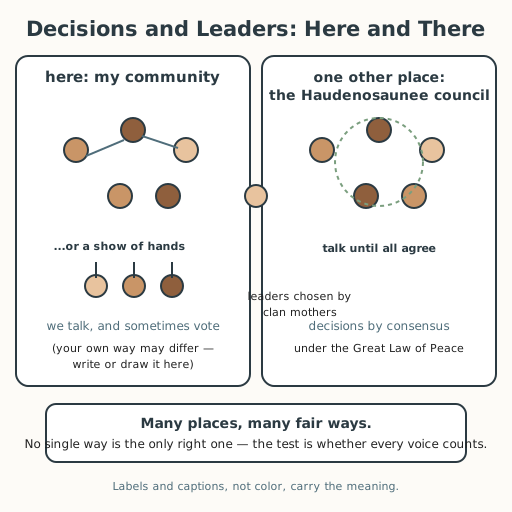
- Here-and-there comparison sheet · per learner A two-column page — "how my community decides and chooses leaders" and "how one other place does it" — for a written or drawn comparison
- Crayons or pencils · per learner
Low-tech / no-cost
- Voice and body Act out each way of deciding (circle talk, hand-raising vote, an elder speaking) and name it; no chart or sheets needed
- A drawn two-column comparison Draw two columns — "here" and "there" — on paper, cloth, or the ground
Enriched / lab & device
- A short video or story of a council or assembly deciding in another place · 1 Optional, showing a real decision-making tradition from one specific community
- A world map or globe · 1 To place "here" and "there" on the planet while comparing
Works in different contexts
- large-group Walk through the "ways to decide" chart together, then compare the class's own way of deciding with one named place, writing or drawing each column as a group
- self-directed The learner lists how their own community decides and chooses leaders, then reads about one other place and fills the two-column comparison
- outdoor-only Rehearse two ways of deciding with a real choice outdoors (talk until all agree vs. a quick show of hands), then compare with one other place from the chart
- multi-age Older learners model "here is how we decide"; younger learners name one way people decide (voting, elders, talking)
- level-grouped Learners who need more support match each way of deciding to its picture; learners ready for more compare two *other* places with each other, not just with home
Lesson 5 — Decisions and Leaders: Here and There
Summary
Learners describe how decisions are made and leaders chosen in their own community, then compare with one other place in the world. They meet several real ways groups decide — consensus, majority vote, elders’ councils — and learn that no single way is the only right one; the fair test is whether every voice counts. This builds on Grade 3’s “having a voice in the group” toward comparing how different communities actually decide and choose leaders.
Objectives
- Describe how people make decisions and choose leaders in their community and compare with one other place in the world. (D09.S3.04.01)
Connection
Every group — a family, a class, a village, a nation — must decide things together and sometimes choose someone to lead. But groups do this in different ways, and no single way is the only right one. Some groups talk until everyone agrees (this is called consensus); some take a vote and follow the majority; some listen to a council of elders who carry long memory and wisdom. Think of your own community: how are decisions made, and how is a leader chosen? Now think of another place in the world — the Haudenosaunee (Iroquois) nations, for example, have long made decisions in councils where leaders chosen by clan mothers talk until all agree; a village in the Andes might gather everyone in a circle to talk it through; a town far away might elect a mayor by vote. Today you will describe how it works where you live, and compare it with one other place on Earth.
Materials
- A “ways to decide” chart (consensus, majority vote, elders’ council, drawing lots)
- A “here and there” comparison sheet per learner
- Crayons or pencils
Preparation
- Prepare the “ways to decide” chart, or decide which ways to act out aloud.
- Prepare the two-column “here and there” comparison sheet.
Facilitator note
Written to the learner (“you”). This lesson introduces ways of deciding and choosing leaders — and it must never rank one political system above another. Present several real ways side by side (consensus, majority vote, elders’ council, drawing lots) as different traditions that all aim at fairness, each with strengths and limits. The Haudenosaunee example is accurate and useful: leaders (called royaner, or chiefs) are chosen by clan mothers, and councils work by consensus under the Great Law of Peace — a real tradition that also influenced later ideas about confederation. Keep the learner’s own community open and undetermined: some learners live under monarchies, some in elected republics, some in communities governed by councils or elders — all are welcomed and described descriptively, never as “better” or “worse.” The fair test we teach is not “which system” but “does every voice count, and is anyone left out?” — hold that as a question. A learner who does not speak aloud points to a way on the chart; a learner who is deaf or hard of hearing follows the chart through sign and caption; a learner who is blind or low-vision hears each way described and compares aloud; a learner with a motor difference can direct a partner to fill the two columns. A learner may always pass, and may describe their community privately to a grown-up if speaking about it publicly is unsafe. The goal is a learner who can say, in their own way, “here is how we decide and choose leaders, and here is how they do it in one other place.”
Procedure
- Gather and remember (5 min). Last time you tested whether a rule is fair to everyone. Who do rules affect? Today we look at who makes the rules — how people decide and choose leaders.
- Meet “ways to decide” (10 min). Look at the chart. Some groups decide by consensus — talking until everyone can agree. Some take a vote — the side with more hands wins. Some turn to a council of elders — people whose long memory and wisdom guide the choice. Some draw lots. None is the only right way.
- Describe “here” (10 min). Think of your own community — your class, family, village, or town. How are decisions made? How is a leader chosen (if there is one)? Write or draw it in the “here” column, or tell it aloud.
- Compare with “there” (15 min). Pick one other place from the chart or a story — the Haudenosaunee council, an Andean village circle, an elected town far away. Write or draw how they decide and choose leaders. Wonder together: how are the two ways alike? How are they different? Does every voice count in each?
- Close (5 min). People decide and choose leaders in many fair ways. The test is not which way — it is whether every voice counts.
Differentiation
- Support: Match each way of deciding to its picture with a grown-up; a non-speaking learner points to the way their community uses; a learner with limited movement directs a partner.
- Extension: Invite learners to compare two other places with each other, and wonder what each way is good at and what it might miss.
Assessment
- Formative (observation): Can the learner describe how their community decides and chooses leaders, and compare it with one other place?
- Artifact (portfolio): The learner’s completed “here and there” comparison sheet.
Home connection
Ask a grown-up: “How does our community decide things, and how is a leader chosen?” Then share one other way from today’s chart and compare.
Resources
- Britannica Kids — Haudenosaunee (Iroquois) and the Great Law of Peace: https://kids.britannica.com/kids/article/Haudenosaunee/353303
- The “ways to decide” comparison (consensus, vote, elders, lots) is a plain-language survey of real practices across cultures; see also UNESCO’s materials on how communities around the world govern shared life.