Lesson 06 — Plan Our Shared Project
Learners plan a small shared project together, **dividing the tasks fairly and listening to each person** before any work begins. Fair division means every voice is heard, the load is shared, and each person takes a task they can do and want — not the loudest person grabbing the easiest job.
Objectives
Objectives
- D09.S3.04.02 Work with classmates on a small shared project, dividing tasks fairly and listening to each person.
Essential question
How do we plan a small shared project, dividing the tasks fairly and hearing every person?
Key vocabulary
Materials
Standard materials
- A "project plan" sheet · 1 per group A page with a project title line, a list of tasks, a "who does what" column, and a "did everyone get a voice?" checklist
- A talking stick or stone · 1 An object passed so each person speaks and is heard in turn
- Crayons or pencils · per learner
Low-tech / no-cost
- Voice and body Plan aloud in a circle, passing a found stone; no sheet needed
- A drawn task chart Draw the project and its tasks on paper, cloth, or the ground, marking who does what with stones or marks
Enriched / lab & device
- Laminated reusable "project plan" boards · 1 per group Wipeable planning boards for repeated use across the year
- Simple role cards · 1 set per group Cards naming jobs (materials, time-keeper, checker, scribe) to help groups self-organize
Works in different contexts
- large-group Split into small groups of three to five; each group plans its own small project with the talking stone, then one person from each shares the plan
- self-directed The learner plans a small project alone, lists tasks, and — if working with others — makes sure each person is heard before tasks are assigned
- outdoor-only Plan a real outdoor project (tidy a shared path, plant seeds, build a shelter model) and divide tasks on the ground with stones
- multi-age Older learners model "would you like this task?"; younger learners name one task they can do
- level-grouped Learners who need more support plan with a grown-up and a two-task list; learners ready for more balance the load so tasks are shared fairly, not just split
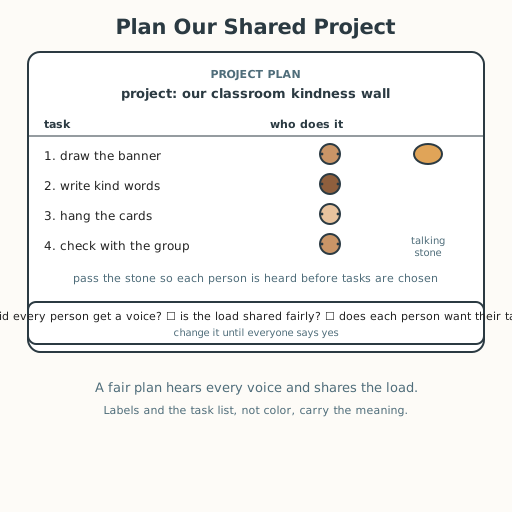
Lesson 6 — Plan Our Shared Project
Summary
Learners plan a small shared project together, dividing the tasks fairly and listening to each person before any work begins. Fair division means every voice is heard, the load is shared, and each person takes a task they can do and want — not the loudest person grabbing the easiest job. This begins the unit’s collective-action standard (carried out in Lesson 7).
Objectives
- Work with classmates on a small shared project, dividing tasks fairly and listening to each person. (D09.S3.04.02)
Connection
A group can do more than one person alone — but only if the work is shared fairly. Think of building a kindness wall, tidying a shared path, or making a welcome poster: someone must draw, someone must write, someone must hang, and someone must check with everyone. If one person does everything and another is never asked, the project is not really shared. Fair division begins with listening — hearing what each person wants to do and can do, then spreading the load so no one is left out and no one is crushed. People everywhere plan this way — a crew lifting a boat, a family harvesting together, a class making a garden. Today you will plan your project and divide the tasks fairly, with every voice heard.
Materials
- A “project plan” sheet per group
- A talking stick or stone
- Crayons or pencils
Preparation
- Prepare the “project plan” sheet (title line, task list, “who does what” column, and a “did everyone get a voice?” checklist).
- Decide on two or three small, safe, doable project ideas groups can choose from (a kindness wall, a welcome poster, tidying a shared space, planting seeds).
Facilitator note
Written to the learner (“you”). This lesson teaches fair task division and listening — the planning half of the shared-project standard. Model the move first as a worked example: name a project, list its tasks, and show how to offer tasks and hear each person (“What would you like to do? What can you do well?”) before writing a name by each task. The core fairness test is listening: every person is asked, every voice counts, and the load is shared — not the quickest or loudest person deciding. Keep projects small and blame-free; the goal is the process, not a perfect product. Emphasize that fair does not mean “everyone does exactly the same amount” — it means each person contributes in a way that fits them, and no one is left out or overloaded. A learner who does not speak aloud points to a task or passes the stone to signal their turn is done; a learner who is deaf or hard of hearing follows the plan through the sheet and sign; a learner who is blind or low-vision hears the task list read and chooses aloud; a learner with a motor difference can be the scribe’s director or the checker. A learner may always pass or take a small, quiet task. The aim is a group that can say, in its own way, “we planned this together, every voice was heard, and the tasks are fairly shared.”
Procedure
- Gather and remember (5 min). Last time you compared how people decide and choose leaders. What was one way? Today you will decide something yourself — as a team.
- Meet “fair division” (10 min). A project is something you make or do together. Dividing the tasks fairly means: listen to every person, ask what each can do and wants to do, and share the load so no one is left out and no one is overloaded.
- Choose and list the tasks (10 min). As a group, pick your small project. List the tasks it needs. Pass the talking stone so each person names one task they could do or want to do.
- Divide the tasks fairly (15 min). Write or draw who does what. Check the checklist: did every person get a voice? Is the load shared fairly? Does each person want their task? Change it until everyone says yes.
- Close (5 min). A fair plan hears every voice and shares the load. Tomorrow you will carry it out — together.
Differentiation
- Support: Plan with a two-task list and a grown-up asking each person “what can you do?”; a non-speaking learner points to a task; a learner with limited movement takes a directing or checking role.
- Extension: Invite groups to plan for a task that no one wants (the “boring but needed” job) and find a fair way to share it.
Assessment
- Formative (observation): Did the group divide tasks fairly and hear every person before assigning work?
- Performance: The completed project plan, with each task matched to a person who was listened to.
Home connection
At home, plan one small family job together — dinner setup, tidying, watering — and divide the tasks by asking each person what they can do and want to do, so every voice is heard.
Resources
- CASEL SEL Framework (relationship skills — cooperation and listening): https://casel.org/fundamentals-of-sel/
- Cooperative learning structures that divide work fairly are described in Slavin’s cooperative-learning research and in the Escuela Nueva self-paced guide tradition; see also the IIRP’s community-practice materials.