Lesson 09 — Restorative Practice: Repair, Not Only Punish
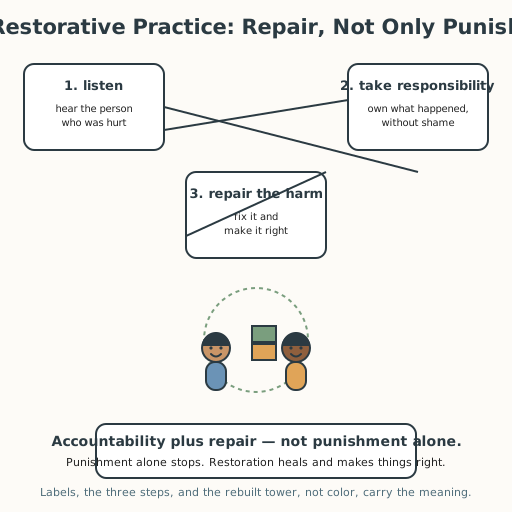
Learners describe **restorative practice**: listen to the person who was hurt, **take responsibility** for what happened, and **repair the harm**. They explain why it can work better than punishment alone — punishment stops an act; restorative practice also heals the hurt and keeps the person accountable for making it right.
Objectives
Objectives
- D09.S4.04.02 Describe restorative practice (listening, taking responsibility, and repairing harm) and why it can work better than punishment alone.
Essential question
What is restorative practice, and why can it work better than punishment alone?
Key vocabulary
Materials
Standard materials
- A "restorative circle" picture · 1 The three restorative steps in a circle — listen, take responsibility, repair the harm — with the person who was harmed at the center of attention
- A "restore vs. only punish" comparison strip · 1 Two paths from the same harm — one that only punishes (the harm stays, accountability is only a penalty) and one that restores (the person owns it and fixes it)
- Two puppets or soft toys · 2 For acting out the restorative steps, including the moment of taking responsibility
Low-tech / no-cost
- Voice and body Act out the harm and the restorative steps; no strip or toys needed
- A drawn three-step circle Draw "listen, take responsibility, repair" as a circle in the dirt, on cloth, or on paper
Enriched / lab & device
- Laminated "restorative steps" cards · 1 set per pair Durable cards for a peace corner showing the three steps and the question "what happened, who was hurt, and how do we make it right?"
- A story of a real repair (a restored friendship, a mended thing, a returned item) · 1 Optional, showing accountability and repair working better than punishment alone
Works in different contexts
- large-group Walk the two paths from the same harm as a whole group, naming what punishment alone leaves undone and what the restorative steps fix, then rehearse the steps in pairs
- self-directed The learner compares the two paths and tells or writes what restorative practice is and why it can work better than punishment alone
- outdoor-only Use a real small harm (a trampled plant, a knocked-over pile) and walk the restorative steps right there
- multi-age Older learners model taking responsibility and repairing; younger learners name the harm and the repair
- level-grouped Learners who need more support order the three steps with pictures; learners ready for more explain *why* accountability plus repair heals better than penalty alone
Lesson 9 — Restorative Practice: Repair, Not Only Punish
Summary
Learners describe restorative practice: listen to the person who was hurt, take responsibility for what happened, and repair the harm. They explain why it can work better than punishment alone — punishment stops an act; restorative practice also heals the hurt and keeps the person accountable for making it right. This deepens Grade 3’s “repairing harm” into the named practice and its why.
Objectives
- Describe restorative practice (listening, taking responsibility, and repairing harm) and why it can work better than punishment alone. (D09.S4.04.02)
Connection
When harm happens — a tower knocked over, a hurt word, a borrowed thing returned broken — there are two ways to answer. Punishment alone stops the act (the child is sent away) but leaves the tower broken and the hurt untouched. Restorative practice asks three things instead: listen to the person who was hurt, take responsibility for what happened, and repair the harm — help rebuild, mean the sorry, fix the break. It does not let anyone off — it holds the person accountable for making things right. That is why it can work better than punishment alone: the harm is healed, and the person who caused it grows instead of only paying a price. People and schools use this around the world — a circle where both sides are heard, and a repair that makes it right. Today you will learn the three steps and why they help.
Materials
- A “restorative circle” picture (listen, take responsibility, repair)
- A “restore vs. only punish” comparison strip
- Two puppets or soft toys
Preparation
- Prepare the restorative circle picture and the “restore vs. only punish” strip.
- Set up a small space for acting out the restorative steps.
Facilitator note
Written to the learner (“you”). This lesson teaches restorative practice — the fuller form of justice this unit builds toward. The three moves are listen (hear the one who was hurt), take responsibility (own what happened, without shame — name the act, never the child), and repair the harm (do something that makes it right). Crucially, restorative practice does not dismiss accountability — it requires it: the person who caused harm must own it and fix it, which is harder and more honest than sitting out a penalty. Teach it as both/and, not either/or: punishment alone stops; restoration heals and holds accountable. Hold it as a question (“what does each path do for the person who was hurt — and for the person who caused it?”), never as a forced ritual: never make a learner confess a real, private harm or perform a scripted apology — invented or acted harms are welcome, and a learner may always pass. A learner who does not speak aloud points to the three steps or signs; a learner who is deaf or hard of hearing follows the circle through sign and caption; a learner who is blind or low-vision hears the steps described and names why repair heals; a learner with a motor difference can direct a partner to do the repair. The aim is that every learner can say, in their own way, “restorative practice means listening, taking responsibility, and repairing harm — and that can heal better than punishment alone.”
Procedure
- Gather and remember (5 min). Last time you practiced “I” statements and active listening. How do those help when there is a disagreement? Today we go further: what happens after harm, so things are made right.
- Meet restorative practice (10 min). Restorative practice answers harm with three steps: listen to the person who was hurt; take responsibility for what happened; repair the harm — fix it and make it right. It holds the person accountable, and it heals.
- Compare the two paths (15 min). Look at the strip: one harm, two paths. For “only punish,” name what is still broken. For “restore,” name what got fixed — and who stayed accountable. Wonder: why can repair work better than punishment alone? What does it give the person who was hurt? What does it ask of the person who caused it?
- Act a repair (10 min). With the puppets, show a small harm, then walk the three steps: listen, take responsibility, repair. A learner who does not move the puppets can point to a step or direct a partner.
- Close (5 min). Restorative practice listens, takes responsibility, and repairs. Punishment alone stops; restoration heals — and keeps the person accountable for making it right.
Differentiation
- Support: Order the three steps with pictures and model “repair fixes the hurt, punishment alone does not”; a non-speaking learner points to the repair step; a learner with limited movement directs a partner.
- Extension: Invite learners to wonder about a harm that cannot be fully undone (a broken vase, a hurt word) and what “taking responsibility and repairing” means when the thing cannot be put back exactly.
Assessment
- Formative (observation): Can the learner describe restorative practice (listen, take responsibility, repair) and why it can work better than punishment alone?
- Performance: The acted-out restorative steps, explained aloud.
Home connection
At home, if a small harm happens, wonder together: would punishment alone heal the hurt, or is there a repair — a listen, a taking-responsibility, a making-it-right — that would work better?
Resources
- International Institute for Restorative Practices (restoring relationships and repairing harm): https://www.iirp.edu/
- Restorative practice (listen, take responsibility, repair) is used in schools worldwide; see UNICEF’s “restorative practices in schools” materials and the IIRP graduate-school framework.