Lesson 08 — Active Listening and 'I' Statements
Learners practice the two moves that turn a disagreement into a fair talk: **active listening** (facing the speaker, hearing, and reflecting back) and **"I" statements** ("I feel ___ when ___ because ___. I need ___."). Saying "I" instead of "you" names feelings without blame, so both people stay heard.
Objectives
Objectives
- D09.S4.04.01 Practice active listening and "I" statements to solve a disagreement fairly.
Essential question
How do I use active listening and "I" statements to solve a disagreement fairly?
Key vocabulary
Materials
Standard materials
- An "I statement" frame card · 1 set Cards with the frame "I feel ___ when ___ because ___. I need ___." and a matching "active listening" card ("I hear that you feel ___")
- Disagreement role-play cards · 1 set Small, blame-free invented disagreements (two friends want the same ball, one was interrupted, a borrowed pencil came back broken)
- Two puppets or soft toys · 2 For modeling the listening-and-"I"-statement exchange before learners try it
Low-tech / no-cost
- Voice and body Model the exchange aloud with calm voices and open bodies; no cards or toys needed
- A drawn "I statement" frame Draw the frame "I feel ___ when ___ because ___" on paper, cloth, or the ground
Enriched / lab & device
- Laminated frame cards for a peace corner · 1 set Durable "I statement" and "active listening" cards kept where learners resolve conflicts
- A short video of a peaceful listening exchange · 1 Optional, showing active listening and "I" statements in action
Works in different contexts
- large-group Model the exchange with puppets for the whole group, then have learners rehearse in pairs with the frame card, then two pairs share
- self-directed The learner reads the frame, practices saying an "I" statement aloud about an invented disagreement, and writes the listening reflection
- outdoor-only Use a real small disagreement outdoors (who uses the swing, who goes first) and practice the exchange on the spot
- multi-age Older learners model the listener's "I hear that you feel..."; younger learners practice the speaker's "I feel..."
- level-grouped Learners who need more support fill the frame with a partner and one feeling word; learners ready for more practice a full exchange including the "I need ___" request
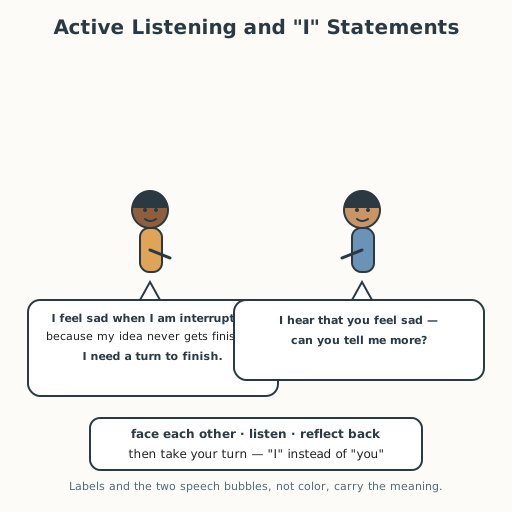
Lesson 8 — Active Listening and “I” Statements
Summary
Learners practice the two moves that turn a disagreement into a fair talk: active listening (facing the speaker, hearing, and reflecting back) and “I” statements (“I feel ___ when ___ because ___. I need ___.”). Saying “I” instead of “you” names feelings without blame, so both people stay heard. This deepens Grade 3’s “calm down and talk it through” into the two named skills.
Objectives
- Practice active listening and “I” statements to solve a disagreement fairly. (D09.S4.04.01)
Connection
When two people disagree, the words can turn into a blame match — “you always,” “you never” — and no one ends up heard. There are two tools that change this. First, an “I” statement: “I feel ___ when ___ because ___,” which names your own feeling without pointing at the other person. Second, active listening: facing the speaker, really hearing them, and reflecting it back — “I hear that you feel ___.” Saying “I” instead of “you,” and listening before answering, is how people everywhere turn a fight into a talk — two neighbors over a fence, two friends over a ball, two caregivers over a plan. Today you will practice both moves, so you can solve a disagreement fairly.
Materials
- “I statement” frame cards (“I feel ___ when ___ because ___. I need ___.”)
- Disagreement role-play cards (two friends want the same ball; one was interrupted; a borrowed pencil came back broken)
- Two puppets or soft toys
Preparation
- Prepare the “I statement” and “active listening” frame cards.
- Prepare a few small, invented, blame-free disagreement cards.
Facilitator note
Written to the learner (“you”). This is a skill lesson, so teach it with a worked example and guided practice (Kirschner, Sweller & Clark, 2006): model the exchange with puppets once, then have learners rehearse in pairs before any independent use. Name the two moves clearly: “I” statement (I feel ___ when ___ because ___; I need ___.) and active listening (face the speaker, hear them, reflect back “I hear that you feel ___”). Emphasize that “I” statements name feelings and needs, not blame — they are not a magic script, and sometimes the first try is clumsy; practice makes them real. Use only invented, gentle disagreements; never have learners role-play a real, live conflict in the class (that could embarrass someone). A learner who does not speak aloud fills the frame by pointing to feeling-word cards or signing; a learner who is deaf or hard of hearing follows the frames through sign and the cards; a learner who is blind or low-vision hears the frames read and practices aloud; a learner with a motor difference can direct a partner or use a communication aid. A learner may always pass. The goal is a learner who can, in their own way, say “I feel ___” and then listen — the two halves of a fair talk.
Procedure
- Gather and remember (5 min). Last time you finished a shared project as a team. What helped you work together? Today we practice a skill teams need when they disagree.
- Meet the two moves (10 min). Watch the puppets. First, an “I” statement: “I feel ___ when ___ because ___. I need ___.” It names my feeling, not blame. Then active listening: face the speaker, hear them, and reflect — “I hear that you feel ___.” No interrupting, no “but you…”
- Guided practice (15 min). Pick a disagreement card. One partner speaks the “I” statement; the other listens and reflects. Then switch roles. Try all the frame lines, even if it feels a little silly at first.
- Try your own (10 min). With a partner, invent a small, safe disagreement and run the whole exchange: “I feel…”, “I hear that you feel…”, then talk out a fair fix. If speaking is not your way, fill the frame by pointing to feeling words or sign.
- Close (5 min). “I” instead of “you” names feelings without blame. Listening before answering keeps both people heard. That is how a disagreement becomes a fair talk.
Differentiation
- Support: Practice one line at a time with a partner and a single feeling word (sad, mad, left out); a non-speaking learner points to feeling-word cards; a learner with limited movement directs a partner.
- Extension: Invite learners to add the fair-fix step (“so what can we both do?”) and practice a full three-turn exchange.
Assessment
- Formative (observation): Can the learner use an “I” statement and active listening (reflect back) in a practiced disagreement?
- Performance: The modeled or role-played exchange, observed for both moves.
Home connection
Tonight, if a small disagreement comes up at home, try one “I” statement (“I feel ___ when ___”) and listen to the other person’s turn before answering. Notice what changes.
Resources
- CASEL SEL Framework (self-management and relationship skills): https://casel.org/fundamentals-of-sel/
- Active listening and “I” statements are core to nonviolent communication and conflict-resolution teaching; see also the International Institute for Restorative Practices materials on listening circles.