Lesson 07 — Where Trash Goes — Reduce, Reuse, Recycle
Learners explain what happens to trash after it is thrown away and name "reduce, reuse, recycle" in order of what is best to do first. They trace the path of a thrown-away wrapper — to a bin and a landfill, or littered, down a drain to a river and the sea — and learn that reduce comes first (make less waste), then reuse, then recycle. They sort actions and rank the three R's.
Objectives
Objectives
- D10.S4.04.01 Explain what happens to trash after it is thrown away and name "reduce, reuse, recycle" in order of what is best to do first.
Essential question
What happens to trash after it is thrown away, and what is the best order of reduce, reuse, recycle?
Key vocabulary
Materials
Standard materials
- A "where trash goes" picture sequence · 1 A wrapper thrown away → a bin → a landfill or dump, or littered → a drain → a river → the sea
- Action cards · 1 set Reduce (don't take what you don't need), reuse (use it again or pass it on), recycle (turn it into something new) — to sort and rank
- Paper and pencils · per learner For drawing the trash path and ranking reduce, reuse, recycle
Low-tech / no-cost
- Real trash items and a spoken story Look at a real wrapper, bottle, or bag and tell where it goes if thrown away; name reduce, reuse, recycle aloud; no printed cards needed
- Voice and body Act out the three R's — refusing extra, reusing a bag, and sorting for recycling
Enriched / lab & device
- A real or pictured local waste system · 1 Photos or a visit note about where the town or village's trash goes, if one exists
- A device to see one recycling or reuse process · 1 Optional — a short clip of paper being recycled, or a repair-and-reuse workshop
Works in different contexts
- large-group Lay the trash path out big and the whole group walks it; then the group ranks reduce, reuse, recycle together on a chart
- self-directed A learner draws the trash path and writes the three R's in order, with one reason why reduce comes first
- outdoor-only Find real litter (or imagine it) and trace where it would go; practice "leave no trace" and name reduce, reuse, recycle
- multi-age Older learners read the trash-path labels and write the reasons; younger learners act out the three R's and place them in order
- level-grouped Learners who finish early add one more example of each R; others rank the three given actions
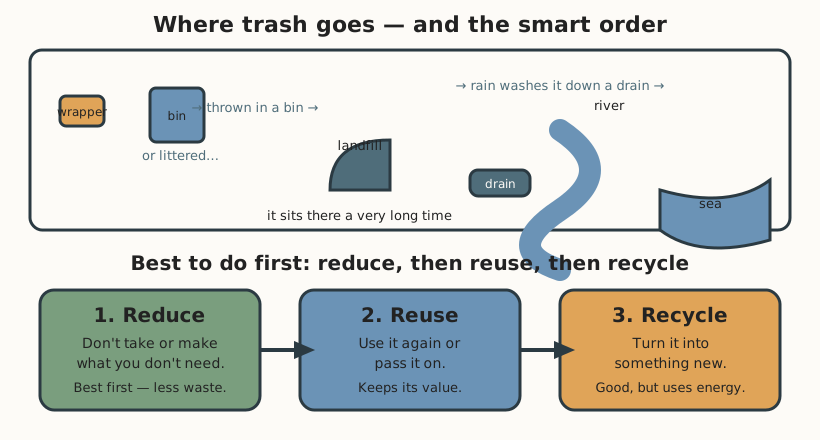
Lesson 7 — Where Trash Goes: Reduce, Reuse, Recycle
Summary
Learners explain what happens to trash after it is thrown away and name “reduce, reuse, recycle” in order of what is best to do first. They trace the path of a thrown-away wrapper — to a bin and a landfill, or littered, down a drain to a river and the sea — and learn that reduce comes first (make less waste), then reuse (use it again), then recycle (turn it into something new). They sort actions and rank the three R’s.
Objectives
- Explain what happens to trash after it is thrown away and name “reduce, reuse, recycle” in order of what is best to do first. (D10.S4.04.01)
Connection
When you throw something away, it does not disappear. A wrapper thrown in a bin is carried to a landfill or a dump, where it sits for a very long time. A wrapper dropped on the ground can be litter — washed by rain down a drain, into a river, and out to the sea. Because making things and throwing them away has real effects, people have a smart order: reduce first (don’t take or make what you don’t need), then reuse (use it again or pass it on), then recycle (turn it into something new). Reduce is best to do first, because making less waste is better than managing waste.
Materials
- A “where trash goes” picture sequence
- Action cards (reduce, reuse, recycle)
- Paper and pencils
Preparation
- Prepare the picture sequence: thrown away → bin → landfill; or littered → drain → river → sea.
- Prepare the action cards, each with a short note: reduce — don’t take or make what you don’t need; reuse — use it again or pass it on; recycle — turn it into something new.
- If you can, find out one true fact about where your own town or village’s trash goes.
Facilitator note
This lesson is written to the learner (“you”). Grade 2 followed what happens to a piece of litter; Grade 3 named resources that run out versus come back and ways to use less; Grade 4 puts it together: explain where trash goes and name the reduce–reuse–recycle order. Teach the order explicitly and give the reasoning — reduce is best first because making less waste avoids the problem, reuse second because it keeps an item’s value, recycle last because it still costs energy and water (the “waste hierarchy,” U.S. EPA). Model the trash path and the ranking once, then guide practice before independent work (Kirschner, Sweller & Clark, 2006). Keep it stewardship-framed, never doom or guilt: the message is “we can do this, and many people already do,” not “you are ruining the Earth.” Honor no-wealth and global contexts: reduce, reuse, and recycle are universal practices — mending clothes, carrying a reusable bag, saving containers, feeding scraps to animals, passing things on — not something that requires buying “eco” products; many of the world’s most careful stewards are people with the least. Name that some places have no curbside recycling at all, and that is not a failing of the people there. Frame the “recycle last” idea without shaming places that lack systems. Honor every body: describe the sequence aloud for a learner who is blind or has low vision; a non-speaking learner points to the three R’s and ranks them; acting out the three R’s works for learners who learn best by moving.
Procedure
- Gather (5 min). When you throw something away, where does it go? It does not vanish. Today you follow it — and learn the smart order of reduce, reuse, recycle.
- Follow the trash (10 min). Look at the sequence. A wrapper thrown in a bin is carried to a landfill. A wrapper dropped on the ground can be litter — rain washes it down a drain, into a river, and out to the sea. The first choice is not “where do I put it” but “did I need it at all?”
- Meet the order (8 min). The smart order is reduce, reuse, recycle. Reduce first: don’t take or make what you don’t need. Reuse second: use it again or pass it on. Recycle third: turn it into something new. Say it together, in order, with a reason for each.
- Sort and rank (10 min). Sort the action cards into the three R’s. Then rank them best-first: reduce, reuse, recycle. Write one sentence for why reduce comes first.
- Your own path (7 min). Draw the path of one thing you used today — a wrapper, a bag, a bottle — from your hand to where it could end up, and write which R would be the better first choice.
- Close (5 min). Reduce, reuse, recycle — in that order. Make less first; it is the kindest thing to do for the Earth and for each other.
Differentiation
- Support: Say the three R’s in order aloud using the frame “First ___, then ___, then ___, because ___.”
- Blind/low vision: Hear the sequence described and say the order and reasons by voice; a partner scribes the drawing.
- Deaf/hard of hearing / non-speaking: Point to the three R’s in order and rank the cards; the learner’s path may be drawn and labeled with pictures.
- Motor differences: Direct a partner’s hands to sort and draw while the learner says or points to the three R’s in order.
- Extension: For each R, name a second example from your own life, or explain why recycling still costs energy and water even though it is good.
Assessment
- Formative (observation): Can the learner explain what happens to trash after it is thrown away and name reduce, reuse, recycle in order of what is best to do first?
- Artifact (portfolio): The drawn trash path with the three R’s ranked in order.
Home connection
At home, follow one thing you were about to throw away. Could you reduce (not take it in the first place), reuse (use it again or pass it on), or recycle it? Tell a grown-up the order and your choice.
Resources
- U.S. Environmental Protection Agency (EPA), “Reduce, Reuse, Recycle” — the waste hierarchy: reduce first, then reuse, then recycle, because making less waste is the best first step. https://www.epa.gov/recycle