Lesson 08 — One Action — Help or Harm
Learners investigate how one human action — such as littering or planting — can help or harm a local place. They compare a littered stream bank with a clean, planted one, name who and what each action helps or harms, and record their own investigation: one action, its observed effects, and what they would do instead or again.
Objectives
Objectives
- D10.S4.04.02 Investigate how one human action, such as littering or planting, can help or harm a local place.
Essential question
How can one human action — like littering or planting — help or harm a local place?
Key vocabulary
Materials
Standard materials
- Before-and-after picture pairs · 1 set A stream with litter versus a clean, planted stream bank; a bare patch versus a planted tree — to compare help and harm
- A "help or harm" investigation sheet · per learner Columns for the action, what I observe, who or what is helped or harmed, and what I would do instead
- Paper and pencils · per learner For recording one action and its effects on a local place
Low-tech / no-cost
- The real outdoors and careful looking Observe a real local place and notice one action that helped or harmed it; no printed sheets needed
- Voice and body Act out littering and planting, and name who and what each helps or harms
Enriched / lab & device
- A small planting or clean-up (with permission) · per class Do one real helping action — plant a seed, pick up litter safely, or water a plant — and observe the effect
- A camera or device to record before and after · 1 Optional — photograph the same place before and after a helping action
Works in different contexts
- large-group Show the picture pairs big and the whole group names help or harm and who is affected; a few learners record on a shared sheet
- self-directed A learner chooses one action, observes or recalls its effects, and records who or what is helped or harmed and what they would do
- outdoor-only Choose a real local spot and investigate one action's effect — litter near a stream, a planted tree, trampled grass — and record help or harm
- multi-age Older learners write the "who is helped or harmed" sentences; younger learners point to the before-and-after pictures and say help or harm
- level-grouped Learners who finish early investigate a second action and propose a care action; others complete one investigation sheet
Lesson 8 — One Action: Help or Harm
Summary
Learners investigate how one human action — such as littering or planting — can help or harm a local place. They compare a littered stream bank with a clean, planted one, name who and what each action helps or harms, and record their own investigation: one action, its observed effects, and what they would do instead or again.
Objectives
- Investigate how one human action, such as littering or planting, can help or harm a local place. (D10.S4.04.02)
Connection
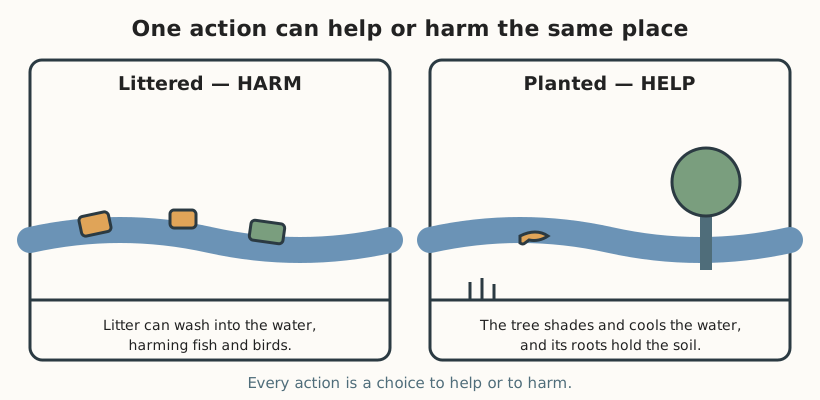
One small action can ripple through a whole place. Drop a wrapper by a stream, and rain may carry it into the water, where it can harm fish and birds. Plant a tree on the same bank, and its shade cools the water and its roots hold the soil, helping everything that lives there. People are part of the place, not separate from it — so every action, small as it looks, is a choice to help or to harm.
Materials
- Before-and-after picture pairs (littered vs. planted stream bank)
- A “help or harm” investigation sheet
- Paper and pencils
Preparation
- Prepare the picture pairs and captions naming who and what is helped or harmed.
- Prepare the investigation sheet: the action, what I observe, who or what is helped or harmed, what I would do instead or again.
- If you can and have permission, plan one real helping action (plant a seed, water a plant, or safely pick up litter with gloves or a stick).
Facilitator note
This lesson is written to the learner (“you”). Grade 2 followed litter to the right place; Grade 4 investigates how one action helps or harms a local place — a step toward stewardship with agency. Model the before-and-after comparison once, then guide learners to observe or recall a real local action before they record (Kirschner, Sweller & Clark, 2006). Keep it stewardship-framed and hope-full: the point is not to shame anyone for litter (people often lack bins, time, or systems) but to show that each of us has power to help — and that many small helps add up. Connect to the ecosystems lessons: an action that harms the water harms the fish, the birds, and the people downstream, because all parts depend on each other. Honor no-wealth and global contexts: caring actions need no money — planting a seed, sweeping a path, keeping trash out of a stream, watering a plant, telling others kindly — and people everywhere practice these. If the local reality is that trash has no bin to go to, say so plainly and without blame, and focus on what is possible. Honor every body: describe the pictures aloud for a learner who is blind or has low vision; a non-speaking learner points to help or harm and to who is affected; acting out the two actions works for learners who learn best by moving.
Procedure
- Gather (5 min). One small action can ripple through a whole place — for good or for harm. Today you investigate one.
- Compare help and harm (10 min). Look at the two pictures of the same stream bank. On the left, litter: rain can carry it into the water, harming fish and birds. On the right, a planted tree: its shade cools the water and its roots hold the soil, helping everything there. Name who and what each action helps or harms.
- Name effects together (8 min). With a partner, think of a second action — trampling a garden bed, or watering a dry plant. Say what you would observe, and who or what is helped or harmed.
- Investigate your own action (12 min). Choose one real action in a local place (or one you remember). Fill the sheet: the action, what I observe, who or what is helped or harmed, and what I would do instead or again.
- Share (5 min). Tell a partner your investigation. Did they see an effect you missed? Did you see one they missed?
- Close (5 min). You are part of the place. Every action is a choice to help or to harm — and helping is something you can do, starting today.
Differentiation
- Support: Complete one investigation together aloud using the frame “The action ___ helps/ harms ___, because ___.”
- Blind/low vision: Hear the pictures described and say help or harm and who is affected by voice; a partner scribes the sheet.
- Deaf/hard of hearing / non-speaking: Point to help or harm and to who or what is affected; the learner’s investigation may be drawn and labeled with pictures.
- Motor differences: Direct a partner’s hands to write and draw while the learner says or points to the action and its effects.
- Extension: Investigate a second action and propose one care action you could actually do, saying who it would help and how.
Assessment
- Formative (observation): Can the learner investigate how one human action helps or harms a local place, naming who or what is affected?
- Artifact (portfolio): The completed “help or harm” investigation sheet.
Home connection
In your own neighborhood or home, watch one human action and its effect — litter, a planted seed, a watered plant, a swept path. Tell a grown-up whether it helps or harms the place, and who or what is affected.
Resources
- National Geographic Education, “Ecosystem” — living and nonliving parts depend on each other, so one action (litter or planting) ripples through the whole place. https://education.nationalgeographic.org/resource/ecosystem/