Lesson 03 — Plan It, Try It, Adjust It
Learners move from a wish to a working plan: they set a real goal, write its steps, try the first step, notice what happened, and adjust the plan when a step does not work — learning that adjusting is part of reaching, not a sign of failing.
Objectives
Objectives
- D01.S3.04.01 Plan the steps to reach a goal, try the plan, and adjust when a step does not work.
Essential question
How do I plan the steps to reach a goal, try the plan, and adjust when a step does not work?
Key vocabulary
Materials
Standard materials
- A plan-try-adjust page · 1 per learner Three sections: "my plan" (steps), "what happened when I tried," and "my adjustment"
- Writing and drawing supplies · per learner
Low-tech / no-cost
- Voice and body Say the steps aloud, act out the try, and name the adjustment; no page needed
- Found objects (stones or sticks) Lay one object per step in a line, then move the last object to show the adjustment
Enriched / lab & device
- A class "try and adjust" chart · 1 A shared record where learners log a step that didn't work and the adjustment they made
- Timer or tablet stopwatch · 1 per group To time a practice try and a second try after adjustment
Works in different contexts
- large-group Model a plan-try-adjust cycle as a whole class (e.g., a class tidy routine), then learners plan their own
- self-directed A learner writes a plan, tries the first step, notes what happened, and writes one adjustment
- outdoor-only Use a real task outdoors (build a small stone tower, cross a marked space); try it, then adjust the plan once
- multi-age Older learners demonstrate a step that failed and how they adjusted, then coach younger learners
- level-grouped Learners ready to extend write a plan with three steps, try the first two, and record two adjustments
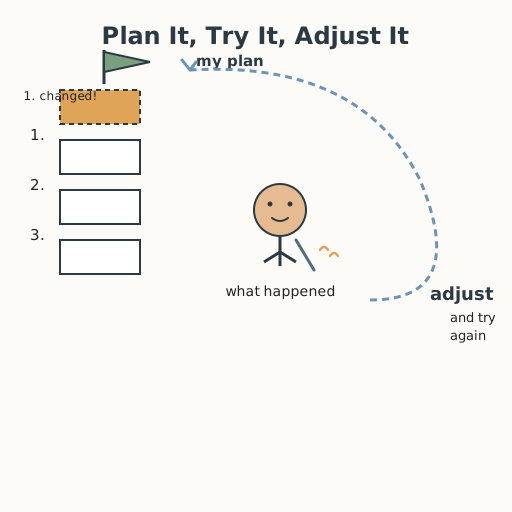
Lesson 3 — Plan It, Try It, Adjust It
Summary
A goal is not a promise to get everything right the first time — it is a plan you are willing to adjust. Learners set one real, reachable goal, break it into steps, try the first step right away, notice honestly what happened, and — when a step does not work — change it and try again. The “plan, try, adjust” page joins the portfolio and carries the year’s agency work forward into the summer and Grade 5.
Objectives
- Plan the steps to reach a goal, try the plan, and adjust when a step does not work. (D01.S3.04.01)
Connection
Every builder, cook, athlete, and gardener knows the same secret: the first plan is almost never the last plan. A cook tastes the soup and adds salt; a gardener sees a seedling leaning and turns it toward the light; a builder finds a wobbly stone and puts a wedge under it. The people who reach their goals are not the ones who never fail — they are the ones who adjust. Today you make a plan, try it, and learn the grown-up skill of changing course when a step doesn’t work.
Materials
- A “plan, try, adjust” page (plan / what happened / adjustment)
- Writing and drawing supplies
Preparation
- Prepare the page with three labeled sections: “my plan” (numbered steps), “what happened when I tried,” and “my adjustment.”
- Have writing and drawing supplies ready.
Facilitator note
This lesson is written to the learner (“you”). It spirals up from Grade 3’s “set a goal and name the first step” to the fuller cycle — plan, try, adjust. Two commitments matter. First, the adjustment is the lesson, not a failure: normalize it explicitly with your own example (“I planned to read every night, but evenings were too tired, so I moved it to mornings”). Second, the goal is the learner’s own and costs no money — some learners live with scarcity, so coach toward concrete, free, near goals (read one new book; learn a new knot; water the class plant for a week; greet three people kindly each day). Model the plan-try-adjust sequence as a worked example before independent work — this is a new procedural skill, and novices need to see it done (Kirschner, Sweller & Clark, 2006). Give the sentence frames: “My first step is…” / “When I tried, I noticed…” / “So I will change…”. For a learner who is blind or has low vision, do the cycle aloud or with objects in a line. For a non-speaking learner, accept pointing, drawing, signing, or a partner voicing. Keep the tone light: adjusting is clever, not shameful.
Procedure
- Gather (5 min). Last year you set a goal and its first step. This year you learn the next grown-up power: when a step doesn’t work, you adjust and try again.
- Watch a worked example (5 min). Watch or read this example together: Goal — learn to water the class plant without spilling. Plan — (1) fill the can halfway, (2) pour slowly near the stem. Try — the can was still too heavy and splashed. Adjust — (1) fill it one-quarter full and use two hands. See how the plan changed after trying?
- Set your goal and plan (10 min). Write one real goal on your page. Then write the steps, in order. Make the first step small enough to try today.
- Try it (10 min). Do the first step now — or, if the goal is for later (like “read one book”), do a tiny practice of it right now. Notice carefully: what actually happened? Write or draw it in the “what happened” section. Be honest, not harsh.
- Adjust (10 min). Look at what happened. If the step worked, write what you’ll do next. If it did not work, change it: make it smaller, get help, switch the order, use two hands. Write your adjustment.
- Share and promise (5 min). Tell a partner your plan, what happened, and your adjustment — and listen to theirs. Promise yourself: I will try my adjusted step.
- Close (5 min). Adjusting is not failing; it is how every goal is actually reached. Add your page to your portfolio.
Differentiation
- Support: Offer a menu of small, free goals with pre-written steps to choose from; scribe the “what happened” and “adjustment” lines.
- Support (non-speaking): Point to or act out each step; a partner voices the adjustment.
- Support (blind/low-vision): Lay one object per step in a line and move one to show the adjustment; the plan lives in words and objects.
- Extension: Write a three-step plan, try the first two steps, and record two adjustments over the week.
Assessment
- Formative (self + portfolio + observation): Can the learner state a goal, list ordered steps, describe honestly what happened on a try, and name one concrete adjustment — by word, drawing, sign, or a partner voicing?
Home connection
Take your plan home and do your adjusted step once before the next lesson. Tell someone how the adjustment changed what happened.
Resources
- Dweck, C. S. (2006). Mindset: The New Psychology of Success — growth through effort and adjustment (facilitator background).
- CASEL SEL Framework (self-management, responsible decision-making): https://casel.org/fundamentals-of-sel/