Lesson 02 — My Tradition, My Community
Learners name a family or cultural tradition, describe what it means, and trace how it connects them to a larger community — showing how the particular things we inherit link us to people beyond our own home.
Objectives
Objectives
- D01.S2.04.02 Describe a family or cultural tradition and how it connects them to a larger community.
Essential question
How does a family or cultural tradition connect me to a larger community?
Key vocabulary
Materials
Standard materials
- A tradition-and-its-threads page · 1 per learner A circle labeled "my tradition" with lines reaching out to a larger circle labeled "the larger community"
- Drawing and writing supplies · per learner
Low-tech / no-cost
- Voice and memory Tell a tradition aloud and trace its threads to the community in words; no page needed
- A stick or found object Stand for the tradition; name each person or group it connects you to as you hold it
Enriched / lab & device
- A family photo or a small object from home (with care and permission) · 1 per learner, optional A token of the tradition to show and explain
- Tablet or recorder · 1 per group Record each learner telling their tradition and its connection, to share with families
Works in different contexts
- large-group Build one shared class "tradition web" on the board first, then learners draw their own
- self-directed A learner completes the page alone and shares it with a trusted person at home
- outdoor-only Draw the two circles in the dirt or with stones, then stand in your tradition and name the threads
- multi-age Older learners share their tradition story first as a model, then younger learners tell theirs
- level-grouped Learners ready to extend compare two traditions and name what they have in common
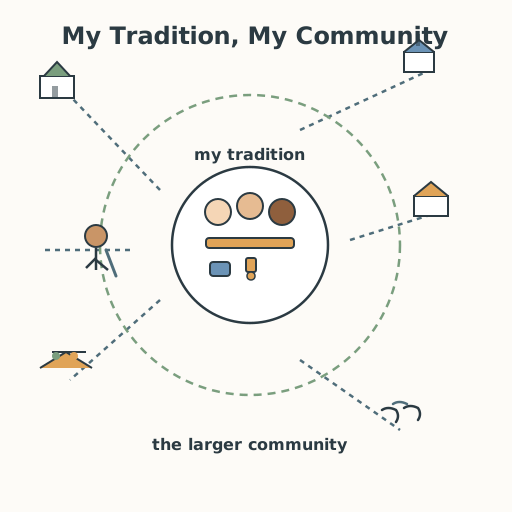
Lesson 2 — My Tradition, My Community
Summary
Every family and culture keeps things alive by passing them on — a food, a song, a holiday, a way of greeting, a way of caring for someone. Learners name one tradition that belongs to their family or culture, describe what it means to them, and then trace how it connects them to a larger community — the many people, near and far, who share or honor that same thread. The page joins the portfolio.
Objectives
- Describe a family or cultural tradition and how it connects them to a larger community. (D01.S2.04.02)
Connection
Think of a special meal, song, holiday, or way of showing respect that happens again and again in your family or culture. That is a tradition — something kept alive by being passed on. When you keep a tradition, you are never doing it alone: you are touching hands with grandparents, neighbors, and people in other towns or countries who keep the same thread. A single lantern, drumbeat, or shared plate can connect one home to a whole world. Today you trace your own thread and see how far it reaches.
Materials
- A “tradition and its threads” page (a center circle and a larger outer circle)
- Drawing and writing supplies
Preparation
- Prepare the two-circle page: a small center circle labeled “my tradition” and a larger surrounding circle labeled “the larger community,” with radiating lines.
- Have drawing and writing supplies ready.
Facilitator note
This lesson is written to the learner (“you”). Its commitment: every family shape and every culture is honored, and no tradition is “better” or “more real” than another. A learner’s family may be parents, one parent, grandparents, extended kin, guardians, foster or group care, a chosen circle, or a blended family — and “tradition” may be anything kept and passed on, from a holiday to a weekly meal to a way of remembering someone who has died. Handle adoption, loss, and mobility gently: a child who has moved or lost someone may hold a tradition that feels far away or painful — invite, never demand, and let “the tradition I carry in my heart” be a full answer. Some learners may have no family tradition they can name; a cultural tradition (a language, a greeting, a food of a place) is equally valid. Model the abstraction aloud: “a tradition connects me to a larger community when other people, beyond my own home, share or honor it.” For a learner who is blind or has low vision, describe the two circles aloud and trace the threads in words or on a raised line. For a non-speaking learner, accept a drawing, an object, signing, or a partner voicing. The goal is connection and belonging, not disclosure.
Procedure
- Gather (5 min). Traditions are the things people keep alive by passing them on. What do you already remember doing again and again with people you love?
- Meet the web (5 min). Look at your page. The center is your tradition; the outer ring is the larger community. The lines between them are the threads that connect one home to many people.
- Name your tradition (10 min). In the center, write or draw one tradition that is yours — a food, a song, a holiday, a greeting, a way of caring. What does it mean to you? Write or tell that, too.
- Trace the threads (10 min). Along the lines to the outer ring, write or draw the people who share or honor this tradition beyond your own home — relatives in another town, neighbors, a place of worship, people in another country, friends, a shop that sells its ingredients. How does it connect you to them?
- Share and listen (10 min). With a partner, tell your tradition and one thread it connects you to. Then listen to theirs. Notice: every home has a thread, and none is more important than another.
- Close (5 min). A tradition is a gift passed from hand to hand — and it reaches farther than you can see. Add your page to your portfolio.
Differentiation
- Support: Offer a menu of traditions (holiday, food, song, greeting, remembrance) to choose from; scribe the “what it means” line.
- Support (non-speaking): Show a drawing or object and point to its threads; a partner voices the connection.
- Support (blind/low-vision): Describe the tradition and its threads in words; trace the two circles tactually.
- Support (experienced loss or mobility): Honor “the tradition I carry in my heart”; a remembered tradition from a former home is a full answer.
- Extension: Compare two traditions — yours and a partner’s — and name one thing they share and one thing that is beautifully different.
Assessment
- Formative (portfolio + observation): Can the learner name a family or cultural tradition, say what it means, and name at least one person or group beyond their home it connects them to — by word, drawing, sign, or a partner voicing?
Home connection
Ask someone at home about the tradition you chose: who taught it to them, and who did they pass it on to? Bring one new thread back to share.
Resources
- UNESCO Intangible Cultural Heritage (how communities pass on traditions): https://ich.unesco.org/
- CASEL SEL Framework (social awareness): https://casel.org/fundamentals-of-sel/