Lesson 05 — Welcome In
Learners think as both newcomer and host: they imagine what it feels like to arrive new, identify concrete ways communities welcome newcomers, and explain why belonging matters — then plan a real welcome they can carry out.
Objectives
Objectives
- D02.S3.04.02 Describe how communities welcome newcomers and why belonging matters.
Essential question
How do communities welcome newcomers, and why does belonging matter?
Key vocabulary
Materials
Standard materials
- A welcome-plan page · 1 per learner A page to list three ways to welcome a newcomer and one reason belonging matters
- Writing and drawing supplies · per learner
Low-tech / no-cost
- Voice and body Say three welcome actions aloud and act out one; no page needed
- An open circle of seats or stones Physically open a space for a newcomer and name what that opening means
Enriched / lab & device
- A story or short video of a newcomer being welcomed · 1 A real example from the class's or region's context
- A class "welcome corner" to design · 1 A real, ongoing welcome practice the class creates and keeps
Works in different contexts
- large-group Act out a welcome as a whole class — one "newcomer" enters a circle that opens and greets them — then each learner writes a plan
- self-directed A learner writes three welcome actions and one reason belonging matters, then tries one with someone real
- outdoor-only Mark a circle on the ground, open it for a newcomer, and name what welcome looks and feels like
- multi-age Older learners who were once newcomers share what helped them; younger learners listen and add their own ideas
- level-grouped Learners ready to extend compare welcome practices across two cultures and explain why belonging matters for health
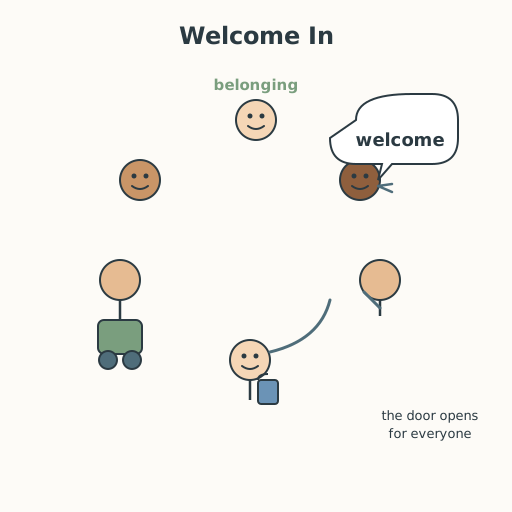
Lesson 5 — Welcome In
Summary
Everyone is a newcomer sometime — new to a school, a neighborhood, a city, a country. Learners feel their way into what that is like, name the concrete things communities do to welcome a newcomer (a greeting, a seat saved, a name learned and said correctly, a tour, an invitation to play), and explain why belonging matters — for the newcomer, and for the community that grows stronger when no one is left at the door. They write a welcome plan they can actually carry out.
Objectives
- Describe how communities welcome newcomers and why belonging matters. (D02.S3.04.02)
Connection
Remember a time you were new — a first day, a new place, a room where everyone else already knew the rules and each other. That feeling of standing at the edge is what a newcomer feels. And remember what made it better: someone said your name, saved you a seat, showed you where to put your things, invited you into the game. A welcome is a small door someone opens for you — and belonging is what it feels like on the other side. Today you learn to open that door for someone else.
Materials
- A “welcome plan” page (three welcome actions / one reason belonging matters)
- Writing and drawing supplies
Preparation
- Prepare the page with two sections: “three ways to welcome a newcomer” and “one reason belonging matters.”
- Have supplies ready.
Facilitator note
This lesson is written to the learner (“you”). Its commitment: belonging is a human
need, and welcoming is a skill everyone can learn and practice. Handle this gently —
some learners in the room are newcomers right now, or have been, and the topic is not
abstract for them. Never single anyone out or demand they tell their arrival story;
invite, and let a pass be a full answer. Frame “why belonging matters” with real, gentle
evidence rather than slogans: humans are social, and when people are included they feel
safer, learn better, and grow healthier, while exclusion hurts (see the evidence in
docs/contexts.md on relationships and belonging; for age-appropriate framing, use the
metaphor of warmth and safety, not clinical terms). Distinguish welcome as value (we
ought to include everyone) from welcome as fact (communities everywhere practice it —
a greeting, a shared meal, a naming). Keep the global lens: welcome looks different
across cultures (a bow, a handshake, a cup of tea, a song) and all are real welcomes.
For a learner who is blind or has low vision, describe the circle aloud and act the
welcome with voice and touch. For a non-speaking learner, accept drawing, signing,
pointing, or a partner voicing. Close on agency: belonging is something we build, not
something we wait for.
Procedure
- Gather (5 min). Everyone is a newcomer sometime. Think quietly: have you ever been new somewhere? You don’t have to say it aloud — just hold the feeling.
- Feel the edge (10 min). Form a circle. One volunteer stands just outside it as a “newcomer.” For a moment, the circle stays closed. What might that feel like? Now — open a space, reach out a hand, say “welcome,” learn and say their name. What changed?
- Name the welcome (10 min). Together, list concrete things communities do to welcome a newcomer: say hello and use their name correctly, save a seat, show them around, invite them to join a game or meal, ask what they like, be patient with what they don’t know yet. Welcomes look different in different places — a bow, a handshake, a cup of tea — but all say the same thing: you belong here.
- Write your welcome plan (10 min). On your page, write or draw three ways you could welcome a newcomer in your class or neighborhood. Make them real and doable.
- Say why belonging matters (5 min). Write or tell one reason belonging matters. Think: how does it feel to be included? What does a community gain when no one is left at the door? Belonging is warmth and safety — and a community grows stronger when everyone is inside.
- Share (5 min). Tell a partner your three welcomes and your reason — and listen to theirs. Pick one welcome you will actually do.
- Close (5 min). A welcome is a door you open for someone else. Add your page to your portfolio.
Differentiation
- Support: Offer a menu of welcome actions to choose from; scribe the “reason belonging matters” line.
- Support (non-speaking): Act out a welcome or point to a picture; a partner voices the plan.
- Support (blind/low-vision): Act the welcome with voice and touch; the plan lives in words.
- Extension: Compare welcome practices across two cultures and explain one more reason belonging matters — for learning, safety, or health.
Assessment
- Formative (portfolio + observation): Can the learner describe at least two concrete ways a community welcomes a newcomer and give one reason belonging matters — by word, drawing, sign, acting, or a partner voicing?
Home connection
This week, notice one person who might be at the edge — new, quiet, or left out — and do one thing from your welcome plan. Tell your class what you did.
Resources
- CASEL SEL Framework (social awareness, relationship skills): https://casel.org/fundamentals-of-sel/
- UNESCO, Learning to Live Together (belonging and inclusion across cultures): https://en.unesco.org/themes/learning-live-together