Lesson 06 — A Small Act of Care
Learners turn care from a feeling into an organized act: they plan a small, concrete act of care for a shared space or a neighbor — deciding what, where, who, and when — then carry it out and record it for the year-end celebration.
Objectives
Objectives
- D02.S4.04.01 Organize a small act of care, such as cleaning a shared space or helping a neighbor.
Essential question
How do I organize a small act of care, such as cleaning a shared space or helping a neighbor?
Key vocabulary
Materials
Standard materials
- A small-act-of-care plan sheet · 1 per learner Sections for what, where, who, when, and what we'll need
- Simple supplies for a class care act (cloth, bin, watering can) · as needed Whatever the chosen act of care requires
Low-tech / no-cost
- Hands, bodies, and found tools Clean with hands and found cloths; help with your own strength; no purchased supplies needed
- Voice Organize by talking through who does what; the plan lives in the speaking
Enriched / lab & device
- A class care log or journal · 1 A running record of acts of care the class organizes and completes
- A camera · 1 Document the act of care (with permission) for the celebration
Works in different contexts
- large-group Organize one shared act of care for the whole class (tidy a shared space), dividing tasks so everyone contributes
- self-directed A learner plans and carries out a solo act of care at home or in the neighborhood and records it
- outdoor-only Organize an outdoor act of care — clear a path, gather litter safely, water a shared plant
- multi-age Older learners organize and assign tasks; younger learners carry out small parts with support
- level-grouped Learners ready to extend write the full plan, lead the act, and reflect on what made it work
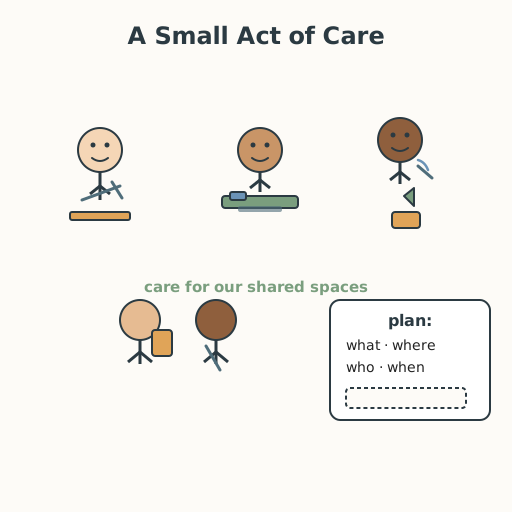
Lesson 6 — A Small Act of Care
Summary
Care is not only a warm feeling — it is something you organize and do. Learners plan a small, real act of care (clean a shared space, water a shared plant, help a neighbor) by deciding what, where, who, and when, then carry it out. The act is recorded and becomes a centerpiece of the closing celebration — proof that the class turned care into action.
Objectives
- Organize a small act of care, such as cleaning a shared space or helping a neighbor. (D02.S4.04.01)
Connection
Think of a place you share — a classroom, a path, a garden, a bus stop, a stairwell. When someone cares for it, everyone who uses it benefits; when no one does, everyone loses a little. Care is often a small act: a floor swept, a plant watered, a heavy bag carried, a litter-free path. Small acts, done together, add up to a community that takes care of itself. Today you don’t just feel like caring — you organize one small act and do it.
Materials
- A “small act of care” plan sheet (what / where / who / when / what we’ll need)
- Simple supplies for the chosen act (cloth, bin, watering can, etc.)
Preparation
- Prepare the plan sheet with the four questions: what will we do? where? who will help? when will we do it?
- Choose, with learners, one shared act of care the class can actually do this lesson, and have its simple supplies ready.
- Ensure safety: no task should involve unsafe heights, sharp objects, or hazardous waste; litter-gathering uses gloves or a safe tool.
Facilitator note
This lesson is written to the learner (“you”). It moves from planning (Lesson 3’s plan-try-adjust) and roles (Lesson 4) into organized care — the unit’s action heart. The commitment: care is organized, not random, and it serves the common good, not just ourselves. Choose an act that is real, free, and safe — tidying a shared space, watering a class plant, wiping tables, helping carry for a neighbor, clearing a path. Model the planning as a worked example first (what/where/who/when) before independent work, since organizing is a new procedural skill. Keep it egalitarian: every task within the act matters equally, and no one’s part is “more important” because it is more visible. Handle ability gently — find a part for every body (a learner with limited mobility can be the “checker” or “caller” who verifies each part is done). The “environment” lens is natural here: caring for a shared space is also caring for the living world. For a learner who is blind or has low vision, assign a part that uses touch, hearing, or verbal checking. For a non-speaking learner, accept acting, pointing, or a partner voicing the plan. Close by recording the act — the celebration (Lesson 7) will show what care looked like.
Procedure
- Gather (5 min). Care is a feeling and an action. What small ways have you seen people care for a shared space or a neighbor this year?
- Watch a worked example (5 min). Read or watch this plan together: What — tidy the reading corner. Where — our classroom. Who — Amara sorts books, Jo wipes the shelf, Mei sweeps. When — right after lunch today. See how “what, where, who, when” turns a wish into a plan?
- Plan your act (10 min). As a class (or on your own), choose one small act of care. On your plan sheet, fill in: what will we do? where? who will help (and what is each person’s part)? when will we do it? What will we need?
- Carry it out (20 min). Do the act of care together, each person doing their part. Notice how it feels to do care, not just plan it. Work safely and help each other.
- Reflect (5 min). Sit back and look at what you did. Ask: who benefits? The answer is everyone who uses this space or lives near it — including you. That is the common good.
- Record it (5 min). Write or draw what you did on your plan sheet — the act, and who it helped. This page will be shown at the celebration.
- Close (5 min). Small acts, done together, add up. You just made your community a little better. Add your page to your portfolio.
Differentiation
- Support: Offer a menu of safe, concrete care acts to choose from; pair learners so each has a clear, small part.
- Support (mobility/sensory): Assign a part that fits each body — checking, calling, sorting by touch, or counting what’s done.
- Support (non-speaking): Act out the part or point to it; a partner voices the reflection.
- Extension: Write the full plan, lead the act, and reflect on one thing that worked and one thing you’d change next time.
Assessment
- Formative (performance + portfolio + observation): Can the learner contribute a concrete part to a planned act of care (or plan a solo act with what/where/who/when) and carry it out — by doing, showing, signing, or a partner voicing?
Home connection
Choose one small act of care for a place you share at home or in your neighborhood this week — sweep, water, carry, clear — and do it. Tell your class what changed.
Resources
- CASEL SEL Framework (responsible decision-making): https://casel.org/fundamentals-of-sel/
- Putnam, R. D. (2000). Bowling Alone — shared spaces and community trust (facilitator background).