Lesson 01 — Thoughts Shape My Feelings
Learners discover that the same event can lead to very different feelings depending on the thought they have about it. Using a thought–feeling chain, they trace a real event to a thought and a feeling, and try swapping in a second thought to see how the feeling changes.
Objectives
Objectives
- D01.S1.05.01 Explain how thoughts, memories, and body sensations can shape a feeling.
Essential question
How can a thought change what I feel?
Key vocabulary
Materials
Standard materials
- Thought–feeling chain poster · 1 A poster showing event → thought → feeling with two different thoughts about the same event
- Blank thought–feeling chain page · 1 per learner A three-box frame (event, thought, feeling) for the learner to fill in
- Pencils · per learner
Low-tech / no-cost
- A stick or chalk drawn on the ground Draw three connected boxes in the dirt or sand and step from event to thought to feeling
- Voice and body Say an event, a thought, and a feeling aloud and act each out; no page needed
Enriched / lab & device
- Laminated thought–feeling chain strips · 1 per pair Reusable wipeable strips with dry-erase markers to build many event–thought–feeling chains
- A class 'thought detective' chart · 1 A shared chart where learners post an event, two different thoughts, and the two different feelings each leads to
Works in different contexts
- large-group Work one big example on the board together, calling out event, thought, and feeling; then learners do their own in small groups
- multi-age Younger learners name the feeling from a picture while older learners explain the thought that led to it and offer a second possible thought
- self-directed A learner fills the three-box chain for one real event of their own and reads it back to check it makes sense
- level-grouped Learners ready to extend write two different thoughts for the same event and compare the two feelings they produce
- outdoor-only Draw three boxes on the ground and walk the chain, saying the event, thought, and feeling aloud at each stop
Lesson 1 — Thoughts Shape My Feelings
Summary
Learners discover that a feeling is not caused only by what happens, but also by the thought they have about it. Using a thought–feeling chain (event → thought → feeling), they trace a real event of their own and then swap in a second thought to see how the feeling changes. This is the first of three “shapers” they will meet this unit: thoughts, memories, and body sensations.
Objectives
- Explain how thoughts, memories, and body sensations can shape a feeling. (D01.S1.05.01)
Connection
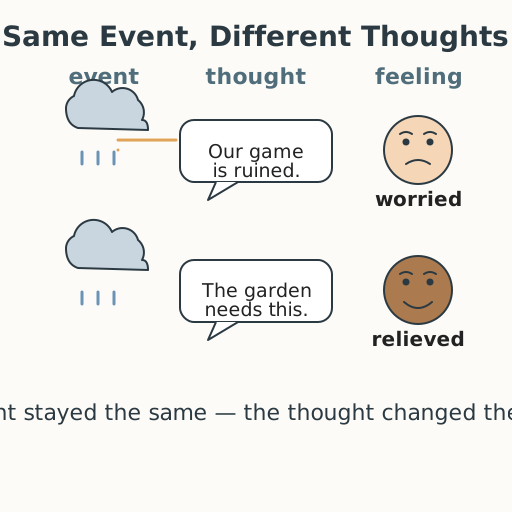
The same rain can fall on two neighbors and mean two different things. One thinks, “Our game is ruined,” and feels disappointed. The other thinks, “The garden needs this water,” and feels relieved. Same rain, different thoughts, different feelings. Whether you live in a busy city or on a mountain farm, the thoughts you carry about an event are part of what makes the feeling. Learning to notice your thoughts is like learning to read the weather inside you.
Materials
- Thought–feeling chain poster
- Blank thought–feeling chain page
- Pencils
Preparation
- Print or draw the thought–feeling chain poster (event → thought → feeling, with two different thoughts for the same event).
- Copy a blank chain page for each learner.
- Arrange a circle for gathering and a quiet space for individual work.
Facilitator note
This lesson is written to the learner (“you”). The one idea to land is that thoughts
are one shaper of feelings — not that a learner’s feelings are “wrong” or that they
should simply “think positive.” Present the second thought as another real way of
seeing the same event, never as the “correct” one. Some learners carry heavy events
(loss, illness, uncertainty); do not push them to reframe something that genuinely
hurts. The skill is noticing the thought, with gentleness. See docs/facilitation.md
on holding difficult topics safely.
Procedure
- Gather (5 min). Last year you learned that feelings have a strength — a little, some, or a lot. Today you learn something new: feelings are also shaped by the thoughts you have. The same event can feel very different depending on what you think about it.
- Meet the chain (10 min). Look at the poster. It shows a chain: event → thought → feeling. Here is a worked example. Event: it rains all afternoon. Thought one: “Our game is ruined.” Feeling one: disappointed. Now a second thought about the same event: “The garden needs this water.” Feeling two: relieved. Same event, two different thoughts, two different feelings. This is what “a thought shapes a feeling” means.
- Trace a real event (15 min). Think of one small, safe event from your week — a test, a game, a visit, a chore. On your chain page, fill the three boxes: what happened (event), what you told yourself about it (thought), and what you felt (feeling). Check it with a partner: does the chain make sense? Could the same event have led to a different thought for someone else?
- Swap the thought (10 min). Try a second, true thought about the same event — not a made-up one, but another real way of seeing it. Write it and the feeling it would lead to. Notice: the event stayed the same; your feeling shifted with the thought.
- Close (5 min). You are not ruled only by what happens to you — the thoughts you notice are part of the story too. Noticing them is the first step to understanding yourself.
Differentiation
- Support: Offer event picture cards and a word bank of thoughts and feelings to arrange into a chain; scribe the learner’s words.
- Extension: Trace a second event where a thought intensified a feeling, and explore what thought might soften it, without judging either as wrong.
Assessment
- Formative (observation): Can the learner state an event, a thought, and the feeling it produced, and suggest a second thought that would change the feeling?
- Self-check: The learner reads their chain back and asks, “Is this really what I thought and felt?” and adjusts if not.
Home connection
Ask someone at home about a time the same event meant something different to two people — and share one thought that changed your own feeling today.
Resources
- Cognitive appraisal — the idea that how we interpret an event shapes our emotion — traces to the work of psychologist Aaron Beck and cognitive-behavioral research. For an accessible classroom framing, see CASEL’s self-awareness competency: https://casel.org/fundamentals-of-sel/