Lesson 02 — Memories and My Body Shape a Feeling
Learners meet two more "shapers" of feeling: memory and body sensation. They trace how a remembered moment can bring a feeling back, and how a body sensation — a warm chest, a tight stomach, loose shoulders — can signal and shape what they feel. They complete a memory–body–feeling frame for a real experience of their own.
Objectives
Objectives
- D01.S1.05.01 Explain how thoughts, memories, and body sensations can shape a feeling.
Essential question
How do a memory and my body help shape what I feel?
Key vocabulary
Materials
Standard materials
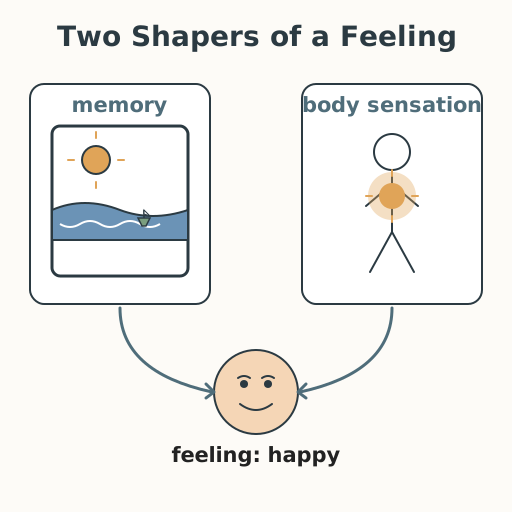
- Memory–body–feeling poster · 1 A poster showing a memory and a body sensation each feeding into a feeling
- Blank memory–body–feeling page · 1 per learner A three-part frame (memory, body sensation, feeling) for the learner to complete
- Pencils and crayons · per learner
Low-tech / no-cost
- Paper and a shared memory object Hold a familiar object (a food, a scent, a sound) to spark a memory; name the body feeling it brings, no poster needed
- Voice and body Tell a memory aloud and point to where it shows up in the body (warm chest, tight tummy, loose shoulders)
Enriched / lab & device
- A classroom 'memory jar' · 1 A jar where learners write small memory slips; pull one and name the body sensation and feeling it stirs
- A tablet or camera · 1 per group To record a short 'this memory feels like this in my body' clip for a class feelings gallery
Works in different contexts
- large-group Share one memory as a whole group, then have everyone silently scan their body and point to where the feeling sits before sharing aloud
- multi-age Younger learners act out a body sensation (shiver, warm smile) while older learners name the memory and feeling behind it
- self-directed A learner recalls one memory, writes the body sensation it brings, and names the feeling, reading it back to check
- level-grouped Learners ready to extend trace two memories — one that warms and one that tightens — and compare the two body signals
- outdoor-only Find a natural object or smell outdoors (a leaf, rain smell, bread from a market) and notice the memory and body feeling it stirs
Lesson 2 — Memories and My Body Shape a Feeling
Summary
Learners meet two more shapers of feeling: memory and body sensation. A memory can bring a feeling back even when nothing is happening right now, and a body sensation — a warm chest, a tight stomach, loose shoulders — can signal and shape what we feel. Learners complete a memory–body–feeling frame for a real experience and notice where feelings live in their own bodies.
Objectives
- Explain how thoughts, memories, and body sensations can shape a feeling. (D01.S1.05.01)
Connection
Have you ever smelled a certain food and suddenly felt happy or homesick — even before you remembered why? That is a memory shaping a feeling. Or have you felt your shoulders tighten and only then realized you were nervous? That is your body shaping a feeling. Whether the memory is of a harvest festival, a market street, or a grandmother’s kitchen, and whether your body speaks in a flutter or a warmth, these signals are part of how feelings come to be — everywhere in the world.
Materials
- Memory–body–feeling poster
- Blank memory–body–feeling page
- Pencils and crayons
Preparation
- Print or draw the memory–body–feeling poster (a memory and a body sensation, each feeding into a feeling).
- Copy a blank memory–body–feeling page for each learner.
- Arrange a circle and a quiet space; prepare a shared memory object if using one.
Facilitator note
This lesson is written to the learner (“you”). The idea to land is that memory and body
are two more shapers of feeling, alongside the thoughts met in Lesson 1. Invite a
range of memories — joyful and tender — but let each learner choose a safe one to
share; memories can touch loss, and a learner’s right to keep a memory private must be
protected. Model your own example first, and keep it ordinary. Watch for learners who
reveal a heavy memory; honor it calmly and move gently, never pressing for detail. See
docs/facilitation.md on holding difficult topics safely.
Procedure
- Gather (5 min). Last time you met the first shaper of feeling: thoughts. An event plus a thought makes a feeling. Today you meet two more shapers: memory and body sensation.
- Meet the two shapers (10 min). Look at the poster. Two arrows point into one feeling. First, a memory: a remembered day can bring a feeling back right now, even though nothing is happening. Second, a body sensation: your body speaks a feeling before you have the words — a warm chest, a tight stomach, loose shoulders. Worked example: the smell of bread from a grandmother’s kitchen (memory) plus a warm, soft feeling in the chest (body) together shape the feeling safe and loved.
- Scan your body (10 min). Close your eyes or soften your gaze. Slowly scan from head to toe. Where is there a sensation — warm, tight, fluttery, heavy, light? Name it without judging it. Share one with a partner: “I notice a flutter in my stomach.”
- Build your frame (15 min). On your page, draw or write one safe memory of your own. Beside it, draw or write the body sensation it brings. Then name the feeling the two of them shape together. Color the body spot where it lives.
- Close (5 min). Your thoughts, your memories, and your body all shape what you feel. Noticing all three — together — is a powerful way to know yourself.
Differentiation
- Support: Provide a memory word bank and a simple body outline to color the sensation spot instead of writing; scribe the feeling name.
- Extension: Trace two memories — one that warms and one that tightens — and compare how the body signal differs for each feeling.
Assessment
- Formative (observation): Can the learner name a memory, a body sensation, and the feeling they shape together?
- Self-check: The learner points to the body spot and checks, “Is this truly where and how that feeling shows up for me?”
Home connection
With someone at home, name one memory and the body sensation it brings — and ask them for one of theirs.
Resources
- The body’s role in emotion is studied in the field of “embodied emotion”; for a classroom-friendly summary of body awareness, see CASEL’s self-awareness competency: https://casel.org/fundamentals-of-sel/