Lesson 04 — How Cultures and Situations Shape Feeling Expression
Learners widen their view from families to cultures and situations. They explore respectful greetings from around the world and discover that *where* and *when* a feeling happens shapes how it is shown — a joy is danced at a festival and held quietly at a ceremony. They complete a two-situation comparison for one feeling, holding every custom as worthy of respect and none as "better."
Objectives
Objectives
- D01.S1.05.02 Compare how feelings are expressed in different families, cultures, and situations.
Essential question
How do culture and situation change how a feeling is shown?
Key vocabulary
Materials
Standard materials
- Greetings-around-the-world cards · 1 set Cards showing different respectful greetings — a bow, a handshake, a hug, a raised hand, a nod
- Blank situation–expression page · 1 per learner A two-column page with one feeling, two situations, and two different ways of showing it
- Pencils · per learner
Low-tech / no-cost
- Role-play with voice and body Practice several greetings and a few 'ceremony vs playground' ways of showing a feeling; no cards needed
- Spoken examples from learners' own cultures Invite learners to share a respectful greeting or a customary way of showing feeling from home
Enriched / lab & device
- A world map and greeting cards · 1 A map where learners place each greeting card near a place it is used, building a global picture of respectful customs
- Short respectful video clips · 1 set Brief clips (if available and respectful) showing greetings and ceremony customs from several cultures
Works in different contexts
- large-group Practice greetings around the circle, then chart on the board how the *same* feeling (joy, grief, respect) looks different at a ceremony and on a playground
- multi-age Younger learners copy a greeting gesture while older learners explain the situation where it fits and why it shows respect
- self-directed A learner fills the two-column page for one feeling across two situations and writes one sentence comparing the two ways
- level-grouped Learners ready to extend research or recall a third culture's greeting or custom and add it to the comparison
- outdoor-only Practice greetings in an open space and discuss how place and occasion shape which greeting fits; no paper needed
Lesson 4 — How Cultures and Situations Shape Feeling Expression
Summary
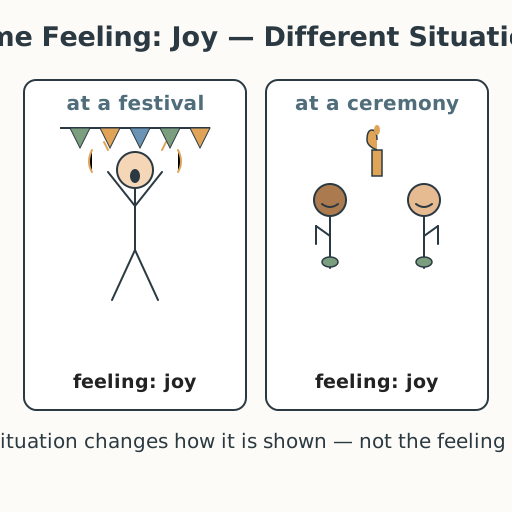
Learners widen the view from families to cultures and situations. They explore respectful greetings from around the world — a bow, a handshake, a hug, a raised hand, a nod — and discover that where and when a feeling happens shapes how it is shown. The same joy is danced at a festival and held quietly at a ceremony. Learners complete a two-situation comparison for one feeling, always holding every custom as worthy of respect and none as “better.”
Objectives
- Compare how feelings are expressed in different families, cultures, and situations. (D01.S1.05.02)
Connection
Think of a single feeling — joy. At a festival you might dance, shout, and throw your arms wide. At a quiet ceremony for someone important, that same joy might be shown with a small smile and folded hands. Same feeling, different situation, different expression. Around the world, people also greet each other in many respectful ways — a bow, a handshake, a raised hand to the heart. Every custom makes sense in its own place. Knowing this helps you meet people unlike yourself with curiosity and respect, not judgment.
Materials
- Greetings-around-the-world cards
- Blank situation–expression page
- Pencils
Preparation
- Print or draw the greetings-around-the-world cards (bow, handshake, hug, raised hand, nod).
- Copy a blank situation–expression page for each learner.
- Arrange a circle with room to practice gestures.
Facilitator note
This lesson is written to the learner (“you”). The idea to land is non-ranking
comparison across cultures and situations. This is a place where stereotypes can slip
in (“those people are loud,” “those people hide their feelings”) — model instead a
posture of wonder: “In this place, that custom shows respect.” If a learner offers a
custom from their own culture, receive it warmly and let them be the authority on its
meaning; never correct a learner about their own culture. Distinguish how a feeling is
shown from whether it is felt — the feeling is real in every case. See
docs/facilitation.md on honoring cultural contexts without ranking.
Procedure
- Gather (5 min). Last time you saw that different families show the same feeling in different ways. Today the view gets wider: different cultures and different situations shape how a feeling is shown — and every way deserves respect.
- Meet the greetings (10 min). Look at the cards: a bow, a handshake, a hug, a raised hand to the heart, a nod. Each is a respectful way to greet someone, from a different part of the world. Practice each one gently. Think: in what situation would each fit? Why might a person bow in one place and shake hands in another? (Both show respect — the form differs.)
- Same feeling, two situations (15 min). Here is a worked example. Feeling: joy. Situation one: a festival — people dance and cheer. Situation two: a solemn ceremony — the same joy is shown with a small smile and quiet hands. Now choose your own feeling — joy, sadness, or respect. On your page, draw or write one feeling, two situations, and two different ways of showing it.
- Compare with a partner (10 min). Share your page. Ask: is the feeling real in both situations? (Yes.) Does the situation change only how it is shown? (Yes.) Did anyone judge another way as “wrong”? Catch it if so — and gently reframe it as “just different.”
- Close (5 min). The same heart can show itself in a hundred ways, each fitting its own place and moment. Meeting those ways with respect is how we make room for one another.
Differentiation
- Support: Offer a set of illustrated “ways to show it” to sort into the two situations rather than drawing; scribe the one-sentence comparison.
- Extension: Add a third situation for the same feeling, or recall a second culture’s greeting and explain the situation where it belongs.
Assessment
- Formative (observation): Can the learner describe how one feeling is shown differently across two situations or cultures, without ranking one as better?
- Self-check: The learner rereads their comparison and checks that it names the feeling as real in both situations.
Home connection
Ask a family member or neighbor about a respectful greeting or custom from a culture they know, and try learning to show it.
Resources
- Cross-cultural differences in expressing feeling are studied as “display rules” (Ekman & Friesen, 1969). For a classroom-friendly framing of curiosity and respect, see CASEL’s social-awareness competency: https://casel.org/fundamentals-of-sel/