Lesson 03 — How Different Families Show Feelings
Learners discover that the same feeling can be shown in many different ways from one family to the next — a loud hug, a quiet smile, a song. They compare how three families express one feeling, then draw or tell how their own family shows joy and sadness, learning that no family's way is "better" than another's.
Objectives
Objectives
- D01.S1.05.02 Compare how feelings are expressed in different families, cultures, and situations.
Essential question
How can the same feeling be shown differently in different families?
Key vocabulary
Materials
Standard materials
- Family expression cards · 1 set Cards showing three different families expressing the same feeling in different ways
- Blank 'my family shows it this way' page · 1 per learner A page with one feeling and space to draw or write how the learner's own family shows it
- Pencils and crayons · per learner
Low-tech / no-cost
- Role-play with voice and body Act out three ways to show one feeling (a big hug, a quiet smile, a song); no cards needed
- A shared family photo or story Each learner tells how their own family shows a feeling, using just their words
Enriched / lab & device
- Laminated family expression cards · 1 set per pair Durable cards for sorting, matching, and comparing family expression styles
- A class 'ways we show it' gallery · 1 A shared wall where learners post drawings of how their family expresses joy, sadness, and love
Works in different contexts
- large-group Show one feeling and collect every family's way of showing it on a shared list; celebrate how many ways there are, without ranking any
- multi-age Younger learners mime one way their family shows a feeling; older learners describe and compare two ways, always framing differences as equally valid
- self-directed A learner fills the page for two feelings — joy and sadness — and writes how their own family shows each
- level-grouped Learners ready to extend compare the *same* family across two different situations (a celebration vs a goodbye) and note how expression changes
- outdoor-only Form a circle and pass a spoken 'family way' around — each learner names or acts one way their family shows a feeling; no paper needed
Lesson 3 — How Different Families Show Feelings
Summary
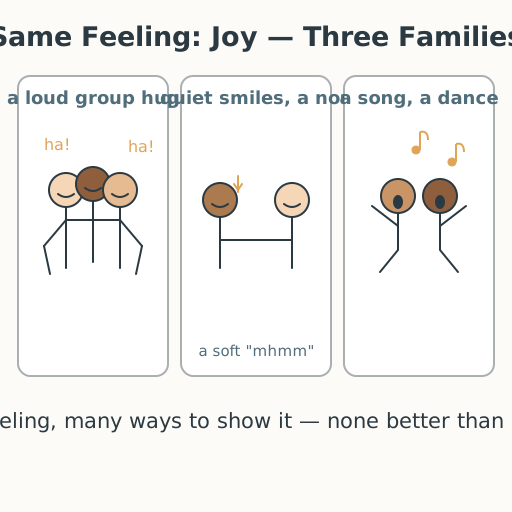
Learners discover that the same feeling can be shown in many different ways from one family to the next. One family greets a joy with a loud group hug; another shows it with quiet smiles; a third breaks into song. Learners compare three families’ ways of showing one feeling, then draw or tell how their own family shows joy and sadness — always holding that no family’s way is better than another’s.
Objectives
- Compare how feelings are expressed in different families, cultures, and situations. (D01.S1.05.02)
Connection
When a good thing happens, one family cheers and hugs; another family smiles quietly and says a kind word; another sings. All three feel the same joy — they just show it differently. The same is true for sadness, pride, and love. Whether your family is big or small, here or far away, its way of showing feeling is real and worth honoring — and so is everyone else’s.
Materials
- Family expression cards
- Blank “my family shows it this way” page
- Pencils and crayons
Preparation
- Print or draw the family expression cards (three families, one shared feeling, three ways of showing it).
- Copy a “my family shows it this way” page for each learner.
- Arrange a circle for sharing; keep the tone warm and non-judging.
Facilitator note
This lesson is written to the learner (“you”). The one idea to land is non-ranking
comparison: differences in how families show feelings are real and equal, never
“better” or “worse,” “right” or “wrong.” Guard against any ranking language (“too loud,”
“too quiet,” “weird”). Learners come from many family shapes — two parents, one parent,
grandparents, adoptive or chosen family, foster care, and more. Frame “family” as
“the people who care for you.” Never ask a learner to justify or explain a family
difference they do not wish to share. See docs/facilitation.md on honoring every
family’s shape.
Procedure
- Gather (5 min). You have met three shapers of feeling: thoughts, memories, and your body. Today a new question: when you have a feeling, how do you show it? Here is the surprise — people show the same feeling in very different ways.
- Meet three families (10 min). Look at the cards. Each shows a family with a big happy event — a new baby, a harvest, a good exam result. Family one: a loud group hug. Family two: quiet smiles and a gentle nod. Family three: a song and a dance. Same feeling — joy — shown three different ways. Which way feels most like your family? There is no wrong answer.
- Compare (10 min). With a partner, look at one more feeling — sadness. Talk: how might each of these three families show sadness? Some cry, some go quiet, some gather close and cook together. Notice: all of them are feeling sadness, just showing it differently. No way is better.
- Your family’s way (15 min). On your page, choose one feeling — joy or sadness. Draw or write how your family shows it. If you have more than one family or caregiver, show both. Then write one sentence: “My family shows joy by…”
- Close (5 min). Feelings are shared by everyone; the ways we show them are our own. Learning to see and honor different ways is a kindness you can carry everywhere.
Differentiation
- Support: Offer a set of three illustrated “ways to show it” (hug, quiet smile, song) to choose from rather than drawing from scratch; scribe the sentence.
- Extension: Compare the same family across two situations — a celebration and a goodbye — and describe how the expression changes while the feeling stays real.
Assessment
- Formative (observation): Can the learner name one feeling and describe two different, equally valid ways families might show it?
- Self-check: The learner checks that they described their own family’s way without calling any other family’s way “wrong.”
Home connection
Ask a family member how their family showed joy or sadness when they were young — and notice how it is alike or different from how you show it now.
Resources
- The idea that feeling-expression differs across families and cultures is studied as “display rules” in emotion research (Paul Ekman and colleagues). For a classroom-friendly SEL framing, see CASEL’s social-awareness competency: https://casel.org/fundamentals-of-sel/