Lesson 09 — Watching My Focus: What Helps and What Hurts
Learners practice monitoring their own attention during a real task. They learn that focus has helpers (quiet, a plan, water, a break) and hurts (noise, hunger, a ringing phone, a wandering thought), and they stop at checkpoints to notice where their attention has gone and name what helped or hurt it — turning awareness into a tool they can use.
Objectives
Objectives
- D01.S3.05.01 Monitor their own behavior and feelings during a task and name what helped or hurt their focus.
Essential question
During a task, how do I notice what helps my focus and what hurts it?
Key vocabulary
Materials
Standard materials
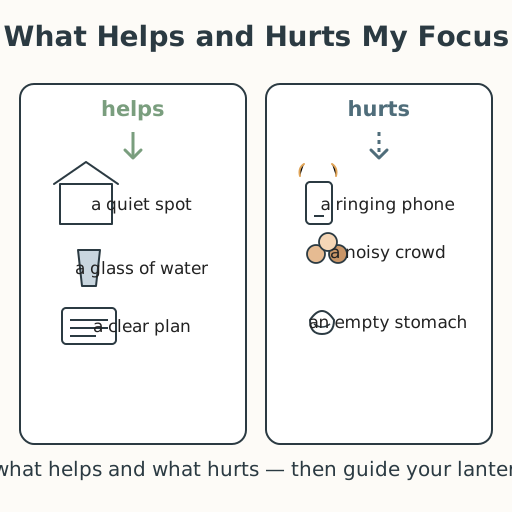
- Focus monitor chart · 1 A two-column chart — 'what helps my focus' and 'what hurts my focus' — with picture prompts
- Blank focus-monitor page · 1 per learner A page with space to record, during a short task, what helped and what hurt focus
- A short, quiet task · 1 A simple 10-minute task (sorting, drawing, a word puzzle, a reading) to practice monitoring focus
Low-tech / no-cost
- A two-column list on the ground or board Draw two columns and add to them aloud; no printed chart needed
- A focus pause signal A clap or a raised hand as a signal to stop and notice where attention has wandered, then name it
Enriched / lab & device
- A focus timer with a gentle chime · 1 per group A timer set for short intervals so learners can pause and record focus at checkpoints
- A personal focus journal · 1 per learner A notebook to track focus patterns across the week and name personal helpers and hurts
Works in different contexts
- large-group Run one shared task with a timer, pausing the whole group at checkpoints to name where attention went; chart helpers and hurts together
- multi-age Older learners self-monitor with a timer while younger learners use a simple red/green 'on task / wandered' card held up at checkpoints
- self-directed A learner chooses a task, sets checkpoints, and records at each one what helped or hurt their focus, then names their top helper and top distractor
- level-grouped Learners ready to extend design a short 'focus plan' — removing one distraction and adding one helper — and try it immediately
- outdoor-only Choose a task that can be done outdoors (sorting leaves, counting steps, a memory walk); pause at checkpoints to name what outdoors helped or hurt focus
Lesson 9 — Watching My Focus: What Helps and What Hurts
Summary
Learners practice monitoring their own attention during a real task. They learn that focus has helpers (quiet, a plan, water, a short break) and hurts (noise, hunger, a ringing phone, a wandering thought), and they stop at checkpoints to notice where their attention has gone and name what helped or hurt it — turning self-awareness into a tool they can use for the rest of their learning.
Objectives
- Monitor their own behavior and feelings during a task and name what helped or hurt their focus. (D01.S3.05.01)
Connection
You sit down to a task, and for a while your mind is right there — and then it is not. Maybe a phone buzzes, maybe your stomach is empty, maybe the room is loud, or maybe a worry tugs at you. Some of those things help your focus (a quiet corner, a clear plan, a glass of water) and some hurt it (noise, hunger, interruptions, tiredness). Learning to notice which is which — in a classroom, at a market stall, or under a tree — is a skill you can use everywhere, for your whole life.
Materials
- Focus monitor chart
- Blank focus-monitor page
- A short, quiet task
Preparation
- Print or draw the focus monitor chart (two columns: helps / hurts, with picture prompts).
- Copy a focus-monitor page for each learner.
- Choose a simple 10-minute task all learners can do, and prepare checkpoint signals.
Facilitator note
This lesson is written to the learner (“you”). The idea to land is monitoring, not
judging: learners notice where attention goes and name helpers and hurts, without being
called “lazy” or “unfocused.” Normalize wandering attention — everyone’s mind wanders;
the skill is noticing and returning. Include bodily hurts (hunger, thirst, tiredness)
alongside environmental ones (noise, devices) — many learners cannot remove a hunger or a
noisy home, and the goal is naming what affects them, not blaming them for it. The
technology lens invites a real question: when do devices help focus, and when do they
hurt it? Let learners answer from their own experience. See docs/contexts.md on
self-paced, low-tech structures.
Procedure
- Gather (5 min). You have grown your skills all unit — noticing thoughts, memories, bodies, values, and identity. Now a skill for doing: noticing your own focus.
- Meet helps and hurts (10 min). Look at the chart. Two columns: what helps my focus (a quiet spot, a clear plan, a glass of water, a short break) and what hurts it (noise, hunger, a ringing phone, tiredness, a wandering worry). Some of these you can change; some you can only notice and work around. Naming them is the first step.
- Try a task and watch (20 min). Begin the short task. Every few minutes, at the signal, pause and ask yourself: Where is my attention right now? What helped it stay? What pulled it away? Jot one word on your focus-monitor page. Then return to the task. Repeat until the task is done.
- Name your helpers and hurts (10 min). Look at your page. Which things appeared in the “helped” column? Which in the “hurt” column? Write or say your top helper and your top distractor. With a partner, share one thing you could change to help your own focus next time.
- Close (5 min). Your attention is like a lantern — it swings. Noticing where it swings, without blaming yourself, is how you learn to guide it back.
Differentiation
- Support: Use a two-card signal (green “on task” / red “wandered”) at checkpoints instead of writing; scribe the top helper and distractor.
- Extension: Design a short “focus plan” — remove one distraction, add one helper — and try it on the spot, then note any difference.
Assessment
- Formative (observation): Can the learner, after a task, name at least one thing that helped and one that hurt their focus?
- Self-check: The learner compares their page to what actually happened and asks, “Did I name it truthfully?” and adjusts.
Home connection
Try a short task at home and notice one helper and one hurt — then share them with someone.
Resources
- Attention monitoring and metacognition are well-studied in learning science; for a classroom-friendly summary, see CASEL’s self-management competency: https://casel.org/fundamentals-of-sel/