Lesson 10 — Owning My Choices and Making It Right
In this capstone lesson, learners learn that when a choice affects someone else, they can take responsibility without shame: name the choice, notice its effect, and make a repair plus a better next step. They work through a choice–effect–repair frame, rehearse a repair in role-play, and connect the skill back to the thoughts and values they have studied all unit — closing the unit with agency and hope.
Objectives
Objectives
- D01.S3.05.02 Take responsibility for a choice and its effects on others, and name a better next step.
- D01.S1.05.01 Explain how thoughts, memories, and body sensations can shape a feeling.
- D01.S2.05.01 Name values they care about, such as fairness, honesty, and kindness, and give an example of living by one.
Essential question
When my choice affects someone else, how do I take responsibility and make a better next step?
Key vocabulary
Materials
Standard materials
- Choice–effect–repair poster · 1 A poster showing a three-step path of choice, its effect on someone, and a repair plus a better next step
- Blank choice–effect–repair page · 1 per learner A page with three boxes — choice, effect, repair/next step — for the learner to complete
- Pencils · per learner
Low-tech / no-cost
- A three-step path drawn on the ground Draw three stepping stones — choice, effect, repair — and step through them aloud; no page needed
- Role-play a repair In pairs, act out a small mistake, an honest "I did it, and I'm sorry," and a concrete repair; no poster needed
Enriched / lab & device
- Laminated choice–effect–repair strips · 1 per pair Reusable strips with dry-erase markers to rehearse many repair scenarios
- A class 'we repair, not just punish' circle · 1 A standing circle practice where the group names a harm, the effect, and a repair together, building shared norms
Works in different contexts
- large-group Model one worked example together, then have small groups rehearse a repair in role-play and share out one better next step each
- multi-age Older learners role-play the full repair while younger learners name the feeling of the person who was hurt and offer a kind word
- self-directed A learner works through the three boxes for a real (small, safe) mistake of their own and writes the repair and a better next step
- level-grouped Learners ready to extend distinguish 'repair' from 'only saying sorry' and write why a repair plus a changed next step matters more
- outdoor-only Step along a three-stone path — choice, effect, repair — speaking each aloud for a small real or imagined mistake; no paper needed
Lesson 10 — Owning My Choices and Making It Right
Summary
In this capstone lesson, learners learn that when a choice affects someone else, they can take responsibility without shame: name the choice, notice its effect, and make a repair plus a better next step. They work through a choice–effect–repair frame, rehearse a repair in role-play, and connect the skill back to the thoughts (Lesson 1) and values (Lessons 5–6) they have studied all unit — closing the unit with agency and hope.
Objectives
- Take responsibility for a choice and its effects on others, and name a better next step. (D01.S3.05.02)
- Explain how thoughts, memories, and body sensations can shape a feeling. (D01.S1.05.01)
- Name values they care about, such as fairness, honesty, and kindness, and give an example of living by one. (D01.S2.05.01)
Connection
Everyone makes a choice that hurts someone, sooner or later — a sharp word, a broken promise, a spill that ruins a friend’s work. The question is not “Am I a bad person?” but “What can I do now?” You can own it — “I did that” — notice the effect — “and it hurt you” — and repair it — “let me make it right.” A person who can do that is not weak; they are strong, and trustworthy. This is true in a village, a city, or anywhere people live together.
Materials
- Choice–effect–repair poster
- Blank choice–effect–repair page
- Pencils
Preparation
- Print or draw the choice–effect–repair poster (three stepping stones: choice, effect, repair + next step).
- Copy a choice–effect–repair page for each learner.
- Arrange a circle and space for paired role-play.
Facilitator note
This lesson is written to the learner (“you”). The idea to land is accountability plus
repair, never shame — the learner is never a “bad kid”; a choice can be changed and a
harm can be repaired. Use a non-shaming frame throughout: name the behavior, not the
person (“that choice hurt someone,” never “you are bad”). Model repair as strength, not
weakness, and let the worked example show the feeling behind the choice (a thought
shaping a feeling, from Lesson 1) so learners see the full picture, not a villain. Some
learners live where “responsibility” has meant punishment; gently distinguish
accountability (facing the truth and repairing) from shame (being told you are
wrong as a person). See docs/facilitation.md on assessing without ranking and holding
difficult topics safely.
Procedure
- Gather (5 min). This is your capstone. All unit you have learned how feelings are shaped, how they are shown, what you value, and what shapes you. Today, the grown-up skill that ties it together: owning a choice and making it right.
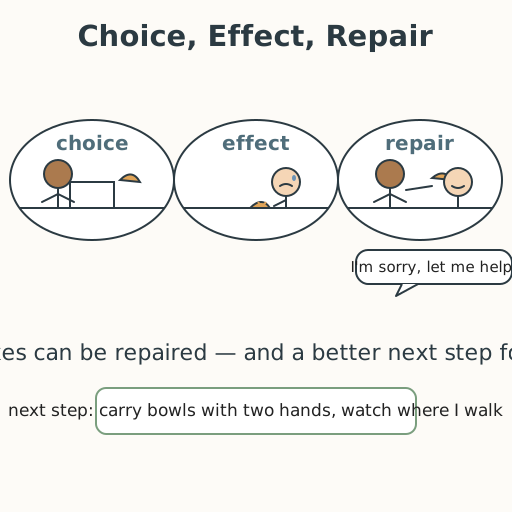
- Meet the three stones (10 min). Look at the poster: three stepping stones. Choice — what you did. Effect — how it touched someone else. Repair — how you make it right, plus a better next step. Worked example: a child bumps the table and spills a friend’s bowl. Choice: I bumped the table. Effect: my friend’s food spilled, and she felt upset — maybe the thought “why did you do that?” was shaping her feeling (remember Lesson 1). Repair: I say, “I did that. I’m sorry. Let me help you clean it and share some of mine.” Better next step: I will carry bowls with two hands and watch where I walk. Notice: the child is not “bad” — the choice is fixed, not the child.
- Rehearse a repair (15 min). With a partner, act out a small, safe mistake and its repair. Use the honest words: “I did it. I’m sorry. How can I make it right?” Take turns being the one who repairs and the one who hears it. Notice how a real repair feels different from only a quick “sorry.”
- Write your own (15 min). On your page, fill the three boxes for a small, real (or imagined) choice of your own. Connect it to a value: which of your values — honesty, kindness, fairness — does the repair live by? Write the better next step you will actually take.
- Close (5 min). Mistakes are not the end of the story; they are the beginning of a repair. You can own a choice, care for the effect, and choose better next time. That is how a growing person grows.
Differentiation
- Support: Provide three picture cards (a spill, a sharp word, a broken promise) to choose from and sentence starters (“I did ___, it made you feel ___, I will ___”); scribe as needed.
- Extension: Write two repairs — one small and one bigger — and name what a real repair needs that a quick “sorry” alone does not.
Assessment
- Formative (performance): In role-play, can the learner name the choice, its effect, and a concrete repair plus a better next step, without shaming language?
- Self-check: The learner rereads their page and checks that their next step is real and doable, and that they framed the behavior (not themselves) as the thing to change.
Home connection
If a small thing goes wrong at home this week, practice the three stones — choice, effect, repair — and notice how the repair changes the day.
Resources
- Repair over punishment echoes restorative practice, which emphasizes accountability and making things right rather than shame (see the work of Howard Zehr and restorative justice in schools). For classroom SEL framing, see CASEL’s responsible-decision-making competency: https://casel.org/fundamentals-of-sel/