Lesson 02 — Using Feedback to Improve Shared Work
Learners take the next step from Lesson 1: using kind feedback to actually improve shared work. They meet a before-and-after example, follow a three-step loop — hear the feedback, choose one change, make it — and then improve a real shared thing with their partner, recording the before and after.
Objectives
Objectives
- D02.S1.05.01 Give and receive feedback kindly and use it to improve shared work.
Essential question
How do I take kind feedback and actually use it to make our shared work better?
Key vocabulary
Materials
Standard materials
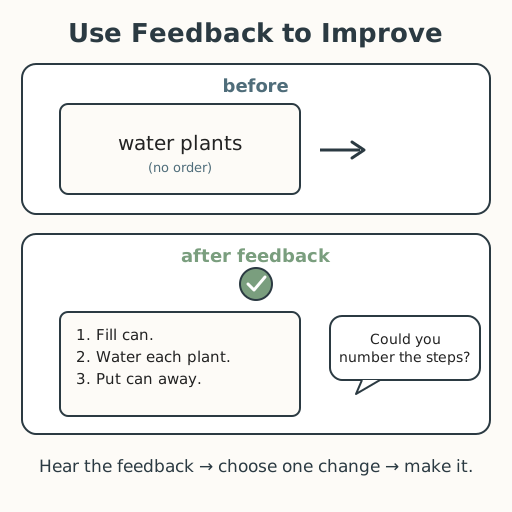
- Before–after poster · 1 A poster showing the same shared sign before and after one piece of feedback was used (a label added, a step reordered)
- Shared-work page · 1 per pair A simple shared thing for each pair to improve — a two-step instruction page, a mini-map, or a recipe strip
- Pencils · per learner
Low-tech / no-cost
- A real shared thing to improve Use any real shared object — a half-made poster, a classroom sign, a tidy-up plan — and improve it with one real change; no printed page needed
- Chalk or a stick in the dirt Draw a shared sign or plan on the ground, improve it once with feedback, and draw it again; no paper needed
Enriched / lab & device
- A class 'improvement log' · 1 A running list where each pair records the feedback they used and the one change it produced, building a record of the unit's shared improvements
- A digital drawing or text tool · 1 per pair To revise a shared document or image on screen, showing the before and after side by side
Works in different contexts
- large-group Model one worked example of using feedback on the board, then have pairs make one real change to a shared thing and share their before–after aloud
- multi-age Younger learners point to the one thing they changed while older learners write a sentence naming the feedback and the change it produced
- self-directed A learner writes one piece of kind feedback for their own shared thing (imagining a partner), then makes the one change and records before and after
- level-grouped Learners ready to extend use more than one piece of feedback, or explain why the change made the shared work clearer for everyone
- outdoor-only Improve a real outdoor shared thing — a marked path, a tidy-up plan, a garden sign — using one piece of spoken feedback; no paper needed
Lesson 2 — Using Feedback to Improve Shared Work
Summary
Learners take the next step from Lesson 1: using kind feedback to actually improve shared work. They meet a before-and-after example, follow a three-step loop (hear the feedback, choose one change, make it), and improve a real shared thing with their partner, recording the before and after.
Objectives
- Use kind feedback to improve shared work by choosing and making one real change. (D02.S1.05.01)
Connection
A cook tastes the soup and a helper says, “It needs a little salt.” The cook doesn’t argue — she adds a pinch, tastes again, and the soup is better. Feedback is only half the skill; the other half is doing something with it. When someone offers you a kind tip about a shared thing — a sign, a plan, a game, a meal — the magic happens when you pick one change and make it.
Materials
- Before–after poster
- Shared-work page
- Pencils
Preparation
- Print or draw the before–after poster (one shared sign improved by one piece of feedback).
- Copy a shared-work page for each pair (a two-step instruction page, a mini-map, or a recipe strip).
- Arrange pairs with room to work side by side.
Facilitator note
This lesson is written to the learner (“you”). The idea to land is that feedback becomes
learning only when it is used — hear it, choose one change, make it. Model the
before-and-after loop explicitly; this is a skill, so worked examples and guided practice
come before independent work (Kirschner, Sweller & Clark, 2006). Guard against the trap
of “I heard you” without a real change: the change is the evidence. Praise the change,
not just the politeness. Keep the shared thing small and safe so learners can risk
changing it. See docs/facilitation.md.
Procedure
- Gather (5 min). Last time you learned to give and receive feedback kindly. Today you learn the other half: using that feedback to make your shared work better.
- Meet the loop (10 min). Look at the before–after poster. Before: a sign reads “water plants” with no order. A helper says, “Could you number the steps?” After: the sign now reads “1. Fill can. 2. Water each plant. 3. Put can away.” That is the loop: hear the feedback → choose one change → make it.
- Practice together (5 min). With the whole group, run the loop once aloud on a shared thing: someone names one kind, specific tip; the group chooses one change and says exactly what it will be.
- Improve your shared thing (15 min). Take your pair’s shared-work page. Partner A gives one kind, specific comment (from Lesson 1’s starter). Partner B chooses one change and makes it on the page. Then swap. Record the before and after — draw or write what changed and why it is better.
- Close (5 min). A kind tip only becomes a real improvement when you act on it. Today you turned someone’s help into a better shared thing. That loop — hear, choose, change — is how teams make everything better together.
Differentiation
- Support: Provide a shared thing that needs one obvious change (a missing label, an out-of-order step), and scribe the before–after sentence.
- Extension: Use two pieces of feedback, or explain how the change helps a third person who will use the shared thing.
Assessment
- Formative (performance/peer): Can the learner take a kind, specific piece of feedback, choose one real change, make it, and say how the work improved?
- Self-check: The learner asks, “Did I actually change something, and is the shared thing clearer or better because of it?”
Home connection
Use one piece of feedback from someone at home to improve a shared thing — a chore chart, a recipe, a note — and show them the before and after.
Resources
- Feedback drives learning only when learners act on it — mastery learning’s “feedback-corrective” cycle (Bloom, 1984) and Hattie’s feedback findings both turn on the learner using the feedback to close the gap. For classroom SEL framing, see CASEL’s relationship-skills competency: https://casel.org/fundamentals-of-sel/