Lesson 03 — Dividing Tasks Fairly in a Team
Learners learn how a team divides its work fairly. They meet a worked example of a job list in which every job is named and matched to a person by skill and interest, with nobody left out and nobody overloaded. In teams of three or four they list all the jobs of a real small task, match jobs to people, and check that everyone has a real part.
Objectives
Objectives
- D02.S1.05.02 Cooperate in a team by dividing tasks fairly and following through on one's part.
Essential question
How does a team divide its tasks so the work is fair and everyone has a real part?
Key vocabulary
Materials
Standard materials
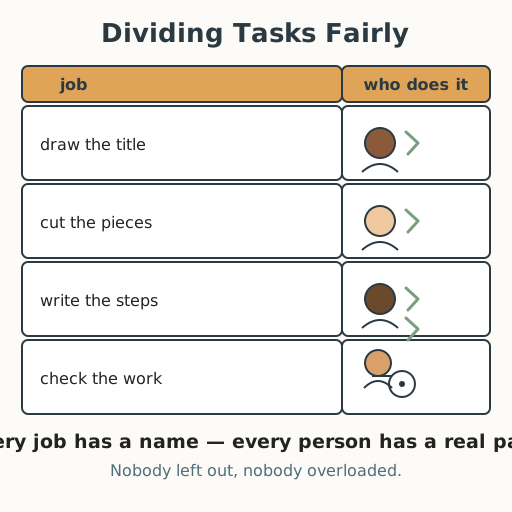
- Task-division poster · 1 A poster showing one team's job list — every job written, matched to a person by skill and interest, with nobody left out and nobody overloaded
- Blank job list page · 1 per team A page with two columns — all the jobs, and who will do each — for a team to fill in together
- A real team task · 1 A small shared project for teams of 3–4, such as making a class display, planning a snack, or tidying a shared space
Low-tech / no-cost
- Voice and a shared job Take any real shared job — tidying a corner, making a sign, planning a game — and divide it aloud so every person has one real part; no page needed
- A 'jobs in the dirt' map Draw the jobs on the ground with chalk or a stick, then stand where each job will be done, so everyone sees the fair split
Enriched / lab & device
- A class 'team roles' wheel · 1 A reusable wheel of team roles (leader-of-the-day, materials keeper, checker, reporter) that teams rotate through across the unit
- A shared task board or list app · 1 per team A digital board where teams post and assign jobs and move each one to "done," making the fair split visible
Works in different contexts
- large-group Model one worked example of dividing a job list on the board, then have small teams divide their own task and post their lists
- multi-age Older learners match jobs to people by skill and interest while younger learners say one job they can do and place themselves in the list
- self-directed A learner lists all the jobs of a one-person task, notes which they would need help with, and plans who they would ask and how the split could be fair
- level-grouped Learners ready to extend discuss fairness when jobs are unequal — heavy vs. light, boring vs. fun — and propose a fair way to balance them
- outdoor-only Divide a real outdoor job — clearing, gathering, building a trail marker — by skill and interest so everyone has a real part; no paper needed
Lesson 3 — Dividing Tasks Fairly in a Team
Summary
Learners learn how a team divides its work fairly. They meet a worked example of a job list in which every job is named and matched to a person by skill and interest, with nobody left out and nobody overloaded. In teams of three or four they list all the jobs of a real small task, match jobs to people, and check that everyone has a real part.
Objectives
- Cooperate in a team by dividing tasks fairly, matching jobs to people so everyone has a real part. (D02.S1.05.02)
Connection
A family makes a meal: one washes the greens, one chops, one watches the pot, one sets the table. Nobody does everything, and nobody stands idle. That is fair task division — list the jobs, share them so each person carries a real part, and the work gets done without one person carrying it all. In a sports team, a garden, or a shop, the same trick holds: fair teams name every job and give everyone a part that matters.
Materials
- Task-division poster
- Blank job list page
- A real team task
Preparation
- Print or draw the task-division poster (a job list with every job matched to a person).
- Copy a blank job list page for each team.
- Choose or set up a real small team task (a class display, a snack plan, a tidy-up).
Facilitator note
This lesson is written to the learner (“you”). The idea to land is fair division of
work: list all the jobs, match them to people by skill and interest, and make sure
nobody is left out and nobody is overloaded. Fairness here is a practice, not a slogan —
model one worked example before teams work independently (Kirschner, Sweller & Clark,
2006; Slavin’s cooperative-learning structures). Watch for the two failures: one child
does everything, or one child gets nothing. Name them gently and redirect to “everyone
has a real part.” Cooperative learning is a strong lever for achievement and belonging
(Bloom, 1984; Hattie’s relationships finding). See docs/contexts.md.
Procedure
- Gather (5 min). Think of a team that worked — and one where one person did everything or someone was left with nothing. Today you learn to divide a team’s work so it is fair.
- Meet fair division (10 min). Look at the poster. A team’s job list: draw the title, cut the pieces, write the steps, check the work. Every job has a name beside it. Jobs are matched to people by skill (who can do it) and interest (who wants to) — and everyone has a real part, no one is left out, no one is overloaded.
- List the jobs (10 min). In your team, take your real task. First, list every job — write down every single thing that must be done, even small ones. Don’t assign yet. Just name them all.
- Divide fairly (15 min). Now match jobs to people. Ask: who can do each job? who wants to? Does everyone have a real part? Is anyone carrying too much? Adjust until the split feels fair to everyone — then write each person’s name beside their job.
- Close (5 min). A fair team is not one where everyone does the same thing, but one where every job is named and every person has a part that matters. That is how work becomes lighter and belonging grows.
Differentiation
- Support: Provide a pre-written job list to sort rather than generate, and pair learners so a confident teammate scribes the names.
- Extension: Discuss fairness when jobs are unequal — heavy vs. light, fun vs. dull — and propose a fair way to balance them (rotate, trade, pair up).
Assessment
- Formative (peer/observation): Did the team name all the jobs and match them so everyone has a real part, with no one left out or overloaded?
- Self-check: Each learner asks, “Do I have a real part, does everyone else, and does the split feel fair to all of us?”
Home connection
Help divide one household job fairly tonight — list the parts of the job and give every helper a real part.
Resources
- Cooperative-learning structures that divide work fairly have a strong research base (Slavin, Cooperative Learning, 1995; Bloom’s reported cooperative-learning effect, 1984). For the relationship-skills and social-awareness framing, see CASEL: https://casel.org/fundamentals-of-sel/