Lesson 04 — Following Through on My Part
Learners complete the teamwork arc by learning to follow through on their part. They meet a three-step path — make the promise, do the part, check in — then actually carry out the part they divided in Lesson 3, helping a teammate who is stuck and asking for help when they need it. Reliability is framed as care, not duty alone.
Objectives
Objectives
- D02.S1.05.02 Cooperate in a team by dividing tasks fairly and following through on one's part.
Essential question
How do I follow through on my part of a team's work — and help when someone is stuck?
Key vocabulary
Materials
Standard materials
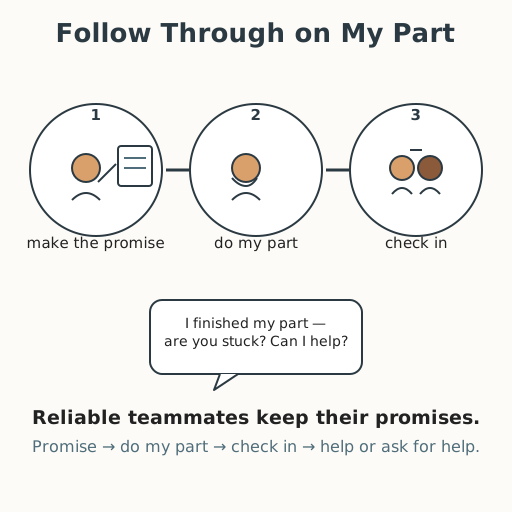
- Follow-through poster · 1 A poster showing the three-step path — make the promise, do the part, check in — with a helper asking a teammate who is stuck
- Commitment card · 1 per learner A small card with three blanks — "My part is ___. I will finish it by ___. If I am stuck I will ___."
- The team task from Lesson 3 · 1 Learners return to the real task they divided in Lesson 3 and actually do their part
Low-tech / no-cost
- Voice and a real part Each learner says their part aloud, does it, then reports back — "I said I would ___, and I did ___"; no card needed
- A 'promise stone' pass Pass a stone or shell as each learner names the part they commit to do, then pass it again when they report it done
Enriched / lab & device
- A class 'we keep our promises' chart · 1 A visible chart where learners move their name from "promised" to "done," building a culture of follow-through
- A short team message thread · 1 per team A shared message thread (if available) where teammates post progress and offer help, modeling real-world check-ins
Works in different contexts
- large-group Model one full promise–do–check-in example, then have each learner make a commitment card and do their part of the Lesson 3 task, reporting back
- multi-age Older learners mentor a younger partner through promise–do–check-in, while younger learners report back with one sentence about what they finished
- self-directed A learner writes a commitment card for a real task, does the part alone, and records what they finished and where they needed help
- level-grouped Learners ready to extend reflect on what makes follow-through hard (forgetting, fear, overload) and name one strategy that helps them keep promises
- outdoor-only Each learner names a real outdoor part — gather stones, mark a path, carry water — does it, and reports back; the pass of a stone marks each promise and its completion
Lesson 4 — Following Through on My Part
Summary
Learners complete the teamwork arc by learning to follow through on their part. They meet a three-step path — make the promise, do the part, check in — then actually carry out the part they divided in Lesson 3, helping a teammate who is stuck and asking for help when they need it. Reliability is framed as care, not duty alone.
Objectives
- Cooperate in a team by following through on my part, checking in, and helping or asking for help when needed. (D02.S1.05.02)
Connection
In a relay race, everyone runs their leg — if one runner stops, the whole team stops. In a garden everyone waters their row; in a kitchen everyone cooks their dish. Following through is how a team trusts each other. When you say “I’ll do my part” and then do it, people learn they can count on you — and when you’re stuck, a good teammate asks for help instead of quietly disappearing.
Materials
- Follow-through poster
- Commitment card
- The team task from Lesson 3
Preparation
- Print or draw the follow-through poster (promise → do → check in).
- Copy a commitment card for each learner.
- Have the Lesson 3 team task and its job list ready so learners can carry out their part.
Facilitator note
This lesson is written to the learner (“you”). The idea to land is reliability as care:
a team runs on people keeping their promises, and “stuck” is a normal, shareable state —
never a shame. Model the three-step path explicitly, then let learners do their real part
(this is guided practice becoming real practice). Praise follow-through and honest
check-ins equally; do not shame forgetfulness — investigate what got in the way and name a
strategy for next time. Contribution and responsibility are protective for children
(Search Institute’s developmental assets). See docs/facilitation.md.
Procedure
- Gather (5 min). Last time you divided a team’s work fairly. Today you learn the other half of teamwork: following through — keeping the promise you made.
- Meet the path (10 min). Look at the poster. Three steps: make the promise (“My part is ___. I’ll finish by ___.”), do the part, and check in (“I finished — are you stuck? Can I help?”). A reliable teammate does all three — and when they are stuck, they ask for help instead of going quiet.
- Write your commitment (5 min). On your commitment card, fill in: My part is ___ . I will finish it by ___ . If I am stuck I will ___ . Say it to your team so everyone knows the promise.
- Do your part (15 min). Carry out the part you divided in Lesson 3. As you work, if a teammate is stuck, offer help. If you are stuck, ask. When you finish, check in with your team: “I finished my part — how is yours?”
- Close (5 min). A team is only as strong as its promises. Today you kept one — and you helped keep the whole team moving. That is what it means to be someone others can count on.
Differentiation
- Support: Give learners a very small, finishable part and a check-in partner; scribe the commitment card if needed.
- Extension: Reflect on what makes follow-through hard (forgetting, fear, too much) and write one strategy that helps you keep promises — a reminder, a buddy, a smaller first step.
Assessment
- Formative (performance/self): Did the learner do the part they promised, check in with their team, and help or ask for help when stuck?
- Self-check: The learner asks, “Did I keep my promise? Did I ask for help or offer it when someone was stuck?”
Home connection
Make one small promise at home tonight — a chore, a call, a note — and keep it, then tell someone how it went.
Resources
- Contribution, responsibility, and follow-through are developmental assets that protect and grow children (Search Institute’s 40 Developmental Assets). For classroom framing of cooperation and relationship skills, see CASEL: https://casel.org/fundamentals-of-sel/