Lesson 06 — Checking My Guess About Feelings
Learners learn that a first guess about someone's feelings can be wrong, and how to check instead of assume. They meet the idea that what we see on the outside may not match what is felt inside, practice the two-step move — notice clues, then check with the person — and rehearse a checking question on everyday scenarios where looks can mislead.
Objectives
Objectives
- D02.S2.05.02 Recognize when a first guess about someone's feelings might be wrong and check with them.
Essential question
What if my first guess about how someone feels is wrong — and how do I check?
Key vocabulary
Materials
Standard materials
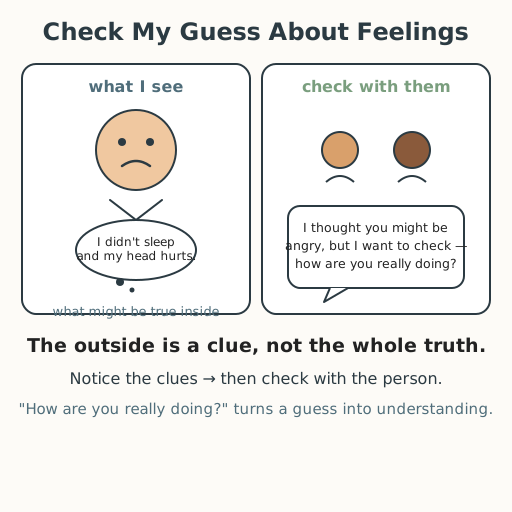
- Guess–check poster · 1 A poster showing a face that looks angry but whose thought bubble shows tiredness, beside the two-step move — "I notice clues → I check with them"
- Scenario cards · 1 set Cards of small everyday scenes where a first guess about feelings could be wrong — a quiet child at a party, a frowning child with a headache, a child smiling while worried about a test
- Checking sentence-starter card · 1 per pair A card with the starter "I thought you might feel ___, but I want to check — how are you really doing?"
Low-tech / no-cost
- Voice and a partner Act out a scene where a first guess could be wrong, then practice the checking question aloud; no cards needed
- A 'guess or check' thumbs game The facilitator names a scene; partners show thumbs for "guess" (assume) or "check" (ask), then say the checking question
Enriched / lab & device
- A class 'check, don't assume' anchor · 1 A standing class phrase and poster — "my first guess could be wrong, so I check" — that becomes a norm across the unit
- A short video of a scene · 1 A brief clip (if available) of a situation where looks mislead, paused to discuss the guess and the check
Works in different contexts
- large-group Model one worked example of guess-then-check, then have pairs act out scenarios and share the checking question they used
- multi-age Younger learners name the clue they see and their guess, while older learners model the checking question and explain why guessing can be wrong
- self-directed A learner recalls a time their own guess about someone was wrong, writes the clue, the wrong guess, and the checking question they could have asked
- level-grouped Learners ready to extend explain *why* a guess can be wrong — feelings are hidden, mixed, or shown differently by different people — and write a rule for checking
- outdoor-only In pairs, mime a feeling in a scene, let the partner guess, then check with words — swapping roles so every learner asks and answers; no paper needed
Lesson 6 — Checking My Guess About Feelings
Summary
Learners learn that a first guess about someone’s feelings can be wrong, and how to check instead of assume. They meet the idea that what we see on the outside may not match what is felt inside, practice the two-step move — notice clues, then check with the person — and rehearse a checking question on everyday scenarios where looks can mislead.
Objectives
- Recognize when a first guess about someone’s feelings might be wrong, and check with them instead of assuming. (D02.S2.05.02)
Connection
Your friend slams a book down and you think, “She’s angry at me.” Then she says, “Sorry — I didn’t sleep and my head hurts.” Your first guess was wrong. Faces and actions are only clues, not proof — and people hide feelings, or have more than one at once, or show them differently than you would. So the kindest move is to hold your guess lightly and check: “I thought you might be upset — how are you really doing?”
Materials
- Guess–check poster
- Scenario cards
- Checking sentence-starter card
Preparation
- Print or draw the guess–check poster (a face that looks one way while the inside is another, beside the two-step move).
- Copy the scenario cards and a checking sentence-starter card for each pair.
- Arrange pairs for acting out scenarios.
Facilitator note
This lesson is written to the learner (“you”). The idea to land is epistemic humility
about others’ feelings: my guess is a guess, and the person is the authority on their own
inner world — so I check. This is the anti-stereotyping lesson of the unit. Watch for two
slips: assuming an expression always means one feeling, and assuming a group shares one
feeling. Model checking as gentle and optional — never pressure someone to disclose; a
person may say “I don’t want to talk about it,” and that is an answer to respect. Hold the
question “how are you really doing?” as an invitation, not an interrogation. See
docs/facilitation.md on holding feelings safely.
Procedure
- Gather (5 min). Think of a time you guessed how someone felt and later found out you were wrong. Today you learn to check your guess instead of trusting it blindly.
- Meet the guess and the check (10 min). Look at the poster. On the outside: a frown and crossed arms — you guess angry. On the inside, the thought bubble: “I didn’t sleep and my head hurts.” The outside is a clue, not the whole truth. So we do two steps: notice the clues, then check with the person.
- Learn the checking question (5 min). Read the starter: “I thought you might feel ___ , but I want to check — how are you really doing?” Practice saying it once with a partner, gently.
- Act out and check (15 min). Take a scenario card: a quiet child at a party, a frowning child with a headache, a child smiling while worried about a test. Partner A acts it; Partner B names their guess, then uses the checking question. Partner A answers honestly. Swap. Notice: was your guess right? Sometimes — but often not, and that is the point.
- Close (5 min). Guessing someone’s feelings is natural; trusting the guess without checking is where we go wrong. A single kind question — “how are you really doing?” — turns a guess into understanding. That is empathy that checks.
Differentiation
- Support: Provide two illustrated clue cards and a scripted checking exchange to rehearse; scribe the checking question if needed.
- Extension: Explain why a guess can be wrong — feelings are hidden, mixed, or shown differently by different people — and write one rule you will follow before assuming.
Assessment
- Formative (peer/self): Can the learner name their guess, then check with the person using a gentle question, and accept the real answer?
- Self-check: The learner asks, “Did I hold my guess lightly, ask instead of assume, and accept the answer I was given?”
Home connection
Before you assume how someone at home feels today, check — ask them how they are really doing, and listen.
Resources
- Perspective-taking and reading others’ feelings are core to CASEL’s social-awareness competency; the “check instead of assume” move is a classroom-friendly application. https://casel.org/fundamentals-of-sel/