Lesson 07 — Shared Work, Symbols, and Stories Build Community
Learners explore how communities are built and held together through shared work, symbols, and stories. They meet a three-builders frame, consider real examples from around the world — a harvest, a patterned cloth, an origin story — and then describe one community they belong to through its shared work, a symbol, and a story, producing a portfolio artifact.
Objectives
Objectives
- D02.S3.05.01 Explain how communities are built through shared work, symbols, and stories.
Essential question
How do shared work, symbols, and stories build and hold a community together?
Key vocabulary
Materials
Standard materials
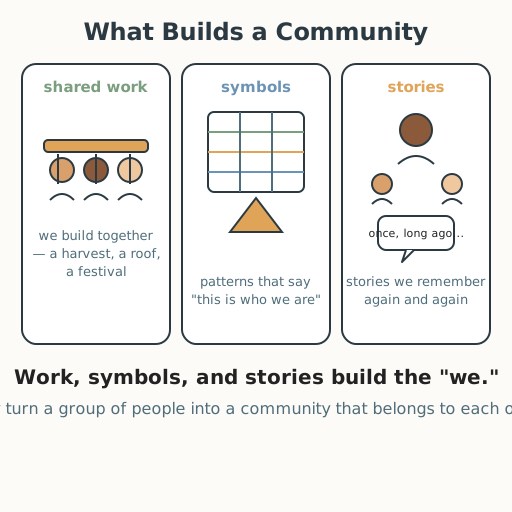
- Three-builders poster · 1 A poster with three panels — shared work (a harvest or building together), symbols (a crest, flag, or patterned cloth), and stories (elders or songs around a fire) — each labeled as one way communities are built
- My community builder page · 1 per learner A three-box page — one shared work, one symbol, one story — for the learner to describe a community they belong to
- Pencils · per learner
Low-tech / no-cost
- Voice and a circle Tell one shared work, one symbol, and one story from the group's own community aloud in a circle; no page needed
- A found-object symbol Each learner picks a found object that stands for something the community shares, and explains it to the group
Enriched / lab & device
- A symbols-and-stories gallery · 1 A display of images of community symbols from around the world — patterned cloth, crests, flags, art — with each meaning named
- A recording of a community story or song · 1 A respectful recording (if available) of a story or song that a community uses to remember who it is
Works in different contexts
- large-group Chart the three builders on the board using examples learners know, then have each learner complete the three-box page for one community
- multi-age Younger learners draw one symbol and one story while older learners write how each builds belonging and share their explanations
- self-directed A learner chooses a community they belong to and writes one shared work, one symbol, and one story, explaining how each builds belonging
- level-grouped Learners ready to extend compare two communities' symbols or stories and explain how each one says "this is who we are"
- outdoor-only Walk to a shared place — a garden, a path, a meeting spot — and name the shared work, symbol, and story that built it; no paper needed
Lesson 7 — Shared Work, Symbols, and Stories Build Community
Summary
Learners explore how communities are built and held together through shared work, symbols, and stories. They meet a three-builders frame, consider real examples from around the world — a harvest, a patterned cloth, an origin story — and then describe one community they belong to through its shared work, a symbol, and a story, producing a portfolio artifact.
Objectives
- Explain how communities are built through shared work, symbols, and stories, using an example I know. (D02.S3.05.01)
Connection
A group of strangers becomes a “we” when they build something together — a garden, a festival, a home — when they share a symbol that says “this is us” (a crest, a flag, a pattern), and when they tell the same stories (how we began, who we remember, what we value). Think of your own class, family, or neighborhood: what do you do together, what mark or pattern stands for you, and what story gets told again and again? Those three things are the glue.
Materials
- Three-builders poster
- My community builder page
- Pencils
Preparation
- Print or draw the three-builders poster (shared work, symbols, stories).
- Copy a my-community-builder page for each learner.
- Gather one or two local examples of a symbol or story to prime the discussion.
Facilitator note
This lesson is written to the learner (“you”). The idea to land is that belonging is
built, not automatic — it is made through shared work, shared symbols, and shared
stories. Ground it in concrete examples the learners already know before the abstraction.
Honor every community’s symbols and stories as meaningful in their own place; never rank
one culture’s symbol or story above another. If a learner shares a symbol or story from
their own culture, let them be the authority on its meaning. This lesson produces the
unit’s community-building description portfolio artifact. See docs/facilitation.md.
Procedure
- Gather (5 min). Last time you learned to check your guess about feelings. Today you ask a bigger question: what turns a group of people into a community — a real “we”?
- Meet the three builders (10 min). Look at the poster. Communities are built three ways. Shared work: people plant, build, or celebrate together. Symbols: a patterned cloth whose colors carry meaning, a crest, a flag, a mark that says “this is us.” Stories: the tales and songs people tell again and again to remember who they are. Each one makes belonging.
- See it in the world (10 min). Think of examples. A village that harvests together. A patterned cloth — like the kente cloth of the Akan peoples of West Africa — whose patterns carry meaning and are worn on important days. An origin story told by elders around a fire. Name one you know or have heard of.
- Describe your own community (15 min). Choose one community you belong to — your class, family, neighborhood, team, or a community of faith or culture. On your page, write or draw one shared work, one symbol, and one story of that community, and one sentence about how each builds belonging. This page becomes part of your portfolio.
- Close (5 min). A community is not just people in one place — it is people who work together, share a sign, and remember a story. When you name those three things, you see the invisible glue that holds your own “we” together.
Differentiation
- Support: Provide illustrated examples to sort into the three boxes, and scribe the one-sentence explanations.
- Extension: Compare two communities’ symbols or stories and explain how each one says “this is who we are.”
Assessment
- Formative (portfolio/self): Does the learner name one shared work, one symbol, and one story of a community, and explain how each builds belonging?
- Self-check: The learner rereads their page and checks that all three builders are present and each is tied to belonging.
Home connection
Ask someone at home about a symbol or story of a community they belong to, and tell them one of yours.
Resources
- Belonging and inclusion are a pillar of UNESCO’s “Learning to Live Together” (https://en.unesco.org/themes/learning-live-together); shared activity and trust build community (Putnam, Bowling Alone). For symbols with meaning, see kente cloth of the Akan peoples (Smithsonian National Museum of African Art) and, for story and knowledge passed person to person, UNESCO’s Intangible Cultural Heritage (https://ich.unesco.org/).