Lesson 10 — Sharing Fairly So Everyone Has Enough
In this capstone lesson, learners practice fairness by dividing limited resources so everyone has enough. They meet two ways to divide — equal shares and need-based shares — role-play dividing a real limited resource in teams, record their division and its reasons, and revisit the unit's skills: kind feedback (S1) and checking feelings (S2) as they negotiate, producing the unit's fair-division record.
Objectives
Objectives
- D02.S4.05.02 Practice fairness by dividing resources so everyone has enough, in a role-play or real task.
- D02.S1.05.01 Give and receive feedback kindly and use it to improve shared work.
- D02.S2.05.02 Recognize when a first guess about someone's feelings might be wrong and check with them.
Essential question
How do we divide limited resources so everyone has enough — and do it fairly and kindly?
Key vocabulary
Materials
Standard materials
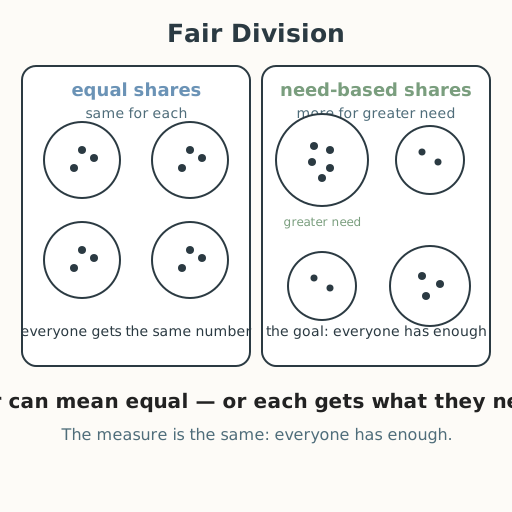
- Fair-division poster · 1 A poster contrasting two ways to divide — equal shares (same for each) and need-based shares (more for greater need) — with a reminder that the goal is everyone has enough
- Resource cards · 1 set per team Cards representing a limited resource — 10 food tokens, 8 pencils, 6 blankets, one jug of water — to be divided in role-play
- Fair-division record page · 1 per team A page to record how the team divided, why, and whether everyone had enough, with room for a better plan
Low-tech / no-cost
- Real objects to divide Divide real limited things — a stack of paper, a pile of fruit, a set of tools — in a role-play where some learners need more than others; no cards needed
- A chalk circle and stones Draw a circle and place stones as the resource; move them into shares while talking through equal vs. need, so the division is visible in the dirt
Enriched / lab & device
- A class 'fair-division' simulation · 1 A larger scenario (a shared meal for the class, a limited set of supplies) divided in teams and compared across the room
- A simple spreadsheet or tally app · 1 per team To record shares and check the totals add up, making the math of fairness visible
Works in different contexts
- large-group Model one worked example of equal vs. need-based division, then have teams role-play a scenario, record their division, and share one rule they used
- multi-age Older learners run the division and explain equal vs. need, while younger learners hand out the resource and count that everyone got enough
- self-directed A learner works a written scenario alone, dividing the resource on paper and writing why they chose equal or need-based shares and whether everyone had enough
- level-grouped Learners ready to extend debate a hard case — what counts as "enough" when needs differ — and propose a rule the whole group could accept
- outdoor-only Divide a real limited outdoor resource — gathered fruit, a shared blanket, turns at a tool — by equal or need-based shares, talking it through aloud
Lesson 10 — Sharing Fairly So Everyone Has Enough
Summary
In this capstone lesson, learners practice fairness by dividing limited resources so everyone has enough. They meet two ways to divide — equal shares and need-based shares — role-play dividing a real limited resource in teams, record their division and its reasons, and revisit the unit’s skills: kind feedback (S1) and checking feelings (S2) as they negotiate, producing the unit’s fair-division record.
Objectives
- Practice fairness by dividing resources so everyone has enough, in a role-play or real task. (D02.S4.05.02)
- Use kind feedback (D02.S1.05.01) and check rather than assume about feelings (D02.S2.05.02) while negotiating a fair division.
Connection
Six people, one jug of water, and different thirsts. One person just ran, another sat in the shade. “Same for each” might leave the runner still thirsty; “to each by need” gives the runner a little more and still leaves enough for all. Fair does not always mean equal — sometimes it means each gets what they need so everyone has enough. In a home, a classroom, or a village sharing a harvest, that is the question we solve together.
Materials
- Fair-division poster
- Resource cards
- Fair-division record page
Preparation
- Print or draw the fair-division poster (equal vs. need-based shares).
- Copy a set of resource cards and a fair-division record page for each team.
- Set up one division scenario per team (10 food tokens, 8 pencils, 6 blankets, one jug of water) with a few “characters” who need more than others.
Facilitator note
This is the unit capstone, written to the learner (“you”). The idea to land is that
fairness is a practice with two tools — equal shares and need-based shares — and the
measure is everyone has enough, not “everyone is identical.” Model one worked example
first (this is a skill; Kirschner, Sweller & Clark, 2006), then let teams negotiate a real
division. Watch for the two traps: “equal at all costs” (ignoring real need) and “loudest
gets most” (ignoring fairness). Invite the unit’s skills back in: when a teammate proposes
a share, respond with kind feedback (Lesson 1); when a teammate seems unhappy, check
instead of assume (Lesson 6). This lesson produces the unit’s fair-division record.
Keep it a game of care, never a ranking. See docs/facilitation.md.
Procedure
- Gather (5 min). For ten lessons you have practiced giving kind feedback, following through, seeing others’ lives, checking your guesses, and helping one another. Today you put it all together: divide limited resources so everyone has enough.
- Meet two ways to divide (10 min). Look at the poster. Equal shares: same for each. Need-based shares: more for greater need, less for less. Both can be fair — the goal is that everyone has enough. Think of the water jug: same for each, or a little more to the one who just ran?
- Worked example (5 min). Together, divide the jug of water among six characters: a runner (very thirsty), a baby (small sips), four others (ordinary thirst). Discuss: equal, or by need? Decide, and check: does everyone have enough?
- Role-play your division (15 min). In your team, take your resource cards and your scenario. Read who needs what. Negotiate the division. Use your unit skills: give kind feedback on a proposal (“that’s fair, but could the one who needs more get a little more?”), and if a teammate seems unhappy, check instead of assume (“are you okay with your share, or do you need more?”). Agree on a split, then record it: how you divided, why, and whether everyone had enough.
- Close (5 min). Fairness is not a rule you memorize — it is a skill you practice, with others, out of care. Today you made sure everyone had enough, and you did it kindly, together. That is the whole unit, in one act.
Differentiation
- Support: Provide a pre-set scenario with two clear needs and a simple equal-vs-need choice, and scribe the record.
- Extension: Debate a hard case — what counts as “enough” when needs differ — and propose a rule the whole group could accept and defend.
Assessment
- Summative (performance/portfolio): Does the team divide the resource so everyone has enough, can they explain why (equal or need-based), and do they use kind feedback and checking during the negotiation?
- Self-check: Each learner asks, “Did everyone end with enough? Could I explain our rule? Was I kind, and did I check instead of assume?”
Home connection
Next time something limited is shared at home — food, space, a turn — help divide it so everyone has enough, and say out loud which rule you used: equal, or by need.
Resources
- Cooperative learning and fair division have a strong research base (Slavin, Cooperative Learning, 1995; Bloom’s cooperative-learning effect, 1984). The “fair can mean equal or by need” framing is a value held by this curriculum — a commitment, not a scientific claim. For classroom SEL framing, see CASEL: https://casel.org/fundamentals-of-sel/