Lesson 09 — Mutual Aid Across Cultures and Times
Learners meet mutual aid — people helping one another not for pay but because they belong to each other. They read six case cards from different cultures and times — a barn-raising, harambee in Kenya, gotong royong in Indonesia, Inuit food-sharing, Andean communal farming, and Wangari Maathai's tree-planting movement — record one example using a who–what–why frame, and connect it to helping they have seen or joined, producing a portfolio artifact.
Objectives
Objectives
- D02.S4.05.01 Describe examples of mutual aid from different cultures and times.
Essential question
How have people in different cultures and times helped one another — not for pay, but because they belong to each other?
Key vocabulary
Materials
Standard materials
- Mutual-aid gallery cards · 1 set of 6 Six one-paragraph case cards — a barn-raising, a harambee in Kenya, a gotong royong in Indonesia, Inuit food-sharing, Andean communal farming, and Wangari Maathai's tree-planting movement — each naming who, what, and why
- My mutual-aid example page · 1 per learner A page with three prompts — who helped, what they did, why it mattered — for the learner to record one example and one they have seen or joined
- Pencils · per learner
Low-tech / no-cost
- A read-aloud and retell The facilitator reads the case cards aloud; learners retell one example and add one they have seen — a neighbor helped, a harvest shared; no cards needed
- A 'hands that help' circle In a circle, each learner names one time people helped without pay, passing a stone or shell to the next speaker
Enriched / lab & device
- A world map and gallery cards · 1 A map where learners place each mutual-aid card near its place, building a global picture of helping traditions
- A short documentary or story clip · 1 A brief respectful clip (if available) showing a community helping one another, discussed with the same who–what–why prompts
Works in different contexts
- large-group Read two case cards together and chart who–what–why, then have pairs work through two more cards and share one example each
- multi-age Younger learners retell one case as a story while older learners write the who–what–why and lead the discussion of why people help
- self-directed A learner reads three case cards, records one example on the page, and writes about one act of mutual aid they have seen or joined
- level-grouped Learners ready to extend compare two examples across time or place and explain what they share — help without pay, from belonging — and what differs
- outdoor-only Act out one mutual-aid scene together — raising a beam, carrying a harvest — then name a real local example; no paper needed
Lesson 9 — Mutual Aid Across Cultures and Times
Summary
Learners meet mutual aid — people helping one another not for pay but because they belong to each other. They read six case cards from different cultures and times — a barn-raising, harambee in Kenya, gotong royong in Indonesia, Inuit food-sharing, Andean communal farming, and Wangari Maathai’s tree-planting movement — record one example using a who–what–why frame, and connect it to helping they have seen or joined, producing a portfolio artifact.
Objectives
- Describe examples of mutual aid from different cultures and times, and explain why people help one another. (D02.S4.05.01)
Connection
When a family moves to a new home, neighbors sometimes come to carry boxes — no one is paid, and everyone is fed at the end. When a village digs a well or brings in a harvest, many hands show up. This is mutual aid: helping because we belong to each other, not because we are hired. People all over the world, in every time, have built this habit — and it is one of the oldest and most human things we do.
Materials
- Mutual-aid gallery cards
- My mutual-aid example page
- Pencils
Preparation
- Copy the six mutual-aid gallery cards (barn-raising; harambee; gotong royong; Inuit food-sharing; Andean communal farming; the Green Belt Movement).
- Copy a my-mutual-aid-example page for each learner.
- Arrange small groups or a circle for reading and sharing.
Facilitator note
This lesson is written to the learner (“you”). The idea to land is mutual aid as a
universal human practice, not a charity or a “quaint” custom: people help because they
belong to each other, in every culture and time — none is more “advanced” than another.
Present each example with the same dignity; guard against ranking (“that is old-fashioned”
or “that is exotic”). Distinguish the fact (these traditions exist and are documented)
from the value (helping one another is good). If a learner shares an example from their
own culture, receive it warmly and let them be its authority. This lesson produces the
unit’s mutual-aid example portfolio artifact. See docs/facilitation.md.
Procedure
- Gather (5 min). Last time you saw how communities meet shared needs. Today you meet one of the oldest human practices: mutual aid — helping one another not for pay, but because we belong to each other.
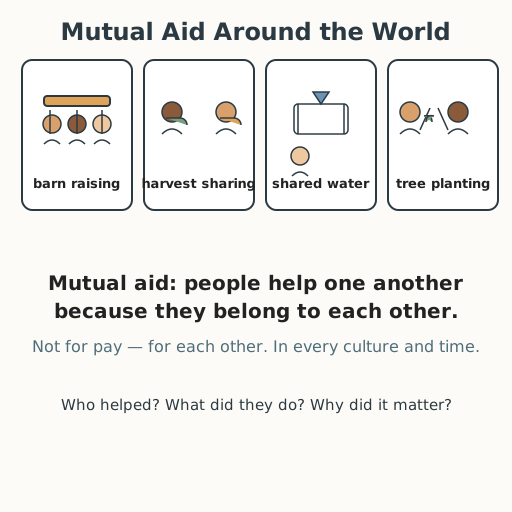
- Meet the gallery (15 min). Read the six case cards. A barn-raising: neighbors gather to raise a family’s barn in a day, and the favor returns when another family builds. Harambee: in Kenya, people pull together — “all pull together” — to build a school or help a family. Gotong royong: in Indonesia, neighbors share the work of a village — a road, a harvest, a celebration. Inuit food-sharing: a successful hunt is shared widely, so no one goes without. Andean communal farming: neighbors farm terraces together, in a minga, for the good of all. The Green Belt Movement: begun by Wangari Maathai in 1977, people planted trees together — over thirty million — to heal the land.
- Find the who–what–why (10 min). Choose one example. Answer three questions: Who helped? What did they do? Why did it matter — and why did they do it without pay? The answer to “why” is almost always: because they belonged to each other.
- Record your example (10 min). On your page, write or draw the example you chose, plus one act of mutual aid you have seen or joined — neighbors helping, a harvest shared, a meal carried to someone sick. This page becomes part of your portfolio.
- Close (5 min). Mutual aid is not one culture’s idea — it is a human habit that appears everywhere and always. When you help because you belong, you are joining the oldest team on Earth.
Differentiation
- Support: Provide two illustrated case cards and a fill-in who–what–why frame, and scribe the local example.
- Extension: Compare two examples across time or place and explain what they share — help without pay, from belonging — and what differs.
Assessment
- Formative (portfolio/self): Can the learner describe one mutual-aid example (who, what, why) and name one they have seen or joined?
- Self-check: The learner asks, “Did I capture who helped, what they did, and why — and did I hold every example with the same respect?”
Home connection
Ask someone at home about a time people helped without pay — a harvest, a move, a neighbor in need — and add it to your page.
Resources
- The concept of mutual aid as a widespread human practice is named in Kropotkin’s Mutual Aid: A Factor of Evolution (1902). Specific examples: the Green Belt Movement, begun by Wangari Maathai in 1977, planted over thirty million trees (Nobel Prize facts, https://www.nobelprize.org/prizes/peace/2004/maathai/facts/); Andean communal farming and the potato’s Andean origin (International Potato Center); Inuit food-sharing and community life (Inuit Circumpolar Council); the 1976 Hōkūleʻa voyage as a whole community’s shared work (Polynesian Voyaging Society). Harambee, gotong royong, and barn-raising are widely documented traditions of communal help; verify local details with community members.