Lesson 04 — Compose a Short Piece or Song: Beginning, Middle, and End
Learners compose their first short piece or song by learning the shape every story and song shares: a beginning that introduces the idea, a middle that contrasts, and an end that returns home. A worked example builds an A–B–A piece with body percussion, then small groups compose and notate their own three-part piece, ready to perform next lesson.
Objectives
Objectives
- D07.S2.05.01 Compose a short piece or song with a clear beginning, middle, and end and perform it.
Essential question
How do I compose a short piece or song with a clear beginning, middle, and end?
Key vocabulary
Materials
Standard materials
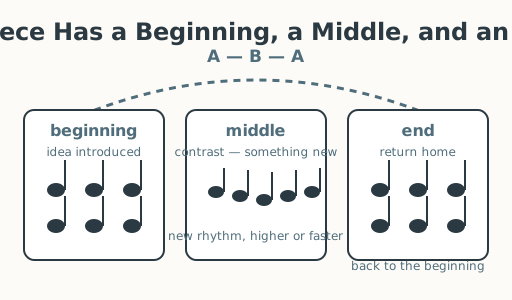
- Beginning–middle–end form card · 1 per group A card showing the A–B–A shape — beginning (idea introduced), middle (contrast, something new), end (return home)
- Simple notation page · 1 per group A page with three boxes (beginning, middle, end) where learners record each part with shapes, lines, letter names, or body-percussion marks
- Found-sound makers and body percussion · per group Voices, claps, taps, desk taps, shakers from cups, and any simple pitched instrument available
Low-tech / no-cost
- Voice and body only Compose the piece with claps, taps, humming, and singing; no instruments or paper needed
- Sticks, stones, and cups Found objects make the sounds — tapping sticks together, shaking seeds in a cup, drumming a flat stone
Enriched / lab & device
- A simple pitched instrument set · 1 per group Chime bars, recorder, or keyboard to give the melody definite pitches
- A recording device · 1 per group To record the composition so learners can hear their beginning, middle, and end and revise
Works in different contexts
- large-group Build one shared A–B–A piece as a whole class first, then have small groups compose their own
- multi-age Younger learners clap a simple beginning and ending while older learners add a contrasting middle and record it
- self-directed A learner composes a three-part piece alone, records or notates it, and checks that the middle really contrasts and the end returns
- level-grouped Learners ready to extend label their form (A–B–A or A–B–C) and explain how the middle creates contrast and the end resolves
- outdoor-only Compose with natural sounds — stones, leaves, water, voices — finding a beginning, a contrasting middle, and a return
Lesson 4 — Compose a Short Piece or Song: Beginning, Middle, and End
Summary
Learners compose their first short piece or song by learning the shape every story and song shares: a beginning that introduces the idea, a middle that contrasts, and an end that returns home. A worked example builds an A–B–A piece with body percussion, then small groups compose and notate their own three-part piece, ready to perform next lesson.
Objectives
- Compose a short piece or song with a clear beginning, middle, and end. (D07.S2.05.01)
Connection
Every good story has a beginning, a middle, and an end. A song is a story told in sound: the beginning introduces the idea, the middle takes you somewhere new, and the end brings you home. You already know this shape — a lullaby starts softly, rises to a fuller middle, and settles back to quiet; a work song sets a rhythm to match the task, and returns to its opening line. Today you become the one who shapes it: you compose — you put sounds together on purpose.
Materials
- Beginning–middle–end form card
- Simple notation page
- Found-sound makers and body percussion
Preparation
- Copy a form card and a notation page for each group.
- Recall Grade 4: learners read and played simple melodies and rhythms from basic notation; today they compose their own.
- Arrange the room into small groups with room to make sound.
Facilitator note
This lesson is written to the learner (“you”). The idea to land is form: a piece has
a beginning (the idea), a middle (contrast), and an end (return). Model the worked example
step by step before groups compose (explicit instruction for a novice skill — Kirschner,
Sweller & Clark, 2006). Keep the vocabulary concrete: “beginning, middle, end” before
“A–B–A.” Grade 4 gave basic notation, so simple shape/letter/body-mark notation is
enough — do not demand staff notation. Celebrate every completed three-part piece; form is
the goal, not virtuosity. Next lesson adds performance. See docs/facilitation.md and
docs/contexts.md on cooperative group work.
Procedure
- Gather (5 min). Think of a story you love. It has a beginning, a middle, and an end. Music works the same way. Today you compose a short piece with those three parts.
- Meet the shape (10 min). Look at the form card. Here is a worked example you will try together. Beginning: clap a slow, steady beat four times — “clap, clap, clap, clap.” That is the idea introduced. Middle: change it — tap the desk fast eight times, or hum a rising sound. Something new happens. End: clap the slow beat four times again — you have returned to the start. That is A (beginning), B (middle), A (end) — a piece with a shape.
- Choose your sounds (5 min). With your group, pick your sound makers — voices, claps, taps, shakers, or a pitched instrument. Decide: what is the idea of your piece? Is it a calm morning, a busy market, a rolling river, a walk home?
- Compose the three parts (15 min). Build your piece: a beginning that introduces the idea (one short phrase you can repeat), a middle that contrasts — faster or slower, higher or lower, louder or softer, or new words — and an end that returns to the beginning. Record each part on your notation page with shapes, lines, letter names, or body marks.
- Check your shape (10 min). Perform your piece once for yourselves. Ask: can we hear three parts? Does the middle really contrast? Does the end return? Adjust anything that blurs the shape.
- Close (5 min). You have just done what every composer on Earth does: shaped sound into a beginning, a middle, and an end. Keep your piece safe — next lesson you share it with an audience.
Differentiation
- Support: Provide a pre-made beginning and ending and ask learners to compose only the contrasting middle; use one repeated body-percussion phrase.
- Extension: Label the form (A–B–A or A–B–C) and write one sentence explaining how the middle creates contrast and how the end resolves it.
Assessment
- Formative (performance/peer): Can the group perform a piece with an audible beginning, a contrasting middle, and an ending that returns, and can they point to where each part happens?
- Self-check: The group asks, “Can we hear three clear parts, and does our middle really feel different from our beginning and end?”
Home connection
Listen to a song you like and try to find its beginning, middle, and end — and whether the ending returns to something from the start.
Resources
- The idea of musical form (beginning, middle, end; ABA) is a standard of elementary music education. For a classroom-friendly framing of composing with found sound, see Smithsonian Folkways’ “Tools for Teaching”: https://folkways.si.edu/tools-for-teaching