Lesson 03 — How an Artwork Reflects Its Culture's Place, Materials, and Beliefs
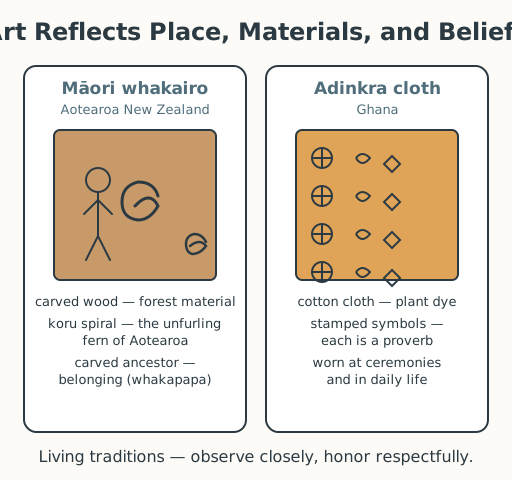
Learners meet artworks from several world regions and learn to read them as windows into a culture's place, materials, and beliefs. A worked example reads a Māori whakairo carving (forest wood, the koru fern spiral, carved ancestors) and an Akan adinkra cloth (plant dye, proverb symbols). Learners then observe other traditions — always as living arts made by living people to honor, never as specimens to rank.
Objectives
Objectives
- D07.S1.05.02 Explain how an artwork from a specific culture reflects that culture's place, materials, or beliefs, citing what they observe.
Essential question
How does an artwork from a specific culture reflect that culture's place, materials, and beliefs?
Key vocabulary
Materials
Standard materials
- Artwork-from-a-culture image cards · 1 set Cards showing artworks from several world regions, each labeled with its community and place — a Māori whakairo (carved wood) panel, Akan adinkra stamped cloth (Ghana), a rangoli/kolam floor drawing (India), an Aboriginal Australian dot painting, an Inuit soapstone carving, a Persian tile mosaic, a Tibetan sand mandala
- Observation chart · 1 per learner A three-column page — "What I observe" → "What it tells me about the place" → "What it tells me about materials or beliefs"
Low-tech / no-cost
- Spoken image descriptions Describe each artwork in words (shapes, patterns, what it is made of) so learners can observe without printed cards
- Observation by voice Complete the observation chart aloud in pairs, naming one observable feature and one thing it tells us
Enriched / lab & device
- A world map and image cards · 1 Place each artwork card near the place it comes from, building a global picture of art reflecting place
- Respectful short video clips · 1 set Brief clips (if available and respectful) of living artists making or showing these traditions today
Works in different contexts
- large-group Model the Māori worked example on the board, then have small groups each take one card and complete the chart before sharing out
- multi-age Younger learners name one thing they see; older learners connect it to place, materials, or beliefs in a full sentence
- self-directed A learner chooses two artwork cards, completes the chart for each, and writes one sentence comparing how each reflects its place
- level-grouped Learners ready to extend research a third artwork from a culture of their choice and add it to the chart with a source note
- outdoor-only Look at art made from natural materials (basketry, stone, earth pigments) and discuss how the local environment shapes what can be made
Lesson 3 — How an Artwork Reflects Its Culture’s Place, Materials, and Beliefs
Summary
Learners meet artworks from several world regions and learn to read them as windows into a culture’s place, materials, and beliefs. A worked example reads a Māori whakairo carving (forest wood, the koru fern spiral, carved ancestors) and an Akan adinkra cloth (plant dye, proverb symbols). Learners then observe other traditions — always as living arts made by living people to honor, never as specimens to rank.
Objectives
- Explain how an artwork from a specific culture reflects that culture’s place, materials, or beliefs, citing what they observe. (D07.S1.05.02)
Connection
A friend’s home tells you about them — the plants in the window, the food on the shelf, the pictures on the wall. An artwork is a community’s home made visible: it shows what materials the place gives, and what the people hold dear. A carving from a forest land is made of wood; a cloth from a place of cotton and dye carries its colors; a floor drawing made of rice flour feeds the insects when it is done. Reading art this way is how we meet a community with respect and wonder, not as a strange “other” but as people who, like us, make beauty from what surrounds them.
Materials
- Artwork-from-a-culture image cards
- Observation chart
Preparation
- Prepare the image cards, each labeled with its community and place.
- Copy an observation chart for each learner.
- Recall Grade 4: learners identified the subject, materials, and likely purpose of an artwork from another culture and asked one respectful question.
Facilitator note
This lesson is written to the learner (“you”). The idea to land is non-ranking
observation: we look closely at what a tradition is made of and shows, and connect
those observations to a place, its materials, and its beliefs — never to rank one
tradition “better” or “more advanced.” These are living traditions, made today by
living artists and communities; say this plainly and often. If a learner (or their
family) belongs to a tradition shown here, invite them to be the authority on its
meaning and never correct them about their own culture. Some works carry sacred meaning
(Aboriginal Australian Dreaming stories, Tibetan sand mandalas); present them with
reverence as knowledge held by specific communities, not as curiosities. See
docs/facilitation.md on honoring living traditions and docs/contexts.md on cultural
power dynamics.
Procedure
- Gather (5 min). Last lesson you finished an artwork of your own. Today you look at artworks made by communities around the world — and read them the way you read a friend’s home: what does this tell me about the place, the materials, and the beliefs of the people who made it?
- Meet the reading (15 min). Look at the first card, a Māori whakairo carving from Aotearoa (New Zealand). What I observe: it is carved from wood, with a spiral like an unfurling fern frond and carved figures. What it tells me: wood is the forest material of Aotearoa; the koru spiral is the unfurling fern, a plant of that land; the carved figures are ancestors, showing whakapapa — belonging through family and ancestry. Now the second card, adinkra cloth from Ghana. What I observe: cloth stamped with repeating symbols, dyed with plant color. What it tells me: cotton and dye are the materials of the place; each symbol is a proverb — a belief in picture form; the cloth is worn at ceremonies and in daily life.
- Observe your own (15 min). Choose two more cards — a rangoli/kolam floor drawing, an Aboriginal Australian dot painting, an Inuit soapstone carving, a Persian tile mosaic, or a Tibetan sand mandala. For each, fill your chart: one thing you observe, and what it tells you about the place, the materials, or the beliefs.
- Share and compare (10 min). In a small group, share one of your readings. Listen for the difference between what you see (the observation) and what it tells you (the meaning). Notice how every tradition makes sense in its own place.
- Close (5 min). Art is a people’s way of saying “this is where we live, this is what we have, this is what we hold dear.” Every tradition you met today is alive and belongs to people who still make and love it. We honor it by looking closely and speaking with respect.
Differentiation
- Support: Use a sentence starter — “I see ___, and it tells me the place is ___ / the people value ___” — and allow a single observation-to-meaning pair per artwork.
- Extension: Research a third tradition (with a source), complete a chart row, and write one sentence on how its materials come from its environment.
Assessment
- Formative (observation/self): Can the learner name at least one observable feature of an artwork and connect it, with a reason, to the culture’s place, materials, or beliefs — without ranking the tradition against another?
- Self-check: The learner asks, “Did I name something I actually saw, and did I connect it to place, materials, or beliefs with a reason — speaking about living people with respect?”
Home connection
Find one object or image from a culture different from your own (online, in a shop, in a neighbor’s home) and name one thing you observe and one thing it might tell you about its place or people.
Resources
- Te Papa Tongarewa (Museum of New Zealand) on Māori carving and the koru: https://www.tepapa.govt.nz/
- The Metropolitan Museum of Art’s Heilbrunn Timeline essay on Akan adinkra cloth: https://www.metmuseum.org/toah/
- UNESCO’s Intangible Cultural Heritage lists frame these arts as living heritage rather than museum pieces: https://ich.unesco.org/