Lesson 07 — Choreograph a Group Dance or Scene Cooperatively
Learners choreograph their first group dance or scene: they choose a clear idea, map a beginning (a shared starting shape), a middle (travel, pathways, and levels), and an end (a final group shape), and rehearse it cooperatively. The emphasis is on listening, taking turns leading, and shaping the piece together so everyone belongs in it.
Objectives
Objectives
- D07.S3.05.01 Choreograph a short group dance or scene with a clear idea, working cooperatively to shape and perform it.
Essential question
How do I choreograph a group dance or scene with a clear idea, working cooperatively?
Key vocabulary
Materials
Standard materials
- Movement map page · 1 per group A page for sketching the floor plan — start shape, middle travel (with pathways and levels), and end shape
- Clear idea cards · 1 set Cards suggesting movement ideas — a storm, a seed growing, a journey, a market morning, a river, a day at work
- Open space and optional music · 1 Enough floor to move safely, with a simple beat or song if desired
Low-tech / no-cost
- Voice and body only Choreograph with movement, levels, and pathways in any open space; no music or paper needed
- A drawn map in sand or on the ground Sketch the start, middle, and end shapes with a stick in dirt or sand, or trace them with bodies
Enriched / lab & device
- A recording device · 1 per group To film the dance, replay it, and refine timing and spacing cooperatively
- Simple prop or fabric · 1 per group A length of cloth or a scarf to shape the movement idea (a wave, a sail, a seed)
Works in different contexts
- large-group Divide into small ensembles so every learner has a part; each ensemble shapes one idea, then shares in a short informal showing
- multi-age Older learners lead by counting and calling the pathways while younger learners hold the start and end shapes
- self-directed A learner choreographs a solo piece with the same beginning–middle–end structure, sketching the map and rehearsing to a beat
- level-grouped Learners ready to extend add a change of speed or level in the middle and explain how it deepens the idea
- outdoor-only Choreograph in an open space using the ground's natural paths, a slope, or a tree's shadow as part of the movement idea
Lesson 7 — Choreograph a Group Dance or Scene Cooperatively
Summary
Learners choreograph their first group dance or scene: they choose a clear idea, map a beginning (a shared starting shape), a middle (travel, pathways, and levels), and an end (a final group shape), and rehearse it cooperatively. The emphasis is on listening, taking turns leading, and shaping the piece together so everyone belongs in it.
Objectives
- Choreograph a short group dance or scene with a clear idea, working cooperatively to shape and perform it. (D07.S3.05.01)
Connection
Bodies in space already make dance without a name for it: a flock of birds turns as one, a market crowd weaves around stalls, a game of tag scatters and regroups. A dance is that same thing made on purpose — people deciding, together, where to begin, where to travel, and how to finish. The secret is not fancy steps; it is cooperation: listening to each other, so that many bodies become one piece. Today you and your group become choreographers.
Materials
- Movement map page
- Clear idea cards
- Open space and optional music
Preparation
- Copy a movement map page for each group and prepare the idea cards.
- Clear a safe space to move; agree on a quiet “freeze” signal.
- Recall Grade 3: learners performed movement with high and low levels, speeds, and shapes, and retold a feeling with movement alone.
Facilitator note
This lesson is written to the learner (“you”). The idea to land is cooperation as the
craft: the group shapes the piece together, and every body belongs. Model the
beginning–middle–end structure in movement before groups begin (a worked example). Watch
for one person dominating or others drifting out — name the norm gently: “in this piece,
everyone has a part, and the lead passes around.” Honor every body: some learners move
differently or use chairs or wheels; a dance includes them fully, and their movement is
the dance, not an exception. No ranking of “better dancers.” See docs/facilitation.md
and docs/contexts.md on cooperative group work and including all bodies.
Procedure
- Gather (5 min). Watch a friend cross a room — they already move with shape, speed, and level. Today you turn that into a dance: a group of bodies moving together with a clear idea and a beginning, middle, and end.
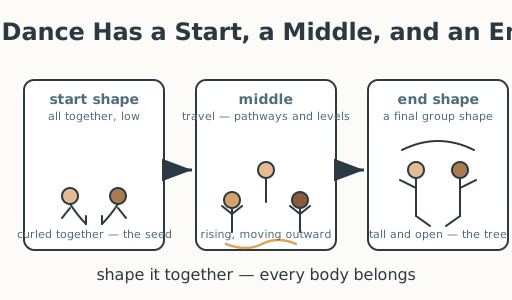
- Meet the map (10 min). Look at the movement map. Here is a worked example. Idea: a seed growing. Beginning: everyone starts low, curled in a tight cluster — the seed. Middle: travel outward, rising to different levels along curved pathways — the shoot reaching for sun. End: come together in a tall, open group shape — the tree in full leaf. One clear idea, three parts.
- Choose your idea (5 min). Pick one from the cards — a storm, a river, a journey, a market morning, a day at work — or invent your own. Say it in one sentence.
- Map it together (15 min). On your movement map, sketch your start shape, your middle travel (who goes where, at what level, along what pathway), and your end shape. Let different people propose each part, and decide together. Everyone has a place in every part.
- Rehearse (10 min). Practice slowly, then up to a simple beat. Fix the spacing, the timing, and the shared shape. Ask: does the idea read clearly? Does everyone belong?
- Close (5 min). You made a dance the way people have always made dances — together. Next lesson you will see how dances around the world carry the place and history of the communities that made them.
Differentiation
- Support: Provide the idea and the start/end shapes pre-sketched, and ask the group to create only the middle travel; keep one shared, simple pathway.
- Extension: Add a change of speed or level in the middle and explain how it deepens the idea for an audience.
Assessment
- Performance (peer/observation): Does the group perform a dance or scene with a clear idea and an audible/visible beginning, middle, and end, shaped cooperatively with every member included?
- Self-check: The group asks, “Did we shape it together, does every person belong in every part, and does our idea read clearly to someone watching?”
Home connection
Watch any group moving together — birds, a sports team, a family at work — and notice the beginning, middle, and end of their movement, and how they cooperate.
Resources
- The elements of choreography (levels, pathways, shapes) are standard in elementary dance education; cooperative ensemble work is a core practice. For accessible framing, see the Kennedy Center’s arts education resources on dance: https://www.kennedy-center.org/education/