Lesson 08 — How Dance and Drama Reflect Place, History, and Community
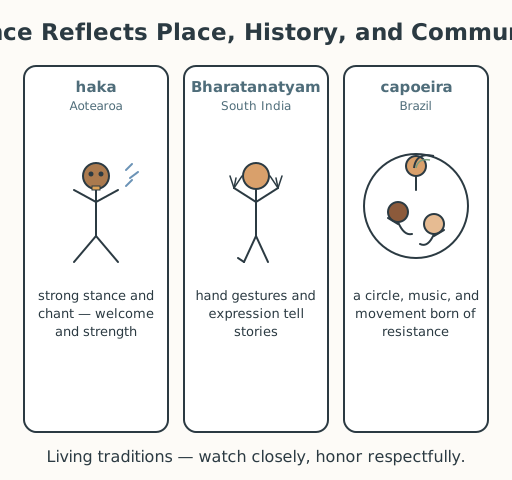
Learners meet dance and drama traditions from three world regions and learn to read movement as a carrier of place, history, and community. A worked example reads the Māori haka (strength, welcome, chant), Bharatanatyam (hand gestures telling epic stories), and capoeira (a circle of music and movement born of resistance). Learners complete a movement observation chart, honoring every tradition as living practice.
Objectives
Objectives
- D07.S3.05.02 Explain how dance or drama reflects the place, history, or community that made it, citing what they observe.
Essential question
How does dance or drama reflect the place, history, and community that made it?
Key vocabulary
Materials
Standard materials
- Dance-from-a-culture observation cards · 1 set Cards describing three traditions with what to watch for — Māori haka (Aotearoa; strong stance, chant, wide eyes), Bharatanatyam (South India; hand gestures and expression telling epic stories), capoeira (Brazil; a circle, music, and dance-martial movement born of resistance)
- Movement observation chart · 1 per learner A three-column page — "What I observe (movement)" → "What it tells me about the place" → "What it tells me about history or community"
Low-tech / no-cost
- Spoken movement descriptions Describe each tradition's movement in words (wide stance, precise hand shapes, low sweeping steps in a circle) so learners can observe without cards or video
- Observation by voice Complete the chart aloud in pairs, naming one observable movement and one thing it tells us
Enriched / lab & device
- Respectful short video clips · 1 set Brief clips (if available and respectful) of living practitioners performing these traditions today
- A world map and observation cards · 1 Place each tradition near its place of origin, building a global picture of movement reflecting place and history
Works in different contexts
- large-group Model the haka worked example on the board, then have small groups each take one tradition and complete the chart before sharing out
- multi-age Younger learners name one movement they see; older learners connect it to place, history, or community in a full sentence
- self-directed A learner chooses two traditions, completes the chart for each, and writes one sentence comparing how each reflects its place or history
- level-grouped Learners ready to extend research a fourth tradition of their choice, cite a source, and add a chart row
- outdoor-only Discuss how a community's dance might grow from its land — flat plains, steep hills, forest or shore — and try one movement idea outdoors
Lesson 8 — How Dance and Drama Reflect Place, History, and Community
Summary
Learners meet dance and drama traditions from three world regions and learn to read movement as a carrier of place, history, and community. A worked example reads the Māori haka (strength, welcome, chant), Bharatanatyam (hand gestures telling epic stories), and capoeira (a circle of music and movement born of resistance). Learners complete a movement observation chart, honoring every tradition as living practice.
Objectives
- Explain how dance or drama reflects the place, history, or community that made it, citing what they observe. (D07.S3.05.02)
Connection
Movement carries memory. The way people move at a wedding, a ceremony, or a game tells you who they are: a strong planted stance says “we stand firm”; precise hand gestures tell a story without a word; a circle of movers around music says “we belong to each other.” A dance is a community’s story told with the body — its land, its history, its togetherness. Today you learn to read movement the way you read a friend’s face, and to meet each tradition with respect.
Materials
- Dance-from-a-culture observation cards
- Movement observation chart
Preparation
- Prepare the observation cards and, if possible, respectful video clips of each tradition.
- Copy a movement observation chart for each learner.
- Recall Grade 4: learners learned and performed a simple dance form from another culture and described its meaning or occasion.
Facilitator note
This lesson is written to the learner (“you”). The idea to land is non-ranking
observation: we cite what we see in the movement and connect it to place, history, or
community — never to rank one tradition “better” or “more advanced.” These are living
traditions, performed today by living practitioners and communities; say this plainly.
If a learner (or their family) belongs to a tradition discussed, invite them to be the
authority on its meaning. Capoeira’s history includes enslavement and resistance — present
it with honesty at a depth grade 5 can hold, always connecting to the strength and
creativity of the people who built it, never to despair. See docs/facilitation.md on
holding difficult history safely and docs/contexts.md on cultural power dynamics.
Procedure
- Gather (5 min). Last lesson you made a dance of your own. Today you look at dances and scenes from around the world and read them the way you read a friend’s face: what does this movement tell me about the place, the history, and the community of the people who dance it?
- Meet the reading (15 min). First, the haka of the Māori people of Aotearoa (New Zealand). What I observe: a strong, planted stance; stamping feet; a chanted call; wide eyes and a tongue thrust forward. What it tells me: this is movement of strength and welcome — a challenge and a greeting, performed to honor visitors and ancestors, belonging to a people and their land. Second, Bharatanatyam from South India. What I observe: precise hand shapes (mudras) and a face that shifts expression, with the body telling a story to music. What it tells me: the gestures and expressions tell the great stories of the epics, a tradition born in the temples and carried forward as living art. Third, capoeira from Brazil. What I observe: people moving low and sweeping inside a circle, while music plays and others clap and sing. What it tells me: it is dance, game, and self-defense grown together — born among enslaved African people in Brazil, kept alive in the circle, and now a proud living tradition.
- Observe your own (15 min). Using the cards, note for each tradition one thing you observe in the movement, and what it tells you about the place, the history, or the community.
- Share and compare (10 min). In a small group, share one chart row. Notice the difference between what you see and what it tells you. Every tradition makes sense in its own place — none is “better,” each is a people’s story in motion.
- Close (5 min). Dance is memory made visible. Each tradition you met today is alive and belongs to people who still perform it. We honor it by watching closely and speaking with respect.
Differentiation
- Support: Use a sentence starter — “I see ___, and it tells me the place is ___ / the community ___” — and accept one movement-to-meaning pair per tradition.
- Extension: Research a fourth tradition (with a source), complete a chart row, and write one sentence on how its movement reflects its place or history.
Assessment
- Formative (observation/self): Can the learner name at least one observable movement feature of a tradition and connect it, with a reason, to place, history, or community — without ranking traditions?
- Self-check: The learner asks, “Did I name something I actually saw, and did I connect it to place, history, or community with a reason — speaking about living people with respect?”
Home connection
Watch a dance or a scene from a place different from your own (in person, in a film, or online) and name one movement you see and one thing it might tell you about that place or its people.
Resources
- UNESCO’s Intangible Cultural Heritage lists frame these as living traditions (e.g., the “Capoeira circle”): https://ich.unesco.org/
- For classroom-friendly framing of dance traditions, see the Kennedy Center’s arts education resources: https://www.kennedy-center.org/education/