Lesson 10 — Compare Designs for Different Climates: How Environment Shapes Design
The capstone brings the unit together: learners compare shelters designed for different climates and resources and explain how the environment shapes design — an igloo's snow dome for the cold, a yurt's felt for the steppe, a stilt house for the floodplain, an adobe house for dry heat. They revisit the unit's through-lines — plan and complete an artwork, compose and perform, choreograph together, design with reason — in a closing reflection.
Objectives
Objectives
- D07.S4.05.02 Compare designs made for different climates or resources and explain how the environment shapes design.
- D07.S1.05.01 Plan and complete an artwork with a clear idea, choosing materials and techniques to fit the idea.
- D07.S2.05.01 Compose a short piece or song with a clear beginning, middle, and end and perform it.
- D07.S3.05.01 Choreograph a short group dance or scene with a clear idea, working cooperatively to shape and perform it.
Essential question
How does the environment — climate and resources — shape what people design and build?
Key vocabulary
Materials
Standard materials
- House cards · 1 set Cards showing shelters shaped by different environments — an igloo (snow, cold Arctic), a yurt/ger (felt, open steppe), a stilt house (wood, floodplain), an adobe house (mud brick, dry heat), a thatched house (palm, tropical rain)
- Comparison chart · 1 per learner A three-column page — "Climate and place" → "Materials available" → "How the design fits the environment"
Low-tech / no-cost
- Spoken house descriptions Describe each shelter in words (what it is made of, where it stands, what it is for) so learners can compare without printed cards
- Natural-material mini-models Build tiny models from sticks, clay, and leaves to feel how each material and shape answers its climate
Enriched / lab & device
- A world map and climate images · 1 Place each house card on the map and connect it to its climate, building a global picture of environment shaping design
- A short respectful video of builders · 1 set Brief clips (if available) of people building with local materials today
Works in different contexts
- large-group Do a whole-class compare of two houses first, then have small groups each take two more and share their comparison
- multi-age Younger learners match each house to its climate; older learners explain how the materials and shape answer that climate
- self-directed A learner completes the chart for three houses and writes one paragraph explaining how environment shapes design
- level-grouped Learners ready to extend design a shelter for a chosen climate, choose materials, and defend the choice in writing
- outdoor-only Compare a real local shelter (a lean-to, a shade, a nest) to the house cards, discussing how each answers its own climate
Lesson 10 — Compare Designs for Different Climates: How Environment Shapes Design
Summary
The capstone brings the unit together: learners compare shelters designed for different climates and resources and explain how the environment shapes design — an igloo’s snow dome for the cold, a yurt’s felt for the steppe, a stilt house for the floodplain, an adobe house for dry heat. They revisit the unit’s through-lines — plan and complete an artwork, compose and perform, choreograph together, design with reason — in a closing reflection.
Objectives
- Compare designs made for different climates or resources and explain how the environment shapes design. (D07.S4.05.02)
- Revisit planning and completing an artwork (D07.S1.05.01), composing and performing a piece (D07.S2.05.01), and choreographing cooperatively (D07.S3.05.01).
Connection
Your home is shaped by where you live, even if you never noticed. Thick walls keep out desert heat; stilts lift a house above floodwater; snow blocks, packed hard, trap warmth in the bitter cold; a felt tent rolls up and travels with a herding family across the steppe. Builders everywhere answer the same need — shelter — with whatever the land gives and the climate demands. Design is the meeting of people, place, and need. Today you compare those answers and see the pattern: the environment shapes the design.
Materials
- House cards
- Comparison chart
Preparation
- Prepare the house cards, each labeled with its place and climate.
- Copy a comparison chart for each learner.
- Recall Grade 4: learners explained how an object from another culture reflects its materials, needs, and ideas.
Facilitator note
This lesson is written to the learner (“you”). The idea to land is environment shapes
design, read through comparison — never ranking. An igloo and an adobe house are each
perfect for their place; neither is “better.” Guard against framing any people’s
building as “primitive”; these are sophisticated, time-tested answers to real conditions,
still built and valued by living communities. The closing reflection is the unit’s
retrieval practice: recall the plan-and-complete artwork, the composed and performed
piece, and the cooperative dance — not as review but as a chance to see the whole. See
docs/facilitation.md and docs/contexts.md.
Procedure
- Gather (5 min). This unit you planned and completed an artwork, composed and performed a piece, choreographed a dance together, and built something that solved a real problem. Today one last idea ties it all together: design answers its environment.
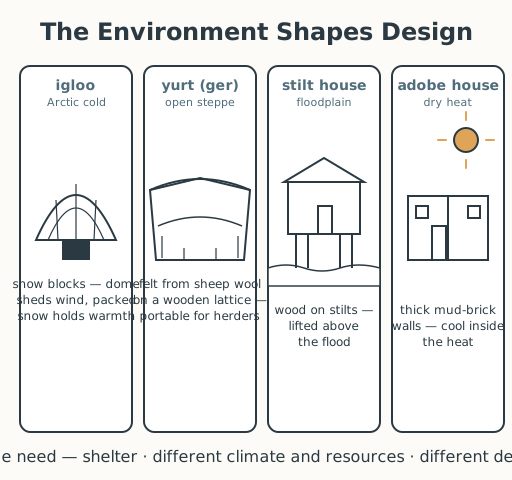
- Meet the shelters (15 min). Look at the house cards, one at a time. The igloo — a dome of snow blocks in the Arctic cold: the dome sheds the wind, and packed snow traps body heat. The yurt (ger) — a round tent of felt over a wooden lattice on the open steppe: felt from sheep wool is warm and rolls up, so herding families can move with their animals. The stilt house — a wooden house raised on posts where rivers flood: the stilts lift the living space above the water. The adobe house — thick mud-brick walls in dry heat: the thick walls hold out the sun’s heat and keep the inside cool. Each is a different answer to the same question: how do we shelter ourselves here, with what this place gives?
- Compare (15 min). On your chart, fill in each shelter: its climate and place, its materials, and how the design fits the environment. Then write one sentence that states the pattern you see across all of them.
- Share the pattern (10 min). In a small group, share your sentence. Listen for how each person names the pattern: the materials come from the place, and the shape answers the climate. No design is “better” — each fits where it lives.
- Revisit the unit (10 min). Look back: you planned an artwork with a clear idea and completed it; you composed a piece with a beginning, middle, and end and performed it; you choreographed a dance cooperatively; you designed and built a fix and explained your choices. Say which of these you are most proud of, and why.
- Close (5 min). The arts and design are one human act: seeing the world, and shaping something honest and useful from it — with the land, with each other, and with a clear idea. That act belongs to everyone, everywhere, and now it belongs to you.
Differentiation
- Support: Match each house to its climate with a sorting activity first, and use a sentence starter — “Because the climate is ___ and the material is ___, the design ___.”
- Extension: Design a shelter for a chosen climate (cold, wet, hot, windy), choose materials, and write a short defense of the choice.
Assessment
- Summative (observation/portfolio): Can the learner compare at least two designs for different climates and explain, with reasons, how each environment shaped its design? Does the closing reflection recall the unit’s through-lines?
- Self-check: The learner asks, “Can I explain how climate and materials shape a design, and can I name what I am most proud of from this unit?”
Home connection
Look at your own home (or a neighbor’s) and name one way its design answers your local climate or materials — thick walls, a sloped roof, shade, or a water channel.
Resources
- For classroom-friendly framing of how environment shapes human shelters, see National Geographic’s education resources on human habitats and adaptation: https://education.nationalgeographic.org/
- UNESCO’s Intangible Cultural Heritage lists include living building and craft traditions (e.g., traditional felt-making for yurts): https://ich.unesco.org/