Lesson 01 — Two Rivers, Two Peoples: A Comparing Timeline
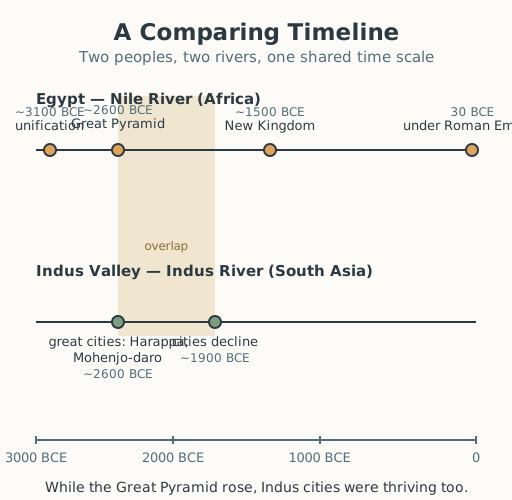
Learners build their first comparing timeline: two civilizations on two parallel rows sharing one time scale. A worked example places ancient Egypt (Nile) and the Indus Valley (Indus) side by side, and learners discover that while Egypt was building the Great Pyramid, Indus cities were thriving at the same time — two peoples, far apart, both growing great river-valley cities.
Objectives
Objectives
- D08.S1.05.01 Build a timeline that compares two cultures or civilizations and identify what changed and what stayed the same in each.
Essential question
How does a two-row timeline show what two civilizations were doing at the same time?
Key vocabulary
Materials
Standard materials
- Comparing-timeline poster · 1 A large two-row timeline showing ancient Egypt on the top row and the Indus Valley on the bottom row, on the same time scale, with four Egyptian and two Indus events
- Event cards · 1 set of 6 Six date-and-event cards (four Egyptian, two Indus Valley) for learners to place in order on the blank timeline
- Blank two-row timeline page · 1 per learner A page with two parallel rows, a shared BCE/CE scale, and spaces for event cards or written events
- Pencils and a straight edge · per learner
Low-tech / no-cost
- A rope or stick timeline on the ground Lay two parallel ropes or draw two parallel lines in the dirt; learners stand on one line for Egypt and one for the Indus, in date order
- Voice and body Learners hold event cards and line up in order facing a partner on the other row to see what happened at the same time; no page needed
Enriched / lab & device
- A digital timeline tool · 1 per pair A simple timeline builder (if devices are available) where learners drag events onto two parallel rows and see them align
- A world map · 1 A map to place the Nile and the Indus so learners see where the two civilizations grew, thousands of kilometres apart
Works in different contexts
- large-group Build one big two-row timeline on the board together, calling out each event and date; then pairs place a smaller set in order and compare with the board
- multi-age Younger learners match event cards to their dates; older learners place them in order and explain what "at the same time" means using two events
- self-directed A learner reads the worked example, places the six event cards on their blank timeline, and writes one sentence about what happened in both places at once
- level-grouped Learners ready to extend add a third civilization's events to a third row, or convert the timeline to a different scale (centuries rather than exact dates)
- outdoor-only Draw two parallel lines on the ground and have learners stand at their event's place, then walk across to find a partner from the other river at the same time
Lesson 1 — Two Rivers, Two Peoples: A Comparing Timeline
Summary
Learners build their first comparing timeline: two civilizations on two parallel rows that share one time scale. A worked example places ancient Egypt (the Nile) and the Indus Valley (the Indus) side by side, and learners discover something surprising: while Egypt was building the Great Pyramid, Indus cities were thriving at the same moment — two peoples, thousands of kilometres apart, both growing great river-valley cities. The timeline is this unit’s first portfolio artifact.
Objectives
- Build a timeline that compares two cultures or civilizations and identify what changed and what stayed the same in each. (D08.S1.05.01)
Connection
Think of two friends born on the same day, far apart. One is learning to swim by the sea while the other is learning to herd goats in the hills. A timeline with two rows shows that these two lives are happening at the same time, even though they look very different. History is like that: peoples on different rivers, on different continents, were building cities and telling stories at the same moment — and a comparing timeline lets us see them together.
Materials
- Comparing-timeline poster
- Event cards (Egypt and Indus Valley)
- Blank two-row timeline page
- Pencils and a straight edge
Preparation
- Print or draw the comparing-timeline poster (Egypt top row, Indus Valley bottom row, shared BCE/CE scale).
- Copy the event cards and a blank two-row timeline page for each learner.
- Arrange a circle for the worked example and a flat space for placing events.
Facilitator note
This lesson is written to the learner (“you”). The skill to build is placing events on
a shared time scale and reading “at the same time” across two rows — not memorizing
dates. Model the worked example fully (explicit instruction, guided practice) before
learners work on their own; a comparing timeline is a new skill for most Grade 5 learners.
Explain BCE (“before the common era”) and CE (“common era”) simply, and note that
many peoples count years in their own ways — BCE/CE is one shared convention, not the only
one. Guard against ranking (“Egypt was better than the Indus”): the point is that both
peoples built great things, differently. This lesson produces the unit’s two-civilization
timeline portfolio artifact. See docs/facilitation.md.
Procedure
- Gather (5 min). Last year you put events on a single timeline with dates. Today you learn something bigger: a comparing timeline — two rows, two peoples, one shared time scale — so you can see what was happening in two places at the same time.
- Meet the two rivers (10 min). Look at the poster. The top row is ancient Egypt, a civilization that grew along the Nile River in Africa. The bottom row is the Indus Valley, a civilization that grew along the Indus River in South Asia. Both rivers flooded and left rich soil for farming; both peoples built great cities. They lived thousands of kilometres apart — and neither one is “more important” than the other.
- Worked example: place the events (15 min). Watch as we place the events in order, oldest to newest. Egypt: unified around 3100 BCE; the Great Pyramid at Giza built around 2600 BCE; the New Kingdom, a time of great power, around 1500 BCE; and rule under the Roman Empire from 30 BCE. Indus Valley: great cities such as Harappa and Mohenjo-daro thriving around 2600 BCE; the cities declining around 1900 BCE. Now look across the rows: while the Great Pyramid was rising in Egypt, Harappa and Mohenjo-daro were busy, brick-built cities on the Indus. That overlap is the “same time” the timeline shows.
- Place your own (15 min). Take the six event cards and place them on your blank two-row timeline — Egypt on top, Indus on the bottom, in date order. Use your straight edge to keep the rows even. Check with a partner: is every card on the right row and in the right order? Which two events happened at the same time?
- Close (5 min). A comparing timeline lets you see two peoples together, at the same moment, each doing remarkable things. You have just built one. It becomes the first page of your portfolio for this unit.
Differentiation
- Support: Provide a pre-marked timeline with faint date lines and fewer event cards; scribe or place cards with the learner and read “at the same time” aloud together.
- Extension: Add a third row for one more civilization (for example, the Maya or early China) and place two or three of its events, noting any overlap with the first two rows.
Assessment
- Formative (observation/portfolio): Can the learner place events on the correct row and in the correct order, and point to two events that happened at the same time?
- Self-check: The learner reads the timeline back and asks, “Are the events in order, and can I name one thing that happened in both places at once?”
Home connection
Ask someone at home to tell you two things that happened in the same year in two different places they know — and share the “same time” you found between Egypt and the Indus Valley.
Resources
- Ancient Egypt: unification around 3100 BCE and the Great Pyramid at Giza around 2600 BCE are standard dates in the archaeological record (see the British Museum’s Egypt collection, https://www.britishmuseum.org/collection/egypt). The Indus Valley civilization’s mature phase around 2600–1900 BCE and its cities Harappa and Mohenjo-daro are documented by the Archaeological Survey of India and UNESCO World Heritage listings (Mohenjo-daro, https://whc.unesco.org/en/list/138/). Dates are approximations that scholars revise as new evidence appears; the comparing idea, not the exact year, is what matters here.