Lesson 02 — What Changed, What Stayed: Change and Continuity on the Nile and Indus
Learners turn from building the timeline to reading it. They sort features of ancient Egypt and the Indus Valley into what changed over time and what stayed the same, and discover that change and continuity live side by side in every civilization — the river kept flooding every year while buildings grew grander, and writing lasted for centuries while cities rose and later declined.
Objectives
Objectives
- D08.S1.05.01 Build a timeline that compares two cultures or civilizations and identify what changed and what stayed the same in each.
Essential question
In a civilization's long life, what changed over time and what stayed the same?
Key vocabulary
Materials
Standard materials
- Changed / stayed the same chart · 1 per pair A two-column chart (changed | stayed the same) with picture prompts for each civilization
- Egypt and Indus fact strips · 1 set Short strips naming a feature of each civilization — the Nile's yearly flood, pyramids, the undeciphered Indus script, brick-built streets, farming, writing — for sorting into changed or stayed
- Pencils · per learner
Low-tech / no-cost
- Two ground circles Draw a circle labeled "changed" and one labeled "stayed the same" in the dirt; call out a feature and learners step to the matching circle and say why
- A read-aloud with thumbs The facilitator names a feature; learners show thumbs-up for "stayed the same" and a wave for "changed"; no paper needed
Enriched / lab & device
- A long timeline strip per pair · 1 per pair A metre of paper per pair to mark where each change happened across the civilization's life, showing change as something that happens over time
- Images of both civilizations' cities and writing · 1 set Photographs or reproductions (brick streets, pyramids, seals, script) to discuss what stayed and what changed
Works in different contexts
- large-group Sort one civilization's features together on the board, then have pairs sort the second and compare their charts
- multi-age Younger learners sort picture cards into changed or stayed; older learners write one sentence explaining why a feature counts as change or continuity
- self-directed A learner reads the fact strips, sorts them into the two columns for each civilization, and writes one changed thing and one stayed thing for each
- level-grouped Learners ready to extend choose a third thing (for example, a tool or a belief) and argue whether it is change or continuity, with a reason
- outdoor-only Use the two ground circles and call out features; after each, one learner says the reason for their choice; no paper needed
Lesson 2 — What Changed, What Stayed: Change and Continuity on the Nile and Indus
Summary
Learners turn from building the comparing timeline to reading it. They sort features of ancient Egypt and the Indus Valley into what changed over time and what stayed the same, and discover that change and continuity live side by side in every civilization — the river kept flooding every year while buildings grew grander, and writing lasted for centuries while cities rose and later declined.
Objectives
- Build a timeline that compares two cultures or civilizations and identify what changed and what stayed the same in each. (D08.S1.05.01)
Connection
Your own life has both change and continuity. Your body grows and your skills change every year — yet some things stay the same: the way your family greets each other, the season the rains come, the food at a festival. History works the same way. A civilization keeps some things steady for a thousand years while other things change completely — and the timeline we built yesterday is the map that shows both.
Materials
- Changed / stayed the same chart
- Egypt and Indus fact strips
- Pencils
Preparation
- Copy the two-column chart (changed | stayed the same) for each pair.
- Copy and cut the fact strips for Egypt and the Indus Valley.
- Keep yesterday’s comparing timeline visible so learners can point to where a change happened.
Facilitator note
This lesson is written to the learner (“you”). The idea to land is that change and
continuity are both real and both normal — a civilization is not “better” because it
changed more or less. Model the first sort aloud (guided practice) so learners see the
reasoning: a feature is “continuity” if it lasted and returned, “change” if it appeared,
grew, or faded. Welcome disagreement and ask for reasons rather than one “right” answer;
some features (a city, a craft) are both. Keep both civilizations at equal dignity. See
docs/facilitation.md.
Procedure
- Gather (5 min). Yesterday you built a timeline of two river peoples. Today you read it a new way: what changed over time, and what stayed the same.
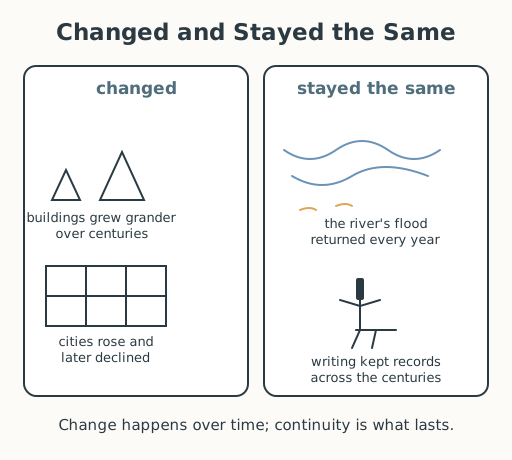
- Meet the two ideas (10 min). Change is when something appears, grows, or fades. Continuity is when something lasts and returns. Look at the chart. Changed: the pyramids grew grander over centuries; the Indus cities rose, then later declined. Stayed the same: the Nile’s flood returned every year; writing kept records across the centuries in both lands. Notice: a civilization has both at once.
- Sort the features (20 min). Take the fact strips. For each strip, ask: did this change over the civilization’s long life, or did it stay the same? Place it in the matching column. Egypt: the yearly flood; pyramids; farming along the river; writing in hieroglyphs; the power of rulers growing and shrinking. Indus Valley: grid streets and brick drains; the still-undeciphered script; farming; the cities rising and declining. Check with a partner: do you agree, and can you each give a reason?
- Point to the timeline (10 min). Go back to yesterday’s timeline. Point to where a change happened (a pyramid built, a city declining) and to what lasted across the whole row (the river, farming, writing). Say it in one sentence: “The river stayed the same, while the cities changed.”
- Close (5 min). Every people keeps some things steady and changes others — that is the rhythm of the human story. You can now find both on a timeline.
Differentiation
- Support: Use picture cards instead of text strips, and sort one civilization with a partner while the facilitator models the reasoning aloud.
- Extension: Choose one feature that could be both change and continuity (a city, a craft) and write two sentences — one for each side — with reasons.
Assessment
- Formative (observation): Can the learner sort features into changed or stayed and give a reason, and name one change and one continuity for each civilization?
- Self-check: The learner asks, “Did I explain why each feature is change or continuity, and did I find at least one of each?”
Home connection
Name one thing in your home or neighborhood that has changed in your lifetime and one thing that has stayed the same — and ask a grown-up which they think changed the most.
Resources
- The idea of change and continuity as two lenses on the past is a standard concept in historical study; it is the foundation of the D08.S1 strand (Time, Change & Continuity). Archaeological evidence for the specific features — the Nile’s annual flood and irrigation (British Museum, Egypt collection) and the Indus cities’ grid streets and drainage (UNESCO, Mohenjo-daro, https://whc.unesco.org/en/list/138/) — supports the changed/stayed sorting. The Indus script remains undeciphered, which is itself an example of continuity (a lasting record we cannot yet read).