Lesson 04 — Stories of Beginnings: Comparing Origin Stories
Learners compare three origin stories as living traditions, told with respect: the Māori separation of Ranginui and Papatūānuku, the Haudenosaunee story of Sky Woman and Turtle Island, and the Yoruba story of land made from the waters. They see how each reflects the place its people live and the things they value — and they practice holding many peoples' stories side by side without ranking them.
Objectives
Objectives
- D08.S2.05.01 Compare origin stories from two or more peoples and explain how each reflects the people who tell it.
Essential question
How does each people's origin story reflect the place they live and the things they value?
Key vocabulary
Materials
Standard materials
- Origin-story cards · 1 set of 3 Three respectful one-page retellings — the Māori separation of Ranginui (sky) and Papatūānuku (earth); the Haudenosaunee story of Sky Woman and Turtle Island; and the Yoruba story of land made from the waters — each naming the people who tell it and that it is kept alive today
- Reflection chart · 1 per learner A three-row chart (story | what it reflects about the people) for comparing the stories
- Pencils · per learner
Low-tech / no-cost
- A spoken retelling The facilitator tells each story aloud; learners retell one in their own words and say what the people value in it; no cards needed
- A listening circle Sit in a circle and pass a stone or shell; each learner adds one image from a story (sky, earth, water, turtle) and what it shows
Enriched / lab & device
- A world map · 1 A map to place Aotearoa New Zealand (Māori), the Haudenosaunee homelands in North America, and Yoruba lands in West Africa, so learners see the places behind the stories
- A guest teller or recorded telling · 1 If a community member can share their people's origin story, or a respectful recorded telling is available, listen and discuss with the same reflection chart
Works in different contexts
- large-group Read one story together and chart its reflections, then have small groups read the other two and share one reflection each
- multi-age Younger learners draw one image from a story; older learners explain what that image shows about the people who tell it
- self-directed A learner reads the three cards, fills the reflection chart, and writes one sentence about how each story reflects its people
- level-grouped Learners ready to extend compare two stories directly — what they share (sky and earth, water and land) and how each reflects a different place
- outdoor-only Sit outside and retell the stories under the open sky, then name what each story notices about sky, earth, or water; no paper needed
Lesson 4 — Stories of Beginnings: Comparing Origin Stories
Summary
Learners compare three origin stories as living traditions, told with respect: the Māori separation of Ranginui (sky) and Papatūānuku (earth), the Haudenosaunee story of Sky Woman and Turtle Island, and the Yoruba story of land made from the waters. They see how each reflects the place its people live and the things they value — and they practice holding many peoples’ stories side by side without ranking them.
Objectives
- Compare origin stories from two or more peoples and explain how each reflects the people who tell it. (D08.S2.05.01)
Connection
Every family has a story about where it comes from — a grandparent’s journey, a village your people left, a place your name remembers. Those stories tell you something real about who you are: what your people noticed, what they valued, where they lived. Peoples all over the world keep such stories about the very beginning — and each one reflects the people who tell it, the way a family story reflects a family.
Materials
- Origin-story cards (Māori, Haudenosaunee, Yoruba)
- Reflection chart
- Pencils
Preparation
- Copy the three origin-story cards, written simply and respectfully, naming the people and noting each is a living tradition kept alive today.
- Copy a reflection chart for each learner.
- Review the note below on how to hold origin stories with respect.
Facilitator note
This lesson is written to the learner (“you”). These are living traditions of real
peoples, not “myths” in the sense of “made-up tales.” Use the words origin story and
told by, and name each people with respect. Some learners may belong to these peoples or
hold other sacred traditions; receive their knowledge warmly and let them be the authority
on their own story. Do not rank the stories or ask which is “true”; hold them side by
side, as the curriculum holds scientific and cultural accounts without ranking them
(docs/philosophy.md §11). Note that details vary from teller to teller and community to
community; that variety is part of a living tradition, not an error. This lesson produces
the unit’s origin-story comparison portfolio artifact. See docs/facilitation.md on
holding topics safely.
Procedure
- Gather (5 min). You have traced change on timelines and in tools. Today you listen to how peoples tell the very beginning — their origin stories — and how each one reflects the people who tell it.
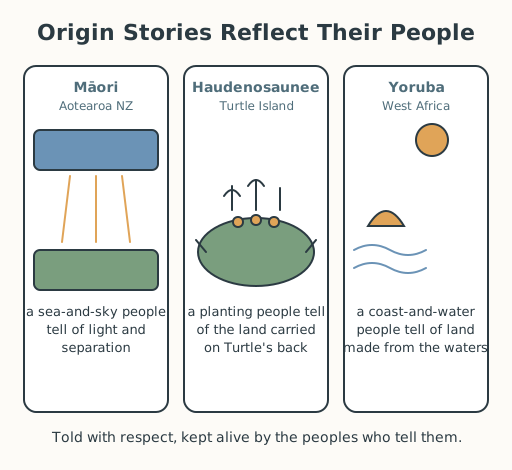
- Listen to three stories (20 min). Read the cards. Māori (Aotearoa New Zealand): the sky, Ranginui, and the earth, Papatūānuku, held each other so closely their children lived in darkness — until the children pushed them apart and let light into the world. A sea-and-sky people tell of light and separation. Haudenosaunee (North America): Sky Woman fell toward the water, and the animals helped her; the earth grew on Turtle’s back, becoming Turtle Island. A planting people tell of land carried and grown. Yoruba (West Africa): the creator sent beings to make land rise from the primordial waters, and the world began from water. A coast-and-water people tell of land made from the waters. Each story is kept alive by its people today.
- Find what each reflects (15 min). On your reflection chart, write each story and what it shows about its people — the sky, earth, sea, water, planting, family, light, balance. Ask: What does this people notice? What do they seem to value? For example, the Māori story holds the sky and earth as parents and the longing for light; the Haudenosaunee story holds the land and the animals who helped; the Yoruba story holds water and the making of land.
- Compare, without ranking (10 min). With a partner, find one thing the stories share — sky and earth, water and land, light and beginning — and one thing that is different because the peoples live in different places. Notice: no story is “better” than another; each is true to its people.
- Close (5 min). Origin stories are a window: through them we see what a people noticed and treasured. You have held three windows side by side, with respect.
Differentiation
- Support: Read one story at a time and draw its central image (sky/earth, turtle, water) before writing; use sentence frames (“This story shows the people valued…”).
- Extension: Compare two stories directly in writing — what they share and how each reflects a different place and way of life.
Assessment
- Formative (portfolio/observation): Can the learner retell each story’s central image and explain one thing it reflects about the people who tell it?
- Self-check: The learner asks, “Did I hold each story with respect, and did I say what each one reflects — not which one is ‘best’?”
Home connection
Ask someone at home if your family or community has a story about where you come from, and share one thing it shows about what your people value.
Resources
- These origin stories are living traditions of real peoples. The Māori account of Ranginui and Papatūānuku is told across iwi (tribes) of Aotearoa New Zealand (Te Ara — The Encyclopedia of New Zealand, https://teara.govt.nz). The Haudenosaunee (Six Nations) account of Sky Woman and Turtle Island is a living tradition of the Haudenosaunee Confederacy (National Museum of the American Indian, https://americanindian.si.edu/). The Yoruba account of creation, involving Olodumare and the making of land from the waters, is a living tradition of Yoruba-speaking peoples of West Africa (see the British Museum and UNESCO’s documentation of Yoruba culture). Details vary by community; the point here is that each story reflects its people, not a single fixed wording. Treat each as its people’s own account, not as a “myth” to rank.