Lesson 03 — Tools That Changed Everything: Writing, the Wheel, the Plow
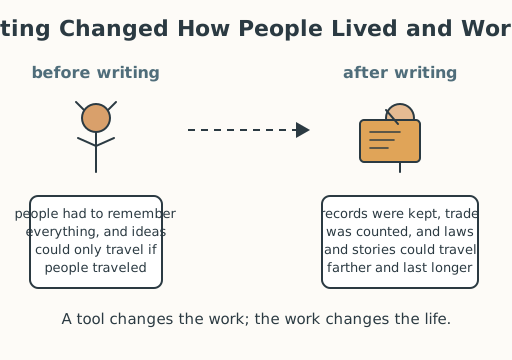
Learners explore how a single tool changes a whole way of life. A worked example traces writing — before it, people had to remember everything and ideas could only travel with people; after it, records, trade, laws, and stories could last and spread. Learners then choose the wheel or the plow and trace its own before-and-after chain, seeing technology as something people invented and used, with effects both helpful and complicated.
Objectives
Objectives
- D08.S1.05.02 Explain how a tool or technology, such as writing, the wheel, or the plow, changed how people lived and worked.
Essential question
How did a single tool — writing, the wheel, or the plow — change how people lived and worked?
Key vocabulary
Materials
Standard materials
- Tool-effect chain poster · 1 A poster showing a before-and-after chain for writing — before (memory only, people had to be present) to after (records kept, trade counted, laws and stories written down)
- Tool cards · 1 set of 3 Three cards — writing, the wheel, the plow — each naming who used it, when it appeared, and what it changed
- Before–after page · 1 per learner A two-column page (before | after) for the learner to trace one tool's effect on daily life and work
- Pencils · per learner
Low-tech / no-cost
- Act out before and after Mime carrying a heavy load by hand, then rolling it on a log (wheel); mime remembering a list, then writing it down; no page needed
- A spoken before–after chain The facilitator names a tool and learners call out what life was like before and after it; voice only
Enriched / lab & device
- Images of early tools · 1 set Photographs of a Mesopotamian clay tablet, a wheeled toy from the Americas, and an early ard plow, to discuss who made them and when
- A short timeline of inventions · 1 A poster showing when writing, the wheel, and the plow appeared in different places, to place the tools in time
Works in different contexts
- large-group Do the writing chain together on the board, then have small groups each trace a different tool and share one before-and-after aloud
- multi-age Younger learners act out before and after; older learners write the chain and add a second effect (for example, the wheel's effect on travel and on pottery)
- self-directed A learner reads the tool cards, chooses one tool, fills the before–after page, and writes one sentence on how it changed work
- level-grouped Learners ready to extend compare two tools and explain which they think changed daily life more, with reasons — no single "right" answer
- outdoor-only Try moving a heavy object with and without rollers (logs or round stones) to feel the wheel's effect, then talk about before and after; no paper needed
Lesson 3 — Tools That Changed Everything: Writing, the Wheel, the Plow
Summary
Learners explore how a single tool changes a whole way of life. A worked example traces writing — before it, people had to remember everything and ideas could only travel with people; after it, records, trade, laws, and stories could last and spread. Learners then choose the wheel or the plow and trace its own before-and-after chain, seeing technology as something people invented and used, with effects both helpful and complicated.
Objectives
- Explain how a tool or technology, such as writing, the wheel, or the plow, changed how people lived and worked. (D08.S1.05.02)
Connection
Imagine your day with no way to write anything down — no list, no message, no book. You would have to carry every word in your head, and a story could only go as far as a person could walk and remember it. Now imagine the same day with writing: a note left on a table tells your family where you are. That difference — before and after a tool — is what we study today. A tool changes the work, and the work changes the life.
Materials
- Tool-effect chain poster
- Tool cards (writing, the wheel, the plow)
- Before–after page
- Pencils
Preparation
- Print or draw the tool-effect chain poster for writing (before → after).
- Copy the three tool cards and a before–after page for each learner.
- Gather a few props for acting out (a log or round stones, a heavy object, a stick to “write” in sand).
Facilitator note
This lesson is written to the learner (“you”). The idea to land is a tool changes how
people live and work, with effects both helpful and complicated — not that tools are
simple “good” or “bad.” Model the writing chain fully (worked example) before learners
trace the wheel or the plow. Keep it honest and global: writing appeared independently in
Mesopotamia, Egypt, China, and Mesoamerica; the wheel spread across Eurasia but appeared
only on toys in the Americas (where large draft animals were not available) — a real,
fascinating difference, not a ranking. Technology is taught with neither worship nor fear.
See docs/philosophy.md §7 and docs/facilitation.md.
Procedure
- Gather (5 min). You have seen change and continuity on a timeline. Today you meet a cause of change: the tool — something people invented that changed how they lived and worked.
- Meet writing (10 min). Look at the chain poster. Before writing: people kept everything in memory, and ideas could only travel as far as a person could walk and remember. After writing: records were kept, trade was counted, laws were written down, and stories could last and travel far. Writing appeared independently in several places — Mesopotamia (clay tablets), Egypt (hieroglyphs), China (oracle bones), and Mesoamerica (Maya glyphs). No single people “invented it for everyone”; many peoples invented it for themselves.
- Trace your own tool (20 min). Choose the wheel or the plow from the tool cards. The wheel: first used for pottery, then for carts, it changed travel and the moving of goods — though in the Americas it appeared only on toys, because there were no large animals to pull carts. The plow: a tool pulled through soil, it let people farm more land and feed more people. On your before–after page, write or draw what work was like before the tool and after it, and one effect on daily life. Check with a partner: does your chain make sense, and could the same tool have had a complicated effect too?
- Share a chain (10 min). Tell your partner your before–after chain in one breath: “Before the plow, people could only scratch small plots; after the plow, they could farm more land and feed more people — but working the soil also got harder and tied people to the land.”
- Close (5 min). A tool is not magic — it is a choice people made that changed their work and their life. You can now trace that change from before to after.
Differentiation
- Support: Provide picture prompts for each tool’s before and after, and scribe the learner’s chain as they act it out.
- Extension: Choose a second tool and write a before–after chain, then compare which tool you think changed daily life more — with reasons, and no single “right” answer.
Assessment
- Formative (observation): Can the learner trace one tool from before to after and name an effect on how people lived or worked?
- Self-check: The learner asks, “Did I show both the before and the after, and did I name at least one real effect — including a complicated one?”
Home connection
Choose one tool your family uses every day (a phone, a stove, a bicycle) and ask someone at home what life or work was like before it was common.
Resources
- Writing emerged independently in several world regions — cuneiform in Mesopotamia (around 3200 BCE), Egyptian hieroglyphs, Chinese oracle-bone script, and Maya glyphs — a widely documented fact (British Museum, cuneiform; Smithsonian, writing systems). The wheel first appears around 3500 BCE in Mesopotamia (pottery then transport), and in the Americas it appears on toys but not for transport, in part because large draft animals were absent (Smithsonian Institution). Early plows (ards) appear in Mesopotamia and Egypt by roughly 4000–3000 BCE, with later iron plows in China; dates are approximate and revised as new evidence appears. The framing that tools have both helpful and complicated effects follows the curriculum’s “honest about technology” commitment (docs/philosophy.md).