Lesson 01 — Patterns in My Emotional Responses
Learners discover that feelings do not happen at random — the same feeling tends to show up again and again in similar situations, forming a pattern. Using a situation-to-feeling chart, they notice a repeated feeling from their own week and begin to predict it, which is the first step toward caring for it.
Objectives
Objectives
- D01.S1.06.01 Identify patterns in their own emotional responses and name what tends to trigger them.
Essential question
What patterns can I notice in how I tend to feel?
Key vocabulary
Materials
Standard materials
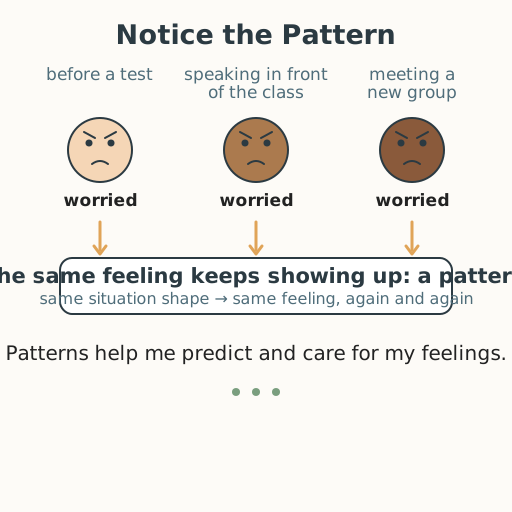
- Feeling-pattern poster · 1 A poster showing three different situations that each lead to the same feeling, connected to a banner reading "a pattern"
- My week's feelings page · 1 per learner A page with three columns — situation, feeling, how often — for the learner to notice a repeated feeling
- Pencils · per learner
Low-tech / no-cost
- A pattern drawn in the dirt or sand Draw three situations and one feeling, then trace the repeating shape with a stick; no page needed
- Voice and body Say three situations aloud and make the same feeling face or gesture for each to feel the repetition
Enriched / lab & device
- Laminated feeling-pattern strips · 1 per pair Reusable strips with dry-erase markers to map many situation-to-feeling patterns over the week
- A class 'feeling weather' chart · 1 A shared chart where learners post a dot for each feeling across the week to reveal class-wide patterns
Works in different contexts
- large-group Work one big example on the board together, then have learners complete their own page in small groups and share out one pattern each
- multi-age Younger learners point to the feeling a situation produces while older learners name the repeated situation-to-feeling shape and propose why it repeats
- self-directed A learner fills the three-column page from their own week and reads it back to check that the pattern really repeats
- level-grouped Learners ready to extend name two patterns — a comfortable one and a hard one — and what tends to come right before each
- outdoor-only Draw three situations and one feeling on the ground, then walk the repeating shape aloud; no paper needed
Lesson 1 — Patterns in My Emotional Responses
Summary
Learners discover that feelings do not happen at random: the same feeling tends to show up again and again in similar situations, forming a pattern. Using a situation-to-feeling chart, they notice a repeated feeling from their own week and begin to predict it. This is the first step toward caring for a feeling — you can prepare for what you can foresee.
Objectives
- Identify patterns in their own emotional responses and name what tends to trigger them. (D01.S1.06.01)
Connection
Think of the weather where you live: the same season tends to bring the same kind of sky — a dry wind, a heavy rain, a cool evening — year after year. Your feelings have a kind of weather too. One person feels worried again and again before being seen or judged; another feels peaceful again and again near water or quiet; another feels charged after a good game. Whether you live in a busy city or on a mountain farm, the feeling that keeps returning in the same kind of moment is your pattern — and once you can see a pattern, you can prepare for it.
Materials
- Feeling-pattern poster
- My week’s feelings page
- Pencils
Preparation
- Print or draw the feeling-pattern poster (three situations → one repeated feeling, with a banner reading “a pattern”).
- Copy a “my week’s feelings” page for each learner.
- Arrange a circle for gathering and a quiet space for individual work.
Facilitator note
This lesson is written to the learner (“you”). The one idea to land is that feelings
repeat in recognizable patterns, not that a learner’s feelings are “predictable” in a
way that boxes them in. Present the pattern as useful knowledge, never as a label or a
verdict (“you’re always worried”). A pattern is information about what tends to happen,
not a rule about who the learner is. Some learners carry heavy or private patterns
(loss, illness, home tension); invite only small, safe examples and never require a
learner to reveal a painful one. The skill is noticing, with gentleness. See
docs/facilitation.md on holding difficult topics safely.
Procedure
- Gather (5 min). Last year you learned that feelings have a strength and can be shaped by thoughts, memories, and body sensations. Today you look for something new: the patterns — the times the same feeling keeps showing up.
- Meet the pattern (10 min). Look at the poster. Here is a worked example: before a test → worried; speaking in front of the class → worried; meeting a new group → worried. Three different situations, the same feeling. That repeating shape — similar situation, similar feeling, again and again — is a pattern. A pattern is not a rule about you; it is a signal you can learn to read.
- Find your own pattern (15 min). Think of one small, safe feeling from your week — worried, excited, annoyed, proud, peaceful. On your page, list a few situations where it showed up. Do you see a repeating shape? What tends to come right before the feeling? Check with a partner: does your partner see the same shape in your list?
- Read the signal (10 min). Pick your clearest pattern. If you know this feeling tends to arrive in this kind of moment, what could you do next time to greet it — a breath, a friend, a plan? Write one small idea.
- Close (5 min). You are not a mystery to yourself. Your feelings have patterns, and reading them is the first step to caring for them.
Differentiation
- Support: Offer a picture-and-word bank of situations and feelings to sort into patterns; scribe the learner’s words.
- Extension: Notice a second pattern — a comfortable one and a hard one — and name what is different about how each arrives.
Assessment
- Formative (observation): Can the learner name a feeling that repeats for them and two or three situations where it shows up?
- Self-check: The learner reads their page back and asks, “Is this shape really repeating, or is it just one hard day?” and adjusts if needed.
Home connection
Ask someone at home about a feeling that shows up for them again and again — and share one pattern you noticed in yourself today.
Resources
- The idea that emotional responses follow recognizable, learnable patterns is central to cognitive-behavioral approaches (see the work of Aaron Beck on recurring thought and feeling patterns) and to self-awareness as framed by CASEL: https://casel.org/fundamentals-of-sel/