Lesson 02 — Naming My Triggers
Learners name what tends to set their feelings off — a trigger. They learn that a trigger can be a sound, a time, a place, a word, or a tired body, and that naming a trigger works like a warning light: it turns a feeling that surprises them into a feeling they can prepare for.
Objectives
Objectives
- D01.S1.06.01 Identify patterns in their own emotional responses and name what tends to trigger them.
Essential question
What tends to set my feelings off, and how does naming it give me power?
Key vocabulary
Materials
Standard materials
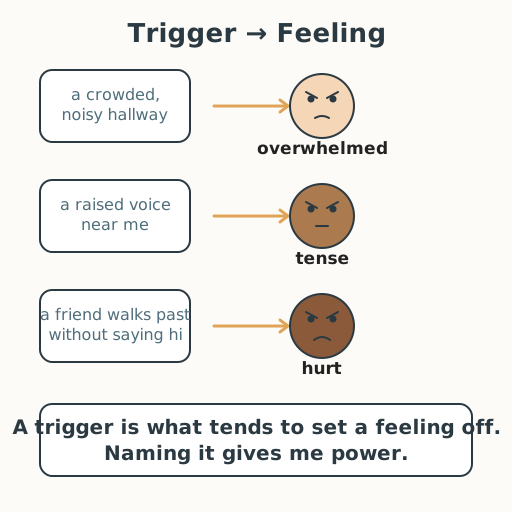
- Trigger-to-feeling poster · 1 A poster mapping three triggers (a noisy hallway, a raised voice, a friend walking past) to the feelings that follow
- My trigger map page · 1 per learner A two-column page — trigger / feeling that follows — for the learner to complete
- Pencils · per learner
Low-tech / no-cost
- A trigger map drawn on the ground Draw two columns in the dirt and place a stone in each while naming a trigger and the feeling it sets off
- Voice and body Say a trigger aloud, then show the feeling it sets off with a face or gesture; no page needed
Enriched / lab & device
- Laminated trigger-map strips · 1 per pair Reusable strips with dry-erase markers to rehearse many trigger-to-feeling pairs
- A class 'warning lights' chart · 1 A shared chart of common triggers with a friendly "warning light" drawn beside each, building shared vocabulary
Works in different contexts
- large-group Model one worked trigger together, then have small groups brainstorm common triggers and share out one each
- multi-age Younger learners name the feeling from a picture while older learners name the trigger and what a good warning signal would be
- self-directed A learner completes the two-column map for two real triggers of their own and reads it back to check the order (trigger, then feeling)
- level-grouped Learners ready to extend sort triggers into "body triggers" (tired, hungry) and "situation triggers" (noise, a word, a time of day)
- outdoor-only Draw two columns on the ground and walk from a trigger to its feeling, speaking each aloud; no paper needed
Lesson 2 — Naming My Triggers
Summary
Learners name what tends to set their feelings off — a trigger. They learn that a trigger can be a sound, a time, a place, a word, or a tired body, and that naming a trigger works like a warning light: it turns a feeling that surprises them into a feeling they can prepare for. This deepens Lesson 1’s pattern: the trigger is the “situation” side of the repeating shape.
Objectives
- Identify patterns in their own emotional responses and name what tends to trigger them. (D01.S1.06.01)
Connection
A storm does not come from nowhere — there is a darkening sky, a drop in the air, a first gust. The moment you learn to read those signs, you can close the window before the rain. Feelings are like that. A crowded market might reliably make one person feel overwhelmed; a raised voice might make another feel tense; being left out of a group might make a third feel hurt. Those “first gusts” are triggers — and naming them gives you a chance to act before the storm, not only after.
Materials
- Trigger-to-feeling poster
- My trigger map page
- Pencils
Preparation
- Print or draw the trigger-to-feeling poster (three triggers → the feelings they set off).
- Copy a “my trigger map” page for each learner.
- Arrange a circle and a quiet space for individual work.
Facilitator note
This lesson is written to the learner (“you”). The idea to land is that a trigger is
information, and naming it is power — never an excuse and never a verdict. Be careful
not to imply that a trigger “makes” a person behave badly; a trigger explains a feeling,
not a choice (the choice comes later, in Lesson 10). Invite only small, safe triggers;
never press a learner to name a trigger tied to trauma or a painful home situation, and
allow “I’d rather keep mine private.” If a learner names something heavy, receive it with
calm care and help them name one small warning signal, not the whole story. See
docs/facilitation.md.
Procedure
- Gather (5 min). Last time you found a pattern — a feeling that repeats. Today you name the part of the pattern that comes first: the trigger, the thing that tends to set the feeling off.
- Meet the trigger (10 min). Look at the poster. A trigger is not the feeling — it is what comes right before it. Worked example: a crowded, noisy hallway → overwhelmed; a raised voice near me → tense; a friend walking past without saying hi → hurt. The trigger is the “before”; the feeling is the “after.” A trigger can be a sound, a time of day, a place, a word, or even a tired, hungry body.
- Map your own triggers (15 min). On your page, list two or three small, safe triggers of yours and the feeling each tends to set off. Which comes first — the trigger or the feeling? Check with a partner that you wrote them in the right order.
- Build a warning light (10 min). For your clearest trigger, design your own early warning: what would you want to notice, say, or do the moment you sense that trigger coming? A breath? A step outside? A word to a friend? Write it or sketch it.
- Close (5 min). Naming a trigger does not make you weak — it makes you ready. A warning light is a kindness you give yourself.
Differentiation
- Support: Provide picture cards of common triggers to sort, and sentence starters (“When ___ happens, I tend to feel ___”).
- Extension: Sort your triggers into body triggers (tired, hungry, too much screen) and situation triggers (a sound, a word, a time of day), and notice which kind is easier to plan for.
Assessment
- Formative (observation): Can the learner name a trigger and the feeling it tends to set off, in the correct “before → after” order?
- Self-check: The learner reads their map back and asks, “Is this really the before, or is it the feeling itself?” and corrects the order if not.
Home connection
Notice one trigger of your own at home this week — a time, a sound, a place — and name what it tends to set off. Share it with someone if you like.
Resources
- Naming antecedents (“before” events) that precede a feeling is a core cognitive- behavioral skill (Beck) and sits inside CASEL’s self-awareness competency: https://casel.org/fundamentals-of-sel/