Lesson 01 — A Friendship Changes
Learners open the unit by normalizing that friendship changes as people grow. They meet the idea that a friendship changing — growing closer, drifting, or shifting roles — is not a failure, and practice naming a change and choosing a healthy way to navigate it, producing a friendship-change reflection as a portfolio artifact.
Objectives
Objectives
- D02.S1.06.01 Navigate a change in friendship and resolve a conflict using respectful, honest communication.
Essential question
What do I do when a friendship changes?
Key vocabulary
Materials
Standard materials
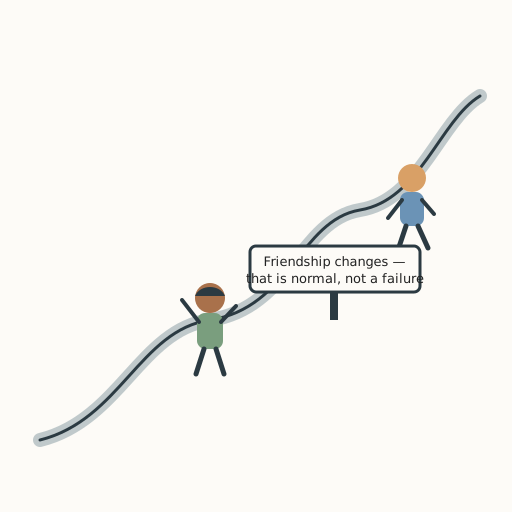
- Friendship-change poster · 1 A poster of a winding path with two figures, one pausing at a bend, beside the words "Friendship changes — that is normal, not a failure"
- Friendship weather card · 1 per learner A card naming four kinds of change — growing closer, growing apart, shifting roles, or a rupture — each with a "what I can do" line
- Reflection page · 1 per learner A page with three prompts: "A friendship that changed," "What I felt," and "What I can do now"
Low-tech / no-cost
- A drawn path in the dirt or on paper Draw a winding path and mark the bends where a friendship changed; talk the change through aloud, no cards needed
- Voice and a partner Tell a partner about one friendship change (invented or your own) and name one thing you could do; no paper needed
Enriched / lab & device
- A class 'friendship map' · 1 A shared map where learners add sticky notes describing a friendship change (real or from a story) and a healthy next step
- A short story or clip about friendship change · 1 A brief, age-appropriate story or scene (if available) where two friends grow apart, paused to discuss what each could do
Works in different contexts
- large-group Read one worked example of a friendship change aloud, then have pairs talk through a scenario and share one healthy next step
- multi-age Older learners name the change and a healthy response, while younger learners name the feeling that comes with a friendship change
- self-directed A learner works through the reflection page alone, naming a friendship change, the feeling, and one thing they can do now
- level-grouped Learners ready to extend distinguish "drift" (a friendship naturally loosening) from "rupture" (a hurt that needs repair) and plan a step for each
- outdoor-only Walk or trace a winding path, pausing at each bend to name a kind of friendship change and a healthy way to respond; no paper needed
Lesson 1 — A Friendship Changes
Summary
Learners open the unit by normalizing that friendship changes as people grow. They meet the idea that a friendship changing — growing closer, drifting apart, or shifting roles — is not a failure, and practice naming a change and choosing a healthy way to navigate it. They produce a friendship-change reflection as a portfolio artifact.
Objectives
- Name a change in a friendship and choose a healthy way to navigate it. (D02.S1.06.01)
Connection
Two friends walked home together every single day. Then one joined a music group that meets after school, and the walks stopped. The other felt left behind — was our friendship over? Not over: changing. People grow, interests shift, families move, and friendships bend with them. The question is not “how do I keep it exactly the same?” but “how do I navigate the change kindly — for my friend and for me?” That is a skill you can learn, everywhere people live side by side, in a village, a city, or a new school far from home.
Materials
- Friendship-change poster
- Friendship weather card
- Reflection page
Preparation
- Print or draw the friendship-change poster (a winding path, a bend, “change is normal”).
- Copy a friendship weather card and a reflection page for each learner.
- Arrange a circle and pairs for sharing.
Facilitator note
This lesson is written to the learner (“you”). The idea to land is that friendship change
is normal, not a failure — and that “navigating” means naming the change and choosing a
next step, not “winning” the friendship back. Peers matter enormously at this age
(docs/development.md, 6–8 band), so loss and change feel big; honor that without
dramatizing it. Two traps to avoid: framing the person who drifts away as a villain, and
framing the person left behind as pitiable. Both people are simply growing, and both can
act with care. Allow invented or story examples for anyone who prefers not to share their own
life. This is a skill (Kirschner, Sweller & Clark, 2006), so model one worked example before
independent reflection. See docs/facilitation.md on holding feelings safely.
Procedure
- Gather (5 min). Think of a friendship that changed — maybe you grew apart, or one of you moved, or you became closer. Notice the feeling. Today you learn that friendship change is normal, and how to navigate it.
- Meet the path (10 min). Look at the poster. A friendship is a path with bends, not a straight line that never turns. At a bend, people pause. That pause is not the end — it is a chance to choose. Worked example: “My friend joined music group and our walks stopped. I felt left out. Healthy choices: tell her I miss our walks, ask to hang out another time, or make room for her new interest and keep our friendship in a new shape.”
- Meet four kinds of change (10 min). Read the friendship weather card: growing closer, growing apart, shifting roles (one becomes a leader, one a helper), and a rupture (a hurt that needs repair). For each, name one feeling it brings and one healthy thing you could do. Which kind is the change you thought of in step 1?
- Reflect (15 min). On your reflection page, write or draw: (a) a friendship that changed (real or invented), (b) what you felt, and (c) one healthy thing you can do now. Share one part with a partner if you want to.
- Close (5 min). Friendships change because people grow — and growing is good, even when it stings. The skill is not to freeze a friendship but to navigate it with honesty and care, for both people.
Differentiation
- Support: Offer a sentence frame (“My friendship changed when ___. I felt ___. One thing I can do is ___.”) and a short list of healthy choices to pick from.
- Extension: Distinguish drift from rupture, and write a one-step plan for each (a gentle reconnection for drift; a repair conversation for rupture).
Assessment
- Formative (self/portfolio): Can the learner name a friendship change, a feeling that came with it, and one healthy next step?
- Self-check: The learner asks, “Did I treat the change as normal rather than a failure, and did I choose a step that is kind to both people?”
Home connection
Think of one friendship that has changed in your life, and tell someone at home one healthy thing you could do about it — even if it is simply to accept the change.
Resources
- Peer relationships intensify in early adolescence and friendships naturally reorganize (CASEL relationship-skills competency; Steinberg, Age of Opportunity). The framing “change is normal, not failure” is a values commitment of this curriculum. For classroom SEL framing: https://casel.org/fundamentals-of-sel/