Lesson 02 — Resolving a Conflict with Respectful, Honest Words
Learners turn the unit's first skill toward conflict: they learn a four-step repair — pause, say it with an honest I-statement, listen, and agree on a next step — and rehearse it on small, invented conflicts. Respect and honesty are framed as two hands of the same move, not opposites.
Objectives
Objectives
- D02.S1.06.01 Navigate a change in friendship and resolve a conflict using respectful, honest communication.
Essential question
How do I resolve a conflict using respectful, honest communication?
Key vocabulary
Materials
Standard materials
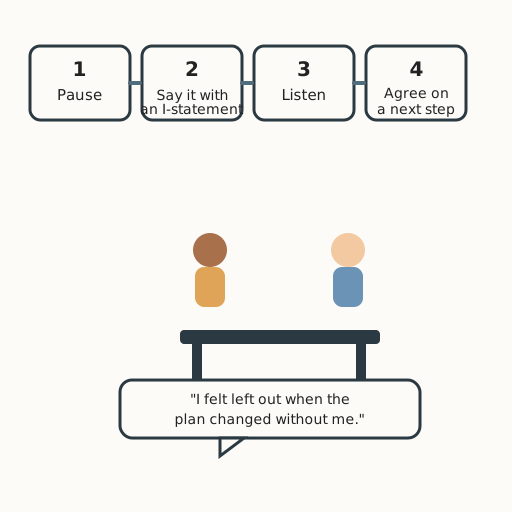
- Four-step repair poster · 1 A poster of the four steps — Pause, Say it with an I-statement, Listen, Agree on a next step — with a worked example
- Conflict scenario cards · 1 set per pair Cards of small, invented conflicts — a borrowed item returned broken, a rumor, one friend left out of a plan — for rehearsing repair
- Repair record card · 1 per pair A card to record the conflict, the I-statement, what each heard, and the agreed next step
Low-tech / no-cost
- Four stones or footprints in a row Step from stone to stone — Pause, Say, Listen, Agree — speaking each step aloud; no paper needed
- A pair and voices In pairs, rehearse the four steps aloud on an invented conflict; no cards or poster needed
Enriched / lab & device
- A class 'repair wall' · 1 A shared wall where learners post anonymous I-statements and agreed next steps, building a bank of healthy repair over the unit
- A recording of a practice repair · 1 per group To replay a practice round and hear whether each step was respectful and honest
Works in different contexts
- large-group Model one full worked repair on the board, then have pairs rehearse a scenario and share the I-statement and next step they agreed
- multi-age Older learners model the full four steps while younger learners practice the I-statement alone and name one fair next step
- self-directed A learner works a written scenario alone, writing an I-statement, what each side might feel, and a fair next step
- level-grouped Learners ready to extend rewrite a blame-statement into an honest I-statement and explain why "you always" escalates while "I felt" opens repair
- outdoor-only Step along a four-stone path — Pause, Say, Listen, Agree — acting out a small conflict and its repair; no paper needed
Lesson 2 — Resolving a Conflict with Respectful, Honest Words
Summary
Learners turn the unit’s first skill toward conflict: they learn a four-step repair — pause, say it with an honest I-statement, listen, and agree on a next step — and rehearse it on small, invented conflicts. Respect and honesty are framed as two hands of the same move, not opposites.
Objectives
- Resolve a conflict using respectful, honest communication. (D02.S1.06.01)
Connection
A friend borrowed your pencil and returned it broken. Your first impulse might be to say nothing (and seethe) or to snap, “You always wreck my stuff!” Both leave the conflict unresolved. A third way exists: pause, say what you felt without blame — “I felt upset when my pencil came back broken” — listen to what happened, and agree on a next step. Honesty is saying the true thing; respect is saying it in a way the other person can hear. Both together are what actually repair a friendship, in a classroom or a courtyard or a kitchen anywhere in the world.
Materials
- Four-step repair poster
- Conflict scenario cards
- Repair record card
Preparation
- Print or draw the four-step repair poster (Pause, Say, Listen, Agree) with a worked example.
- Copy conflict scenario cards and a repair record card for each pair.
- Arrange pairs for role-play.
Facilitator note
This lesson is written to the learner (“you”). The idea to land is that respect and honesty
are partners, not enemies — you can say the true thing and say it so the other person can
hear it. Use invented scenarios only, never real classmates, so no learner is put on trial
in front of peers. Model the worked example fully before pairs begin; this is a skill
(Kirschner, Sweller & Clark, 2006). Watch for the two slips: suppressing the honest thing
(which turns respect into silence) and blurting blame (which turns honesty into attack). The
I-statement is the bridge. Note that “conflict” here is ordinary disagreement, not harm or
bullying — if a learner raises something bigger, hold it privately and connect them to a
trusted adult. See docs/facilitation.md on holding difficult topics safely.
Procedure
- Gather (5 min). Think of a small conflict you have had — a broken thing, a missed plan, a sharp word. Today you learn a four-step repair that is both honest and kind.
- Meet the four steps (10 min). Look at the poster. Pause (breathe; don’t fire back). Say it with an I-statement: “I felt ___ when ___.” Listen (repeat back what you heard). Agree on a next step. Worked example: “I felt upset when my pencil came back broken.” Listen: “You didn’t know it was fragile.” Agree: “Next time I’ll tell you it’s fragile, and you’ll ask before borrowing.”
- Learn the I-statement (5 min). Practice the frame aloud: “I felt ___ when ___.” Notice what it does not do — it names your feeling and the event, without “you always” or “you never.” That is honesty with the blame left out.
- Rehearse a repair (15 min). With a partner, take a scenario card. Walk the four steps together — Pause, Say, Listen, Agree. Record the I-statement, what each of you heard, and the next step you agreed. Swap and do a second scenario.
- Close (5 min). Conflict is ordinary; unresolved conflict is what corrodes a friendship. Four steps — pause, say it honestly, listen, agree — turn a fight into a repair. You can be the one who begins.
Differentiation
- Support: Provide a scripted four-step exchange to read through, and a fill-in I-statement frame with a feeling word bank.
- Extension: Rewrite two blame-statements (“you always…”, “you never…”) into honest I-statements, and explain why the rewrite invites repair instead of defense.
Assessment
- Formative (performance/peer): Can the learner state their feeling with an I-statement, listen by reflecting back, and agree on a fair next step — without blame or silence?
- Self-check: The learner asks, “Was I honest and respectful? Did I name my feeling without blaming, listen, and end with a next step both of us could accept?”
Home connection
Next time a small conflict comes up at home, try the four steps before anything else: pause, say “I felt ___ when ___,” listen, and agree on a next step.
Resources
- I-statements and repair conversations are well-established relationship-skill practices in SEL; respectful, honest communication is a core CASEL relationship-skill outcome: https://casel.org/fundamentals-of-sel/