Lesson 05 — Empathy (With) vs Sympathy (For)
Learners distinguish empathy — feeling *with* someone, shoulder to shoulder — from sympathy — feeling *for* someone, from above and apart. They sort real responses into the two and write an empathy note, learning that "with" is felt as being joined, while "for" can feel like being pitied from a distance.
Objectives
Objectives
- D02.S2.06.01 Distinguish empathy, feeling with someone, from sympathy, feeling for someone.
Essential question
What is the difference between empathy and sympathy?
Key vocabulary
Materials
Standard materials
- With vs for poster · 1 A poster of two panels — one figure beside another, shoulder to shoulder ("with"), and one figure above another, patting a head ("for") — with sample lines
- With-or-for sorting cards · 1 set per pair Cards with responses ("I'm sorry that happened to you," "That must be so hard — I'm right here," "Oh, you poor thing") to sort as empathy or sympathy
- Empathy note page · 1 per learner A page to record a scene, a sympathy response, an empathy response, and what each would feel like to receive
Low-tech / no-cost
- Body positions and voices Stand beside a partner (with) and then apart and above (for), saying a line each way, and feel the difference; no cards needed
- A 'with or for' thumbs game The facilitator says a response aloud; partners show a hand beside their own heart (with) or a hand reaching down (for) to sort it
Enriched / lab & device
- A class 'empathy bank' · 1 A shared wall where learners post kind, with-them responses they have heard or used, building a bank of empathic language over the unit
- A short video or story scene · 1 A brief clip or story (if available) where a character receives sympathy and then empathy, paused to name the difference in what each feels like
Works in different contexts
- large-group Model one scene with a sympathy line and an empathy line, then have pairs sort cards and share which response they would rather receive and why
- multi-age Older learners name the difference and model an empathy line while younger learners point to whether a response is beside (with) or above (for)
- self-directed A learner reads a scene, writes a sympathy response and an empathy response, and reflects on what each would feel like to receive
- level-grouped Learners ready to extend explain *why* sympathy can feel distant or pitying while empathy feels like being joined, and write a rule for staying "with"
- outdoor-only In pairs, physically stand "above and apart" for sympathy, then "side by side" for empathy, saying a line each way; no paper needed
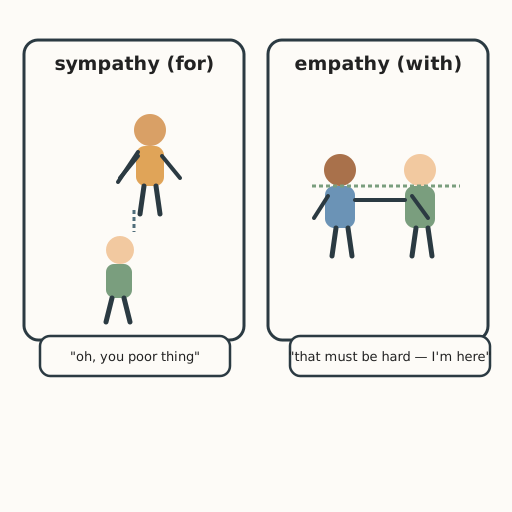
Lesson 5 — Empathy (With) vs Sympathy (For)
Summary
Learners distinguish empathy — feeling with someone, shoulder to shoulder — from sympathy — feeling for someone, from above and apart. They sort real responses into the two and write an empathy note, learning that “with” is felt as being joined, while “for” can feel like being pitied from a distance.
Objectives
- Distinguish empathy (feeling with someone) from sympathy (feeling for someone). (D02.S2.06.01)
Connection
Your friend’s grandparent is very ill. One person says, “Oh, you poor thing, I feel so sorry for you” — and somehow your friend feels smaller. Another sits down beside them and says, “That must be so scary — I’m right here.” That second one is empathy: it stands with the person, at their level, not above them. Sympathy reaches down; empathy reaches across. The difference is felt in the body — and it matters in every place people comfort one another, a hospital ward in one city or a neighbour’s doorstep in another.
Materials
- With vs for poster
- With-or-for sorting cards
- Empathy note page
Preparation
- Print or draw the with-vs-for poster (beside vs above, with sample lines).
- Copy sorting cards per pair and an empathy note page per learner.
- Arrange pairs and space to stand in the two positions.
Facilitator note
This lesson is written to the learner (“you”). The idea to land is a felt distinction, not
a vocabulary quiz: empathy is “with,” sympathy is “for” — one joins, the other can rank.
The egalitarian lens is central here: sympathy, even when kind, can quietly place the helper
above the helped, while empathy places them beside. Be gentle — sympathy is not wrong or
unkind; it is simply a different (and sometimes distancing) stance, and everyone uses it.
Use invented scenes or story characters, never real classmates in distress. The body carries
the meaning, so have learners physically try both positions. See docs/facilitation.md on
holding feelings safely and docs/contexts.md.
Procedure
- Gather (5 min). Think of a time someone comforted you. Did you feel joined or looked down on — even a little? Today you learn the difference between empathy and sympathy.
- Meet “with” and “for” (10 min). Look at the poster. Sympathy stands above: “Oh, you poor thing” — feeling for someone, from a distance, a little above them. Empathy sits beside: “That must be so hard — I’m right here” — feeling with someone, at their level. Same caring heart; different body, different message.
- Feel the positions (10 min). With a partner, physically try both. Stand apart and a little above, say “I feel sorry for you.” Then sit side by side, shoulders level, say “I’m right here with you.” Which one would you rather receive when you are hurting? Why?
- Sort with and for (10 min). Take the sorting cards and place each response as empathy or sympathy: “I’m sorry that happened to you,” “That must be so hard — I’m right here,” “Oh, you poor thing,” “I can’t imagine — but I’m here.” For each, ask: is this speaker beside the person or above them?
- Write an empathy note (10 min). On your page, choose a scene (a friend failed a test, a neighbour lost a pet, a teammate made a mistake that cost the match). Write one sympathy line and one empathy line, then one sentence on what each would feel like to receive. Close by sharing your empathy line with a partner.
Differentiation
- Support: Provide a scene with a sympathy line and an empathy line already written, and ask the learner to circle which is “beside” and which is “above.”
- Extension: Explain why sympathy can feel distant or pitying, and write one rule for keeping your comfort “with” rather than “for” (e.g., sit down, don’t stand over; say “I’m here,” not “poor you”).
Assessment
- Formative (self/portfolio): Can the learner sort responses as empathy or sympathy and explain the “with vs for” difference in their own words, using body position?
- Self-check: The learner asks, “Is my comforting beside the person or above them — and would I want to receive what I am offering?”
Home connection
Next time someone at home is sad or worried, try sitting with them — literally at their level — and notice what you say and how it lands.
Resources
- The empathy–sympathy distinction follows from empathy research (Batson’s work on empathic concern vs personal distress; Decety & Cowell on empathic responding). The “with vs for” framing is a teaching simplification of that literature. For classroom SEL framing: https://casel.org/fundamentals-of-sel/