Lesson 04 — Choosing Assertion in Real Situations
Learners practice *choosing* assertion: they learn a three-part formula — say the need, respect the other person, propose a fair next step — and rehearse it on real situations, including making a request and saying no. They name the passive and aggressive traps they are avoiding and record one assertion, preparing to use it in the week ahead.
Objectives
Objectives
- D02.S1.06.02 Distinguish assertive, passive, and aggressive communication and choose assertion.
Essential question
How do I choose assertion in real situations?
Key vocabulary
Materials
Standard materials
- Assertion formula poster · 1 A poster of the three-part assertion — "I feel/need ___ (say it), you matter too (respect it), so let's ___ (a fair next step)" — with a worked example
- Situation cards · 1 set per pair Cards of real situations — asking to borrow something, refusing an unfair dare, asking for quiet, saying no to a plan — to rehearse assertion
- Assertion record page · 1 per learner A page to write the situation, the passive and aggressive traps, and the assertive line chosen
Low-tech / no-cost
- A partner and voices Rehearse the three-part assertion aloud on real situations; no cards or poster needed
- A 'both-needs' hand gesture Hold up one hand for "my need" and the other for "your need," then bring them together to signal a fair next step while speaking the assertion
Enriched / lab & device
- A class 'assertion practice corner' · 1 A standing space with situation prompts where learners can rehearse assertion and get kind feedback across the unit
- A recording of a practice assertion · 1 per group To replay a rehearsal and hear whether the voice stayed assertive rather than slipping passive or aggressive
Works in different contexts
- large-group Model one full three-part assertion, then have pairs rehearse a situation and hold up the 'both-needs' gesture when they reach the fair next step
- multi-age Older learners model the full three-part assertion while younger learners practice the single "I need ___" opening and a kind refusal
- self-directed A learner works through situation cards alone, writing the passive trap, the aggressive trap, and their chosen three-part assertion, then reading it aloud to check its tone
- level-grouped Learners ready to extend add a *refusal* (saying no without apology) and a *boundary* (a repeated limit), and explain how tone keeps refusal assertive, not aggressive
- outdoor-only In pairs, rehearse an assertion standing tall and calm, using the two-hand gesture for both needs; no paper needed
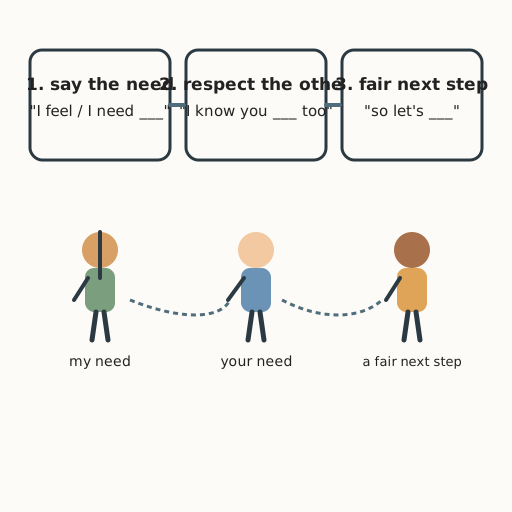
Lesson 4 — Choosing Assertion in Real Situations
Summary
Learners practice choosing assertion: they learn a three-part formula — say the need, respect the other person, propose a fair next step — and rehearse it on real situations, including making a request and saying no. They name the passive and aggressive traps they are avoiding and record one assertion, preparing to use it in the week ahead.
Objectives
- Choose assertion in real situations. (D02.S1.06.02)
Connection
A friend asks you to copy your answers in a test, or to join a dare you do not like. Saying “whatever, fine” swallows your own limit; snapping “leave me alone!” breaks the friendship. The assertive middle sounds like this: “I’m not comfortable with that, and I still want to be your friend — so let’s do something else after.” Assertion is a choice you make in the moment — and like any skill, it gets stronger with practice. In a schoolyard or a workshop or a fishing boat, saying your need and honoring the other person’s is how people stay in relationship without losing themselves.
Materials
- Assertion formula poster
- Situation cards
- Assertion record page
Preparation
- Print or draw the assertion formula poster (say the need, respect the other, propose a fair next step) with a worked example.
- Copy situation cards per pair and an assertion record page per learner.
- Arrange pairs and space to stand and speak.
Facilitator note
This lesson is written to the learner (“you”). The idea to land is that assertion is a
choice, not a personality — and it is built by rehearsal, not willpower. The three-part
formula keeps both people’s needs on the table, which is the egalitarian heart of the skill.
Carry forward Lesson 3’s caution: how a person states a need “assertively” looks different across
cultures — in some, indirect speech, deference, or quietness is the respectful way, not passivity.
Honor each learner’s own cultural style; the skill is that needs get honored within the
relationship, not that everyone must speak in one “direct” register. Model a full worked example,
then do guided practice before independent rehearsal; this is a
skill (Kirschner, Sweller & Clark, 2006). Give special care to refusals: saying no to a
friend can feel like betrayal to an 11-year-old, so frame “no” as protecting the friendship,
not ending it. Use invented situations; never script a real classmate into a scenario. If a
learner’s situation involves real pressure or harm, connect them to a trusted adult. See
docs/facilitation.md.
Procedure
- Gather (5 min). Last time you met the three voices. Today you practice choosing the assertive one in real situations — including the hard ones, like saying no.
- Meet the formula (10 min). Look at the poster. Assertion has three parts: say the need (“I feel ___ / I need ___”), respect the other (“I know you want ___ too”), and propose a fair next step (“so let’s ___”). Worked example: “I need to finish this before I can play. I know you’re ready to go. So give me ten minutes, then I’ll join you.”
- Learn the refusal (5 min). Saying no is a kind of assertion. The frame: “I’m not comfortable with that, and I still want to be friends — so let’s ___.” Practice it once aloud, calm and upright, not apologizing and not attacking.
- Rehearse real situations (15 min). With a partner, take situation cards: asking to borrow something, asking for quiet, refusing an unfair dare, saying no to a plan. Name the passive trap (giving in, going silent) and the aggressive trap (blaming, snapping), then deliver your three-part assertion. Partner gives kind feedback: was it calm, honest, and fair to both? Swap and try a second situation. Record one on your page.
- Close (5 min). Assertion is a muscle: the more you use it, the readier it is. Choose it once this week — a request or a kind no — and notice how it feels to hold both people’s needs at once.
Differentiation
- Support: Provide the three-part frame with blanks and a bank of fair next steps to choose from; rehearse one situation as a script first.
- Extension: Add a boundary (a limit you will repeat if needed) to the refusal, and explain how tone — calm, not apologetic or angry — keeps “no” assertive rather than passive or aggressive.
Assessment
- Formative (performance/peer): Can the learner state a need, acknowledge the other person’s need, and propose a fair next step — in a request and in a refusal — without slipping into passivity or aggression?
- Self-check: The learner asks, “Did I say my need, respect theirs, and propose a fair next step? Would a friend hear this as fair, not bossy and not weak?”
Home connection
Use the three-part assertion once at home this week — a request or a kind refusal — and tell someone how it went.
Resources
- Assertiveness training has a strong evidence base for relationship and self-advocacy outcomes; the “say the need, respect the other, propose a step” formula is a classroom-friendly summary of standard assertiveness practice (CASEL relationship skills): https://casel.org/fundamentals-of-sel/