Lesson 07 — Belonging: Who's In, Who's Out, and Why
Learners analyze how belonging can include some people and exclude others, and why. They meet the idea of in-group and out-group, examine invented scenes of everyday exclusion — a saved seat, a repeated pick, a left-out chat — and ask two questions: why does it happen, and what would open the circle? They produce an inclusion analysis.
Objectives
Objectives
- D02.S3.06.01 Analyze how belonging can include some people and exclude others, and why that happens.
Essential question
How can belonging include some people and exclude others — and why does that happen?
Key vocabulary
Materials
Standard materials
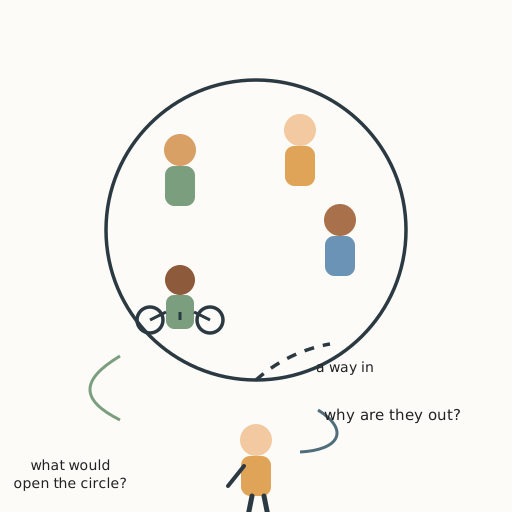
- Circle poster · 1 A poster of a circle with some figures inside and one outside looking in, with arrows asking "why?" and "what would open the circle?"
- Belonging scenario cards · 1 set per pair Cards of invented scenes — a lunch table with an empty seat saved for no one, a team that always picks the same players, a group chat that leaves one person out
- Inclusion analysis page · 1 per learner A page to record who was in, who was out, why it happened, and one thing that could open the circle
Low-tech / no-cost
- A rope or chalk circle on the ground Stand some learners in and one out, then talk through why and how to open the circle; no cards needed
- A story told aloud Tell an invented scene of inclusion and exclusion and name who was in, who was out, and why; no paper needed
Enriched / lab & device
- A class 'open the circle' wall · 1 A shared wall where learners post one real or invented example of exclusion and one small act that opened the circle, building a bank over the unit
- A short video or story about belonging · 1 A brief clip or story (if available) from any culture showing a newcomer excluded and then included, paused to analyze the why and the opening
Works in different contexts
- large-group Model one full analysis, then have pairs work a scenario and share the 'why' and one opening move; collect the openings on a shared wall
- multi-age Older learners name the 'why' and an opening move while younger learners point to who is in and who is out and how the outsider might feel
- self-directed A learner works a scenario alone, recording who was in, who was out, why, and one thing that could open the circle
- level-grouped Learners ready to extend analyze how *unspoken rules* (who sits where, who gets picked) exclude without anyone meaning to, and propose a counter-rule
- outdoor-only Make a real circle with rope or stones, stand some in and one out, and talk through the why and the opening; no paper needed
Lesson 7 — Belonging: Who’s In, Who’s Out, and Why
Summary
Learners analyze how belonging can include some people and exclude others, and why. They meet the idea of in-group and out-group, examine invented scenes of everyday exclusion — a saved seat, a repeated pick, a left-out chat — and ask two questions: why does it happen, and what would open the circle? They produce an inclusion analysis.
Objectives
- Analyze how belonging can include some people and exclude others, and why that happens. (D02.S3.06.01)
Connection
A lunch table has one empty seat, and someone keeps saving it “for a friend” who never comes. A game is picked, and the same players are always chosen first, the same faces left last. No one is shouting “you can’t sit here” — and yet the circle quietly closes. Belonging isn’t only about loud walls; it is often about quiet ones: habits, unspoken rules, and who we notice and who we don’t. When we ask why someone is out, we can see the barrier — and when we see it, we can open the circle. This is true of a classroom, a neighbourhood, and every community humans build, everywhere.
Materials
- Circle poster
- Belonging scenario cards
- Inclusion analysis page
Preparation
- Print or draw the circle poster (some in, one out, the “why” and “what would open it”).
- Copy scenario cards per pair and an inclusion analysis page per learner.
- Arrange pairs and, if possible, space for a physical circle.
Facilitator note
This lesson is written to the learner (“you”). The idea to land is that exclusion is often
quiet and unintentional — habits, unspoken rules, and unnoticed absence — and that the first
step to inclusion is noticing and asking why. Use invented scenarios, never real
classmates, so no learner is named as the excluder or the excluded. This lesson is the
egalitarian heart of the unit: every person has an equal claim to belonging, and barriers are
usually built by systems of habit, not by “bad people.” Hold both truths — exclusion hurts,
and it is usually not intended — so the analysis stays curious rather than blaming. If a
learner raises a real, painful exclusion, hold it privately and gently. See
docs/facilitation.md on holding difficult topics safely.
Procedure
- Gather (5 min). Think of a time you felt in a group — and a time you felt out. What made the difference? Today you analyze belonging: who is in, who is out, and why.
- Meet the circle (10 min). Look at the poster. Some figures are inside the circle; one is outside, looking in. Every group has an inside and an outside — an in-group and an out-group. The question is never “is there a circle?” but “who is outside it, and why?” Worked example: a lunch table with one empty seat saved “for a friend” who never comes. Who is out? The new learner with nowhere to sit. Why? An unspoken habit, not a spoken rule. What would open it? “Come sit with us — there’s room.”
- Learn the two questions (5 min). Whenever you notice an outside, ask two things: “Why are they out?” (habit? a rule? a difference? fear?) and “What would open the circle?” (a word, a gesture, a change in the rule). The second question turns noticing into action.
- Analyze scenarios (15 min). With a partner, take scenario cards — a team that always picks the same players, a group chat that leaves one person out, a game with a rule no one explained. For each, record on your page: who is in, who is out, why it happens, and one thing that could open the circle. Swap and try a second.
- Close (5 min). Belonging is not automatic; it is built — or quietly blocked — by small habits. You now have two questions that can open any circle: why are they out? and what would let them in? Use them.
Differentiation
- Support: Provide a scenario with the in-group and out-group already labeled, and ask the learner to choose one opening move from a short list.
- Extension: Analyze how unspoken rules (who sits where, who gets picked first) exclude without anyone meaning to, and propose one counter-rule your own group could adopt.
Assessment
- Formative (self/portfolio): Can the learner name who is in and who is out in a scene, give a reason why the exclusion happens, and propose one concrete way to open the circle?
- Self-check: The learner asks, “Did I look for the quiet barrier, not just the loud one? Did I move from noticing to one real opening?”
Home connection
Notice one quiet “circle” in your own life this week — a table, a team, a group chat — and ask yourself who might be just outside it, and one way you could open it.
Resources
- In-group/out-group dynamics and their quiet, often unintentional nature are well documented in social psychology (Tajfel’s minimal-group work; the “preference for the familiar” in group formation). The “open the circle” framing is a values commitment of this curriculum. For classroom SEL framing: https://casel.org/fundamentals-of-sel/