Lesson 08 — Identity Shapes Belonging: Culture, Language, Ability
Learners describe how identity — culture, language, and ability — shapes belonging. They treat each identity thread as ordinary and welcome, not exotic or deficient, and practice naming one ordinary way a group can honor each thread so everyone is at home, producing a belonging map.
Objectives
Objectives
- D02.S3.06.02 Describe how identity, such as culture, language, and ability, shapes belonging.
Essential question
How does identity — culture, language, and ability — shape belonging?
Key vocabulary
Materials
Standard materials
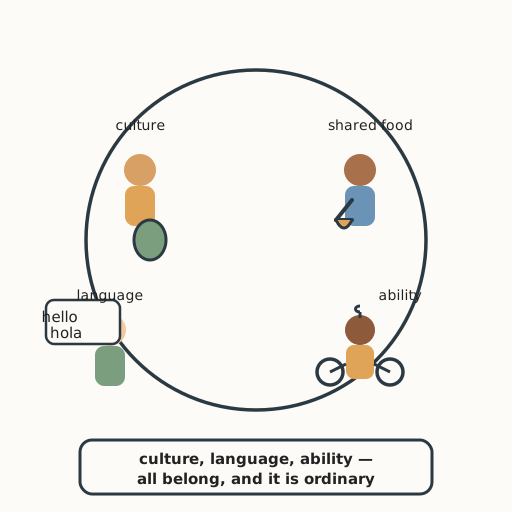
- Identity-and-belonging poster · 1 A poster of one circle containing figures carrying three identity markers — a drum and shared food (culture), speech bubbles in two scripts (language), a wheelchair and a hearing aid (ability) — all labeled "belonging, and it is ordinary"
- Identity cards · 1 set per pair Cards naming an identity thread — a home language, a festival, a way of moving or hearing — each with a question: "what would make this person feel at home?"
- Belonging map page · 1 per learner A page to map one identity thread, one way it could shape belonging, and one ordinary thing that honors it
Low-tech / no-cost
- A circle and three objects Place three found objects in a circle — a shared food item, a written word in two scripts, a tool used differently — and talk through how each shapes belonging; no cards needed
- Voice and story Tell about one identity thread of your own or a story character's, and name one ordinary thing that makes it welcome; no paper needed
Enriched / lab & device
- A class 'who we are' wall · 1 A shared wall where learners (optionally) post one identity thread they carry and one ordinary way the group honors it, building belonging over the unit
- A short video or story from another culture · 1 A brief clip or story (if available) from any culture or ability community, paused to notice how identity shapes belonging and how welcome is built
Works in different contexts
- large-group Model one worked example of an identity thread and its honoring, then have pairs map one thread each and share one ordinary honoring move
- multi-age Older learners map an identity thread and its honoring while younger learners name one thing that makes them feel at home and one thing that makes a friend feel at home
- self-directed A learner maps one identity thread (their own or a story character's), one way it shapes belonging, and one ordinary honoring move, in writing or drawing
- level-grouped Learners ready to extend analyze how the *same* trait (a home language, a way of moving) can be treated as ordinary in one place and as 'different' in another, and why welcome is a choice
- outdoor-only Gather three found objects that stand for culture, language, and ability, place them in a circle, and talk through how each shapes belonging and is honored; no paper needed
Lesson 8 — Identity Shapes Belonging: Culture, Language, Ability
Summary
Learners describe how identity — culture, language, and ability — shapes belonging. They treat each identity thread as ordinary and welcome, not exotic or deficient, and practice naming one ordinary way a group can honor each thread so everyone is at home, producing a belonging map.
Objectives
- Describe how identity, such as culture, language, and ability, shapes belonging. (D02.S3.06.02)
Connection
A new learner arrives. Her home language is not the classroom’s, she eats foods the others don’t know, and she uses a wheelchair. Whether she feels she belongs depends less on who she is than on how the group receives her — whether her language is treated as a gap or a gift, her food as strange or welcome, her chair as ordinary or different. Identity shapes belonging not because some identities fit and others don’t, but because welcome is a choice we make. Every person carries threads — a language, a way of being, a body — and in every human community, from a mountain village to a port city, belonging is built when those threads are honored as ordinary.
Materials
- Identity-and-belonging poster
- Identity cards
- Belonging map page
Preparation
- Print or draw the identity-and-belonging poster (one circle, three identity threads, “all belong, and it is ordinary”).
- Copy identity cards per pair and a belonging map page per learner.
- Arrange pairs; optionally prepare found objects for the low-tech variant.
Facilitator note
This lesson is written to the learner (“you”). The idea to land is that identity is never
the problem — reception is. Culture, language, and ability shape belonging because of how
groups treat them, not because some are “normal” and others “special.” Guard the words
carefully: a home language is a gift, never a gap; a wheelchair or a hearing aid is
ordinary, never a sad story; a food is welcome, never strange. This is the
anti-deficit heart of the lesson and of the curriculum’s egalitarian lens. Keep examples
global and varied — no single culture or region as the default “normal.” If a learner
discloses their own identity, receive it warmly and never rank it. See docs/facilitation.md.
Procedure
- Gather (5 min). Think of one thread of who you are — a language, a food, a way your body works, a tradition. Today you explore how identity shapes belonging.
- Meet the circle (10 min). Look at the poster. One circle holds four people, each with a thread: a drum and shared food (culture), two scripts in one bubble (language), a wheelchair and a hearing aid (ability). All are inside — because belonging is not about matching; it is about being received. Worked example: a learner whose home language differs. Treated as a gap: “she can’t keep up.” Treated as ordinary: the class learns to greet in her language too. Same learner, two very different belongings.
- Meet the threads (10 min). Read the identity cards. For each — a home language, a festival, a way of moving or hearing — ask the card’s question: “what would make this person feel at home?” Name one ordinary, doable thing (learn one word, share one food, make one space that fits).
- Map a belonging (15 min). On your page, choose one identity thread — your own, a story character’s, or one from the cards. Map it: what is the thread, how could it shape belonging (for better or worse), and one ordinary thing a group could do to honor it. Draw or write. Share one part with a partner.
- Close (5 min). Nobody is “hard to include”; every person is easy to welcome once we treat their threads as ordinary gifts. Belonging is built by the small, daily choice to honor who people already are.
Differentiation
- Support: Provide one identity thread with the honoring move already written, and ask the learner to draw or act out the welcome.
- Extension: Analyze how the same trait (a home language, a way of moving) can be treated as ordinary in one place and as “different” in another, and write one sentence on why welcome is always a choice.
Assessment
- Formative (self/portfolio): Can the learner name an identity thread, explain how it can shape belonging, and give one ordinary, honoring move — without framing the identity as a deficit?
- Self-check: The learner asks, “Did I treat the identity as ordinary and welcome, not as a problem to fix? Is my honoring move real and doable, not grand or pitying?”
Home connection
Notice one identity thread someone around you carries — a language, a food, a way of moving — and do one ordinary thing to honor it this week.
Resources
- Belonging is shaped by how identity is received, and inclusive settings treat difference as ordinary rather than deficient (a core principle of inclusive education; UNESCO guidance on inclusion). The “gift, not gap” framing is a values commitment of this curriculum. For classroom SEL framing: https://casel.org/fundamentals-of-sel/