Lesson 10 — Capstone: Why Some Have More Than They Need
In this capstone lesson, learners explain — in age-appropriate terms — why some people have more than they need while others lack, and frame it as a fairness and systems question, never as a verdict on anyone's worth. They sort reasons (where you were born, work and pay, illness, displacement, unfair rules) as circumstances and systems, and name fair actions — sharing, cooperating, changing a rule — revisiting the unit's assertion, belonging, and cooperation skills to produce a fairness plan.
Objectives
Objectives
- D02.S4.06.02 Explain why some people have more than they need while others lack, in age-appropriate terms.
- D02.S3.06.01 Analyze how belonging can include some people and exclude others, and why that happens.
- D02.S4.06.01 Compare cooperation and competition and explain when each helps or harms a group.
Essential question
Why do some people have more than they need while others lack — and what can fairness do about it?
Key vocabulary
Materials
Standard materials
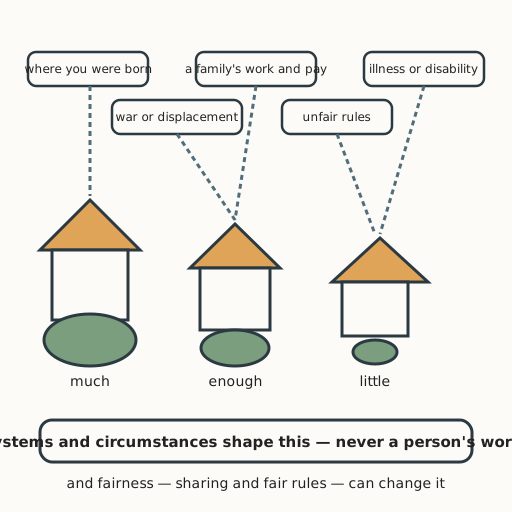
- Systems-not-worth poster · 1 A poster of three households with different amounts — one with much, one with enough, one with little — with arrows labeled "systems and circumstances shape this, not anyone's worth"
- Reason cards · 1 set per team Cards naming reasons some have more and others lack — where you were born, a family's work and pay, land and inheritance, illness or disability, war or displacement, unfair rules — to sort as 'circumstance/system' rather than 'worth'
- Fairness plan page · 1 per learner A page to record one reason for unequal shares, one thing that makes it unfair, and one thing people can do — cooperate, share, or change a rule — so more have enough
Low-tech / no-cost
- Piles of stones or seeds Make three unequal piles and talk through why the piles differ (systems and circumstances) and how sharing or a fair rule could even them out; no cards needed
- A circle story told aloud Tell a gentle invented story of two families whose shares differ by circumstance, not worth, and name one fair thing people did; no paper needed
Enriched / lab & device
- A class 'fairness wall' · 1 A shared wall where learners post one reason for unequal shares and one fair action, building a bank of fairness ideas over the unit
- A short documentary or map · 1 A brief age-appropriate clip or map (if available) showing how resources differ across places, paused to discuss the 'why' and the fair actions
Works in different contexts
- large-group Model one worked example of a reason and a fair action, then have teams sort reason cards and share one fair action; collect actions on a shared wall
- multi-age Older learners explain systems and circumstances while younger learners sort 'circumstance' from 'worth' and name one way to share
- self-directed A learner works through the reason cards alone, writing one reason, why it is unfair, and one fair action, in their own words
- level-grouped Learners ready to extend distinguish 'circumstance' (how things are) from 'worth' (what a person deserves) and argue why confusing them is the root of unfairness
- outdoor-only Make three unequal piles of found objects and talk through why they differ and how a fair rule or sharing could even them out; no paper needed
Lesson 10 — Capstone: Why Some Have More Than They Need
Summary
In this capstone lesson, learners explain — in age-appropriate terms — why some people have more than they need while others lack, and frame it as a fairness and systems question, never as a verdict on anyone’s worth. They sort reasons (where you were born, a family’s work and pay, illness, displacement, unfair rules) as circumstances and systems, and name fair actions — sharing, cooperating, changing a rule — revisiting the unit’s assertion, belonging, and cooperation skills to produce a fairness plan.
Objectives
- Explain why some people have more than they need while others lack, in age-appropriate terms. (D02.S4.06.02)
- Revisit the unit: analyze inclusion and exclusion (D02.S3.06.01) and compare cooperation and competition (D02.S4.06.01) while planning a fair action.
Connection
Two families live on the same street. One pantry overflows; the other is often empty. Is it because one family is better and the other worse? No — that is the trap. The difference comes from systems and circumstances: where you were born, what work your family could find and what it paid, whether the land or savings were passed down, whether illness or war or displacement struck. These are not choices, and they are not measures of anyone’s worth. Understanding this is not blaming the family with more or shaming the family with less — it is seeing how shares get shaped, so that fairness — sharing, cooperating, changing a rule — can make sure more people have enough.
Materials
- Systems-not-worth poster
- Reason cards
- Fairness plan page
Preparation
- Print or draw the systems-not-worth poster (three households, arrows to the reasons, “never a person’s worth”).
- Copy reason cards per team and a fairness plan page per learner.
- Arrange teams and, if possible, objects for the low-tech pile-making variant.
Facilitator note
This is the unit capstone, written to the learner (“you”). Handle it with care — this is
the lesson where a learner could feel shamed for having less or blamed for having more, and
neither may ever happen. The idea to land is that unequal shares come from systems and
circumstances, never from a person’s worth — and that fairness is something people build
together, not something some people deserve and others don’t. Keep the analysis at the level
of systems (work and pay, land and inheritance, health and disability, war and displacement,
unfair rules), never at the level of individual character. Never ask learners to disclose their
own family’s resources. Always connect the analysis to agency and hope — a concrete fair
action — so the lesson lands as empowerment, not despair (docs/facilitation.md; docs/ development.md 6–8 band). Model one worked example first (Kirschner, Sweller & Clark, 2006).
The distinction “how things are vs what people deserve” is the ethical core; hold it firmly
and kindly.
Procedure
- Gather (5 min). For nine lessons you have practiced honest words, assertion, empathy, perspective-taking, belonging, and cooperation. Today you bring them to the unit’s biggest question: why do some people have more than they need while others lack?
- Meet the question — and the trap (10 min). Look at the poster. Three households, three different amounts. The tempting answer — “one family is better” — is the trap. The truer answer: systems and circumstances shape the shares. Read the arrows: where you were born, the work a family could find and its pay, land or savings passed down, illness or disability, war or displacement, unfair rules. None of these is a measure of worth.
- Sort circumstances from worth (10 min). In your team, take the reason cards and sort each one: does it explain how shares got shaped (a circumstance or system) or what a person deserves (worth)? Every card should land on “circumstance/system” — that is the point. Worked example: “her family was displaced by war” → circumstance, not worth.
- Plan a fair action (15 min). On your page, write: (a) one reason shares differ, (b) one way that is unfair, and (c) one thing people can do — share, cooperate, or change a rule — so more have enough. Use your unit skills: choose assertive, honest words when you propose; notice who is left out and open the circle; and ask which mode — cooperation or fair competition — serves the goal.
- Close (5 min). Nobody’s worth is measured by how much they have. Unequal shares are made by systems — and systems can be remade by people who act fairly, together. That is the whole unit, in one question and one act.
Differentiation
- Support: Provide two pre-sorted reasons and one fair action to choose from, and ask the learner to say in one sentence why the reason is circumstance, not worth.
- Extension: Distinguish circumstance (how things are) from worth (what a person deserves), and argue in one sentence why confusing them is the root of unfairness.
Assessment
- Summative (performance/portfolio): Can the learner explain unequal shares through systems and circumstances (never worth), and propose one fair action — sharing, cooperating, or changing a rule — so more have enough?
- Self-check: The learner asks, “Did I explain the systems, not blame or shame any person? Did I end with a real fair action, not just a problem?”
Home connection
Talk with someone at home about one fair thing your family or neighbourhood could do so more people have enough — and, if you can, do one small part of it.
Resources
- Economic inequality is driven largely by structural factors — where one is born, access to work and pay, inherited wealth, health, and the effects of conflict — rather than individual worth (widely documented; e.g., World Bank and UN data on inequality and poverty). The statement that no person’s worth is measured by their resources is a values commitment of this curriculum, not a scientific claim. For a developmentally careful classroom framing of fairness and inequality, see CASEL social awareness and the UNESCO/UN “equity” materials: https://casel.org/fundamentals-of-sel/