Lesson 09 — Cooperation vs Competition: When Each Helps or Harms
Learners compare cooperation and competition and explain when each helps or harms a group. They meet the key distinction — a shared goal calls for cooperation; a contest of skill can use fair competition — and analyze situations to choose the mode that serves the common good, producing a cooperation-versus-competition note.
Objectives
Objectives
- D02.S4.06.01 Compare cooperation and competition and explain when each helps or harms a group.
Essential question
How do cooperation and competition differ, and when does each help or harm a group?
Key vocabulary
Materials
Standard materials
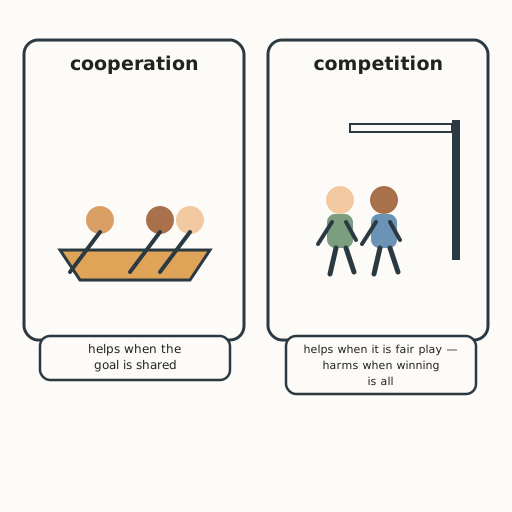
- Cooperation vs competition poster · 1 A poster of two panels — figures rowing one boat together (cooperation) and figures racing toward one finish line (competition) — each with "when it helps" and "when it harms"
- Situation cards · 1 set per pair Cards of invented situations — a group project, a sports match, a shared harvest, a race for a single prize — to sort as better suited to cooperation or competition
- Cooperation-versus-competition note page · 1 per learner A page to record a situation, which mode fits, when each would help, and when each would harm
Low-tech / no-cost
- A shared task and a race Do one task that needs everyone's hands (carry a heavy thing together), then one race, and name which mode each called for; no cards needed
- A 'which mode?' thumbs game The facilitator names a situation; partners show two hands cupped together (cooperation) or one hand pointed forward (competition) and say why
Enriched / lab & device
- A class 'modes' anchor wall · 1 A shared wall with real and invented situations sorted under cooperation and competition, with the 'helps' and 'harms' noted
- A short video or story of both modes · 1 A brief clip or story (if available) — a team lifting together and a fair race — paused to name when each mode helps and harms
Works in different contexts
- large-group Model one worked example of choosing a mode, then have pairs sort situations and share one 'when it harms' they noticed
- multi-age Older learners explain when each mode helps or harms while younger learners name which mode a situation calls for and why
- self-directed A learner works through situations alone, choosing a mode for each and writing when each would help and when each would harm
- level-grouped Learners ready to extend analyze a *zero-sum* situation (one prize, one winner) versus a *common-good* one (a shared goal), and argue when competition is fair and when it becomes harmful
- outdoor-only Do a real shared task (lift or build together) and a real fair race, then discuss which mode each needed and when each helps or harms; no paper needed
Lesson 9 — Cooperation vs Competition: When Each Helps or Harms
Summary
Learners compare cooperation and competition and explain when each helps or harms a group. They meet the key distinction — a shared goal calls for cooperation; a contest of skill can use fair competition — and analyze situations to choose the mode that serves the common good, producing a cooperation-versus-competition note.
Objectives
- Compare cooperation and competition and explain when each helps or harms a group. (D02.S4.06.01)
Connection
A boat needs every pair of hands rowing together — cooperation, because the goal is shared. A footrace has one finish line and many runners — competition, because the test is who is fastest. Neither is good or bad by itself; each is a tool, and a tool helps when it matches the task. Competition helps when it is fair and joyful and lifts everyone’s play; it harms when winning becomes the only thing that matters. Cooperation helps when a goal is shared; it can stall when people hide their own best ideas. The skill is choosing the right mode — in a crew, a classroom, a market, or a village sharing a harvest.
Materials
- Cooperation vs competition poster
- Situation cards
- Cooperation-versus-competition note page
Preparation
- Print or draw the cooperation-vs-competition poster (rowing together vs racing to a line).
- Copy situation cards per pair and a note page per learner.
- Arrange pairs and, if possible, space for a shared task and a short race.
Facilitator note
This lesson is written to the learner (“you”). The idea to land is that neither mode is
good or bad in itself — each is a tool that helps or harms depending on the goal and the
spirit. The curriculum’s stance (docs/philosophy.md §8) values cooperation as the default
for learning, while honoring fair play as a real and joyful kind of competition. Avoid
moralizing: don’t cast competition as villain and cooperation as saint. Instead, ask the
functional question — what is the goal, and which mode serves it and every member of the
group? This is a concept with a strong worked-example need (Kirschner, Sweller & Clark,
2006); model the choice explicitly. See docs/facilitation.md.
Procedure
- Gather (5 min). Think of a time you worked with others toward one goal — and a time you raced against them. Today you compare the two and learn when each helps or harms.
- Meet the two modes (10 min). Look at the poster. Cooperation: figures row one boat together — the goal is shared, so it helps. It can harm if people go quiet and hide good ideas. Competition: figures race to one line — it helps when it is fair play that lifts everyone; it harms when winning becomes everything and others are trampled or left out. Worked example: a group project (shared goal) → cooperate. A spelling match (test of skill, everyone wants to play) → compete, fairly.
- Learn the choosing question (5 min). Before any task, ask: “Is the goal shared, or is it a test of who is best?” Shared → lean to cooperation. A fair contest → competition is fine, with fair play. And always ask: “Does this mode help every member of the group, or only the winner?”
- Sort situations (15 min). With a partner, take situation cards — a group project, a sports match, a shared harvest, a race for one prize. For each, decide which mode fits, and write on your note page: the situation, the mode, when each would help, and when each would harm. Swap and try a second.
- Close (5 min). Cooperation and competition are two tools in one box. The wise person picks the tool that fits the task and lifts the whole group — and keeps fair play in both.
Differentiation
- Support: Provide two clear situations (one shared goal, one fair contest) with the mode already chosen, and ask the learner to say why each fits.
- Extension: Analyze a zero-sum situation (one prize, one winner) against a common-good one (a shared goal), and argue in one sentence when competition stays fair and when it turns harmful.
Assessment
- Formative (self/portfolio): Can the learner name the two modes, choose the fitting one for a situation, and explain when each helps and when each harms the group?
- Self-check: The learner asks, “Did I choose the mode that fits the goal and serves every member — and can I say when each mode would help and when it would harm?”
Home connection
Notice a moment of cooperation and a moment of competition at home or in your neighbourhood this week, and ask quietly which mode fit and whether it helped or harmed the group.
Resources
- Cooperative learning improves achievement and relationships (Slavin, Cooperative Learning; Johnson & Johnson on cooperation vs competition), and fair, well-structured competition can motivate when it does not become the sole aim. The “each is a tool” framing is a values position of this curriculum. For classroom SEL framing: https://casel.org/fundamentals-of-sel/